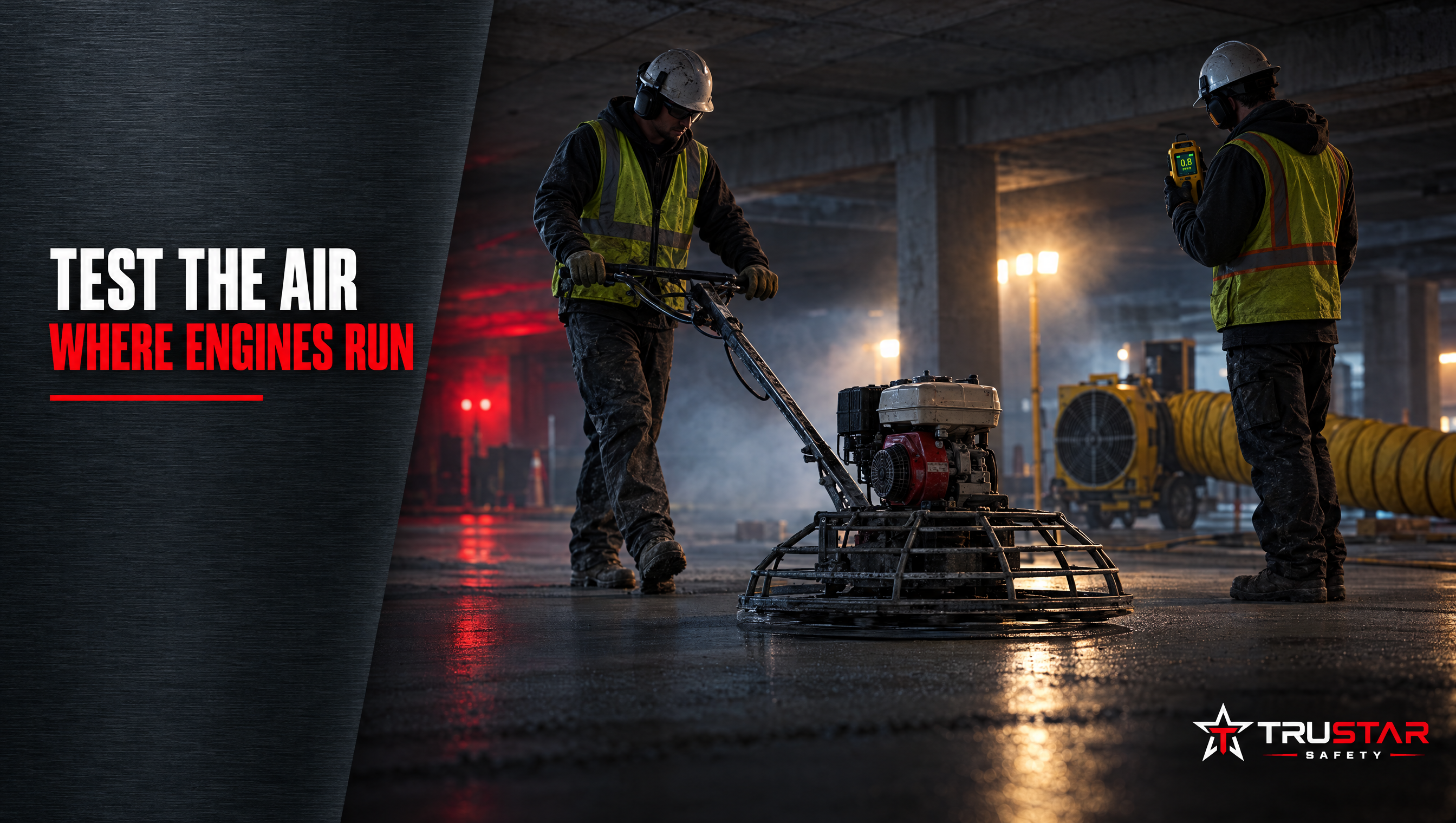
Carbon monoxide testing on a construction site has to happen where the fuel-burning equipment is actually running, not just somewhere in the building. Two Toronto contractors learned that in court this year, when they were fined a combined $85,000 after workers finishing concrete in a parking garage were treated for carbon monoxide exposure.
The case is from Ontario, but the lesson travels to every province and every enclosed or below-grade work area: a parkade, a basement, a hoarded building in winter, a tunnel or an excavation. Here is what happened, what the rules say in Ontario and Alberta, and a practical way to set up CO monitoring that would stand up to an investigation.
What happened in the Toronto parking garage
According to an Ontario Construction News report of a court bulletin from Ontario's Ministry of Labour, Immigration, Training and Skills Development (MLITSD):
- The project at 5868 Yonge St. in Toronto was building a new car dealership and a three-level parking garage.
- On July 4, 2023, a subcontractor, Metro Concrete Works, was installing a concrete topping layer of about three inches over the structural floor.
- Workers were finishing the concrete with hand tools and gasoline-powered concrete finishing machines when several of them began to feel unwell.
- Emergency Medical Services treated multiple workers for carbon monoxide exposure. Toronto Fire Services tested the air, found elevated carbon monoxide levels and ventilated the building.
The detail that matters most: the companies were testing and monitoring air quality in the garage. The ministry's investigation found that Level P2, the level where workers were operating the gasoline-powered finishing equipment, was not being adequately tested for airborne carbon monoxide as Ontario Regulation 213/91 (Construction Projects) requires.
The fines
Both companies pleaded guilty in the Provincial Offences Court in Toronto. The constructor, Fieldgate Construction Management Inc., was fined $55,000 for failing to ensure the prescribed measures and procedures were carried out. Metro Concrete Works was fined $30,000 for failing, as an employer, to ensure compliance with the same requirement. The fines were imposed on August 28, 2026, along with the 25 per cent victim fine surcharge required under Ontario's Provincial Offences Act.
Notice that both the constructor and the subcontractor were convicted. Prime contractors and constructors cannot hand the gas monitor to the trade and walk away, and trades cannot assume the general contractor's air testing covers their work area.
Why "we were testing" was not enough
A CO reading taken at the ramp, the stairwell or the site office tells you about the ramp, the stairwell or the site office. Carbon monoxide from a gasoline engine can build up around the engine and the people running it, especially on a closed-in level with little air movement. If the monitoring plan does not follow the equipment, it can show clean air while the crew next to the machine is breathing exhaust.
That is the gap the ministry found on Level P2. The lesson for any employer: test the air where the fuel-powered equipment is working and where the workers are breathing, for as long as it runs.
What Ontario's Construction Regulation requires for carbon monoxide
Ontario's guidance on carbon monoxide poisoning in workplaces summarizes sections 46, 47, 49 and 93 of O. Reg. 213/91. For construction projects, the key points are:
- Ventilation. A project must be adequately ventilated by natural or mechanical means where a worker may be injured by inhaling a noxious gas, vapour, dust or fume, or by a lack of oxygen. Where that is not practicable, suitable respiratory protective equipment must be provided and used.
- Internal combustion engines. An engine may only run in an excavation, building or other enclosed structure if there is an adequate supply of air for combustion and either the exhaust is discharged directly outside, far enough away that it cannot return, or ventilation keeps the exhaust from accumulating.
- Carbon monoxide testing. Where an internal combustion engine runs in an excavation, building or other enclosed structure, the space must be tested for airborne carbon monoxide so concentrations do not exceed the occupational exposure limits set under section 4 of Regulation 833. A competent worker must do the testing, following a written testing strategy the employer develops in consultation with the joint health and safety committee or health and safety representative, if there is one.
- Fuel-fired heaters. A fuel-fired heating device must not be used in a confined or enclosed space without an adequate supply of air for combustion and adequate general ventilation.
The IHSA's carbon monoxide guidance places the engine and testing requirements in section 47 of the regulation. Tunnels are handled separately under the regulation.
Carbon monoxide rules for Alberta employers
Alberta's OHS Code does not copy Ontario's wording, but the same hazard is covered, and an Alberta officer would ask the same question the Ontario ministry did: did you know what the workers were breathing?
Hazard assessment comes first
Part 2 of the OHS Code requires a hazard assessment (section 7), worker participation (section 8) and elimination or control of the hazards found (section 9). Running a gasoline trowel, saw, pump or generator indoors is a hazard that belongs on the assessment, with the controls written down.
Harmful substances and exposure limits
Part 4 of the OHS Code covers worker exposure to harmful substances (section 16), airborne concentration measurements (section 20) and potential worker exposure (section 21). Section 20 sets out how measurements taken to show compliance with occupational exposure limits must be made, including when a continuous direct-reading instrument may be used. Section 21 requires an employer to establish procedures that minimize a worker's exposure to a harmful substance and to make sure the worker is informed of its health hazards. Carbon monoxide's exposure limits are listed in Schedule 1, Table 2.
Internal combustion engines and confined spaces
Part 10 includes a section on internal combustion engines (section 166), and if the work area meets the definition of a confined space, Part 5 adds its own requirements for testing, ventilation and emergency response. Check the current Code text for your situation; a consultant can help you work out which parts apply.
How to set up carbon monoxide monitoring that follows the equipment
Here is a practical approach for any enclosed or below-grade work with fuel-powered equipment, whether it is concrete finishing in a parkade, cutting in a basement or running a generator inside a hoarded structure.
1. Ask first: does it have to burn fuel?
The best control is no exhaust at all. Before the job starts, ask whether electric or battery-powered equipment can do the work, or whether the engine can stay outside with only the tool going in. Elimination and substitution beat any monitor.
2. Write the testing strategy before the engines start
Put it on paper: which equipment, which levels or rooms, who tests, with what instrument, how often, and what happens at each reading. In Ontario a written strategy is required; everywhere else it is simply how you prove you were in control.
3. Test where the work is, at breathing height
Place monitoring at the equipment and with the operators, not just at the entrance. Personal or area monitors that travel with the crew catch what a fixed reading near the ramp will miss. When the crew moves to another level, the monitoring moves with them.
4. Keep the air moving and the exhaust going out
Plan mechanical ventilation for the space and the number of engines in it. Direct exhaust outside where possible, keep doors and openings clear, and remember that ventilation set up for the morning may not suit the afternoon once more machines are running.
5. Set action levels and stop-work triggers
Decide in advance what reading means more ventilation, what reading means shut the engines off and leave, and who makes the call. Make sure every worker knows they can and should stop and leave if they feel unwell.
6. Know the symptoms and the response
In Toronto, the first sign was workers feeling unwell. Treat anyone who feels unwell around running engines as a possible CO exposure, not as heat or fatigue: get them to fresh air, call for medical help and shut down the source. Your emergency response plan should cover it, and the crew should hear the signs of CO exposure at the tailgate meeting.
7. Coordinate between the constructor and the trades
The Toronto case convicted both the constructor and the subcontractor. Agree at the pre-job meeting who supplies the monitors, who reads them, where readings are recorded and how the results are shared.
8. Record every reading
Log the time, location, reading, instrument and person. Records show the plan was followed, reveal patterns (the same level climbing every afternoon) and are what an investigator will ask for first.
Carbon monoxide testing checklist
- Fuel-powered equipment in enclosed or below-grade areas is on the hazard assessment
- Electric or battery alternatives considered and documented
- Written testing strategy in place, with worker or committee input
- Competent worker assigned to test, with a calibrated, bump-tested instrument
- Monitoring at the equipment and the workers' breathing zone, moving with the crew
- Ventilation planned for the space and the number of engines
- Action levels and stop-work triggers set and communicated
- Symptoms and emergency response covered in the tailgate meeting
- Constructor and trades agree on who monitors and how results are shared
- Readings recorded with time, place, instrument and tester
Frequently asked questions
Do you need to test for carbon monoxide when using gas-powered equipment indoors?
In Ontario, yes: O. Reg. 213/91 requires testing for airborne carbon monoxide wherever an internal combustion engine runs in an excavation, building or other enclosed structure on a construction project. In Alberta, the OHS Code requires employers to assess and control the hazard and keep exposure within the limits in Schedule 1, and measuring the air is how you know you are.
Where should carbon monoxide be measured on a construction site?
Where the engines are running and where the workers are breathing. The Toronto contractors were testing air quality, but not adequately on the level where the gasoline-powered equipment was working, and that gap led to the conviction.
Who is responsible for carbon monoxide monitoring, the general contractor or the subcontractor?
Both can be. In the Toronto case, the constructor and the subcontractor employer were each convicted of failing to ensure the same requirement was met. Settle who does what before the work starts, in writing.
What should you do if a worker feels unwell near gas-powered equipment?
Treat it as possible carbon monoxide exposure. In the Toronto case, workers began feeling unwell before EMS treated several of them for CO exposure. Move the person to fresh air, get medical help, shut down the source and confirm the air is clear before anyone goes back in.
How TruStar can help
TruStar Safety helps Alberta and Canadian contractors build safety programs that hold up when an officer asks the hard questions: hazard assessments that catch fuel-powered equipment in enclosed spaces, written air-monitoring procedures, emergency response plans, and COR and SECOR programs that tie it all together. If you want a second set of eyes on how your crews handle CO in parkades, basements and hoarding this winter, talk to us.
TruStar Connect puts the hazard assessments, inspections and incident reports in the crew's hands on their phones, so the readings and the controls are recorded on site, where the work is happening. Start a free trial at connect.trustarsafety.com.