

British Columbia COR safety manual template
A complete written occupational health and safety program for British Columbia construction employers, laid out element by element on the BC Construction Safety Alliance (BCCSA) COR audit and written to the Workers Compensation Act and the OHS Regulation. It arrives as an editable Word file you make your own: your name, your logo, your job titles and your work.
A look inside
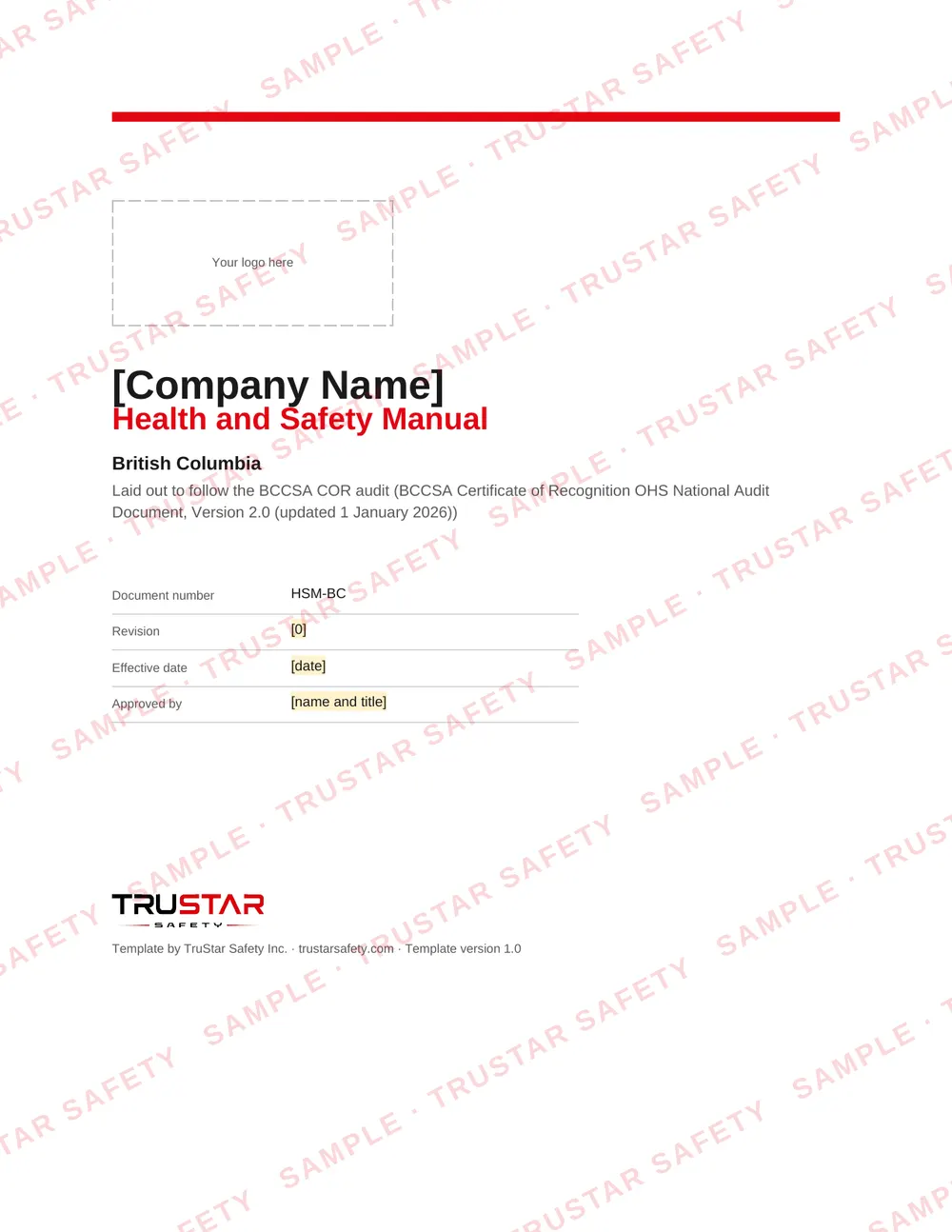
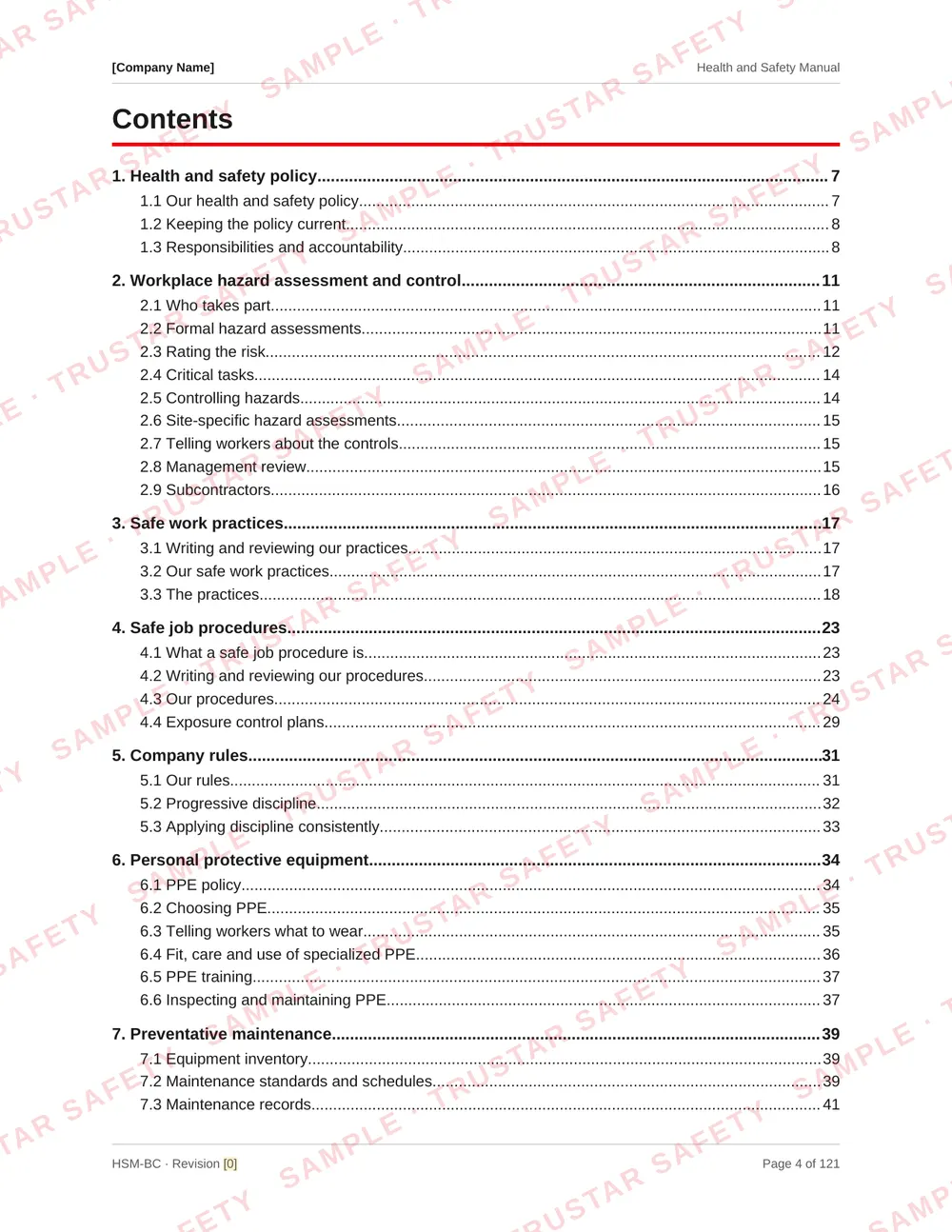
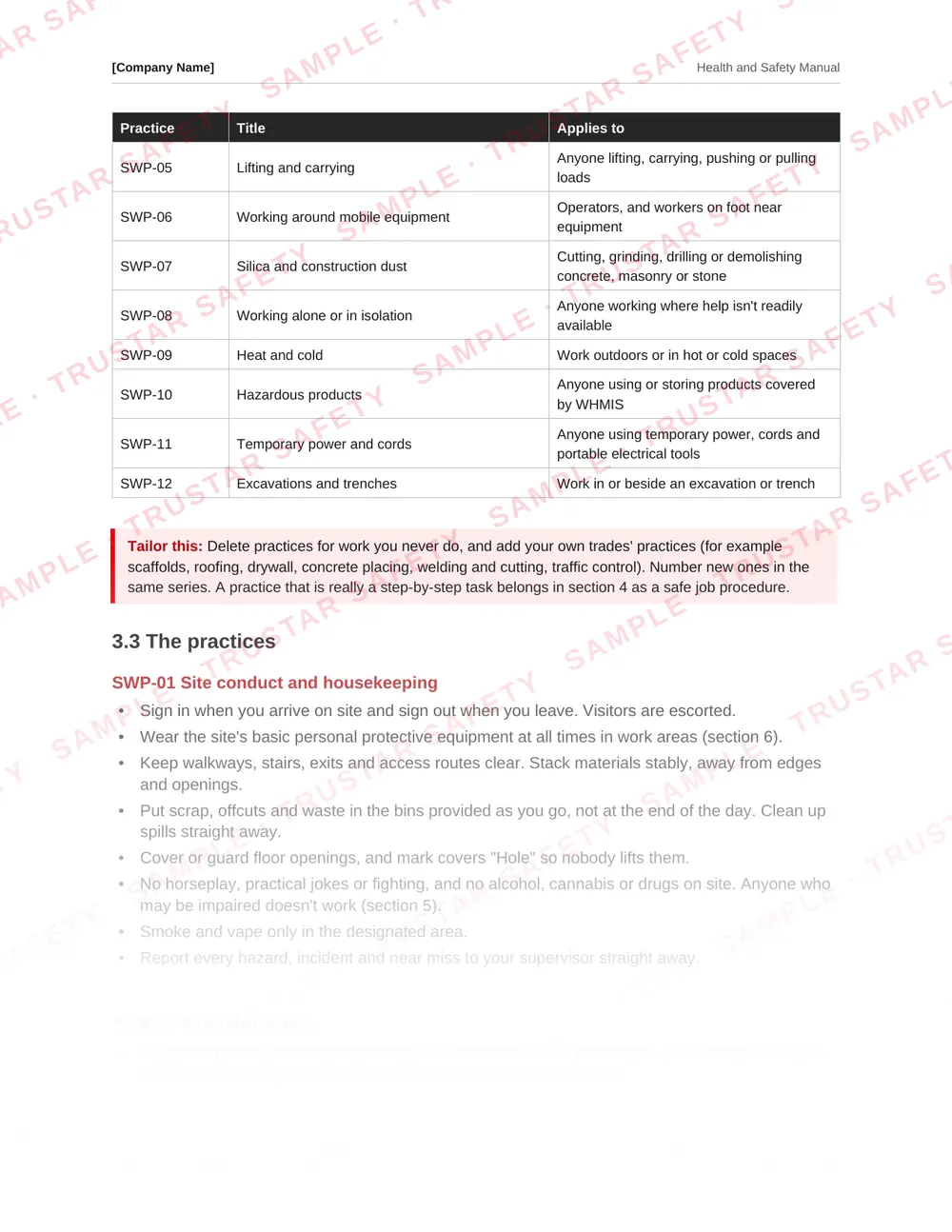
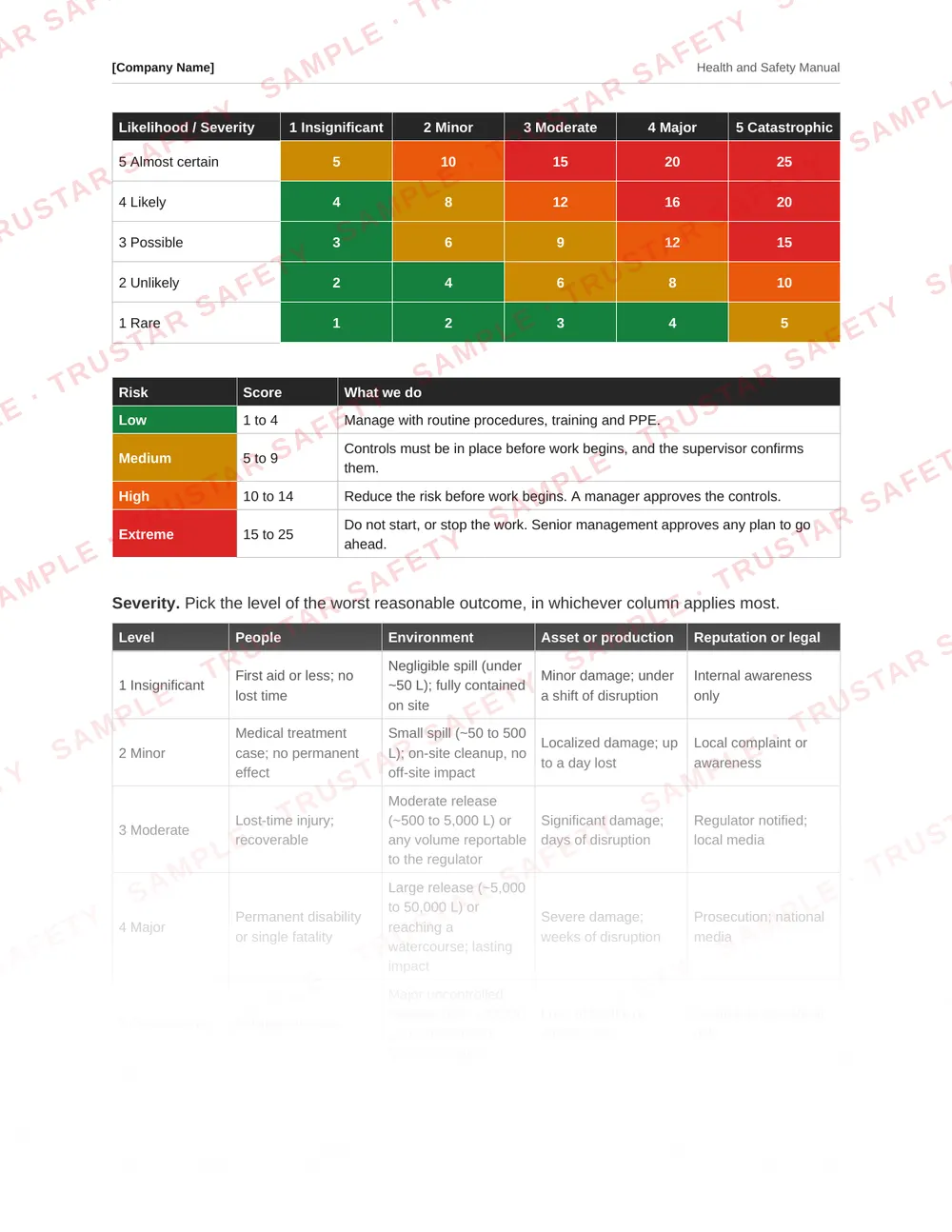
Sample pages from the manual, marked and cut short. Your copy has no watermark.
What’s in the manual
1. Health and safety policy
A signed, dated policy covering what the audit checks, a yearly review, and written responsibilities and accountability for senior management, managers, supervisors, workers, subcontractors and visitors, including your duties as prime contractor.
2. Workplace hazard assessment and control
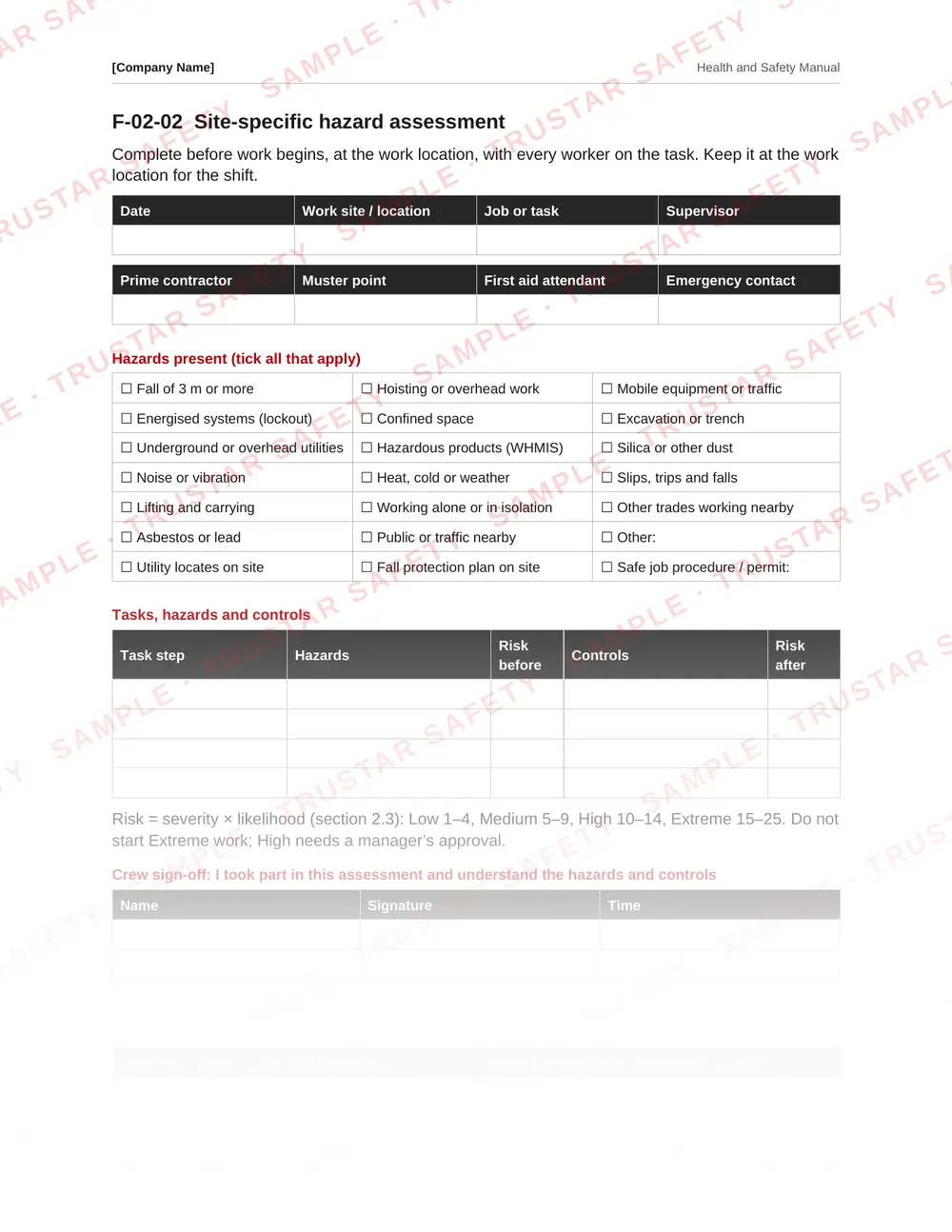
Formal and site-specific hazard assessments, the 5 × 5 risk matrix, critical tasks, controls in order, management sign-off, subcontractor screening, and a table of the written assessments BC’s Regulation requires by name.
3. Safe work practices
Twelve starter practices for common construction work: site conduct, ladders, working at heights, tools, lifting, mobile equipment, silica, working alone, heat and cold, WHMIS, temporary power and excavations.
4. Safe job procedures
Step-by-step procedures for six critical tasks, from lockout and fall arrest to cutting concrete and hoisting, and when an exposure control plan is required and what it must contain.
5. Company rules
Written rules and a progressive discipline process that is applied the same way every time and never used against a worker for exercising their rights.
6. Personal protective equipment
Basic and specialized PPE, how it is chosen, fit, care and use of harnesses, respirators and hearing protection, training and inspection.
7. Preventative maintenance
An equipment inventory, maintenance to manufacturer and Regulation standards, mobile equipment pre-shift inspections, repair records, and tagging defective equipment out of service.
8. Training and communication
New and young worker orientation covering every topic BC requires, checking tickets before work, task training, supervisor training with a knowledge check, safety meetings and toolbox talks.
9. Inspections
What is inspected, how often and by whom, the checklists used, and correcting what inspections find.
10. Investigations and reporting
What must be reported to WorkSafeBC and when, near misses, preliminary (48-hour) and full (30-day) investigations, corrective action and management review.
11. Emergency preparedness
Emergency risk assessments for each site, response plans, training and yearly drills, fire response, and first aid to Schedule 3-A.
12. Records and statistics
Where records are kept and for how long, statistics and year-over-year trends, one calendar of every yearly review, first aid records and audit action plans.
13. Legislation
Written so workers and supervisors can answer the auditor’s interview questions: the law on site, rights and duties, refusing unsafe work, reporting to WorkSafeBC, and the policies BC requires on working alone, violence, bullying and harassment, and impairment.
14. Joint health and safety committee or worker representative
Which one you need at your size, terms of reference, training, duties, meetings, minutes and the yearly evaluation.
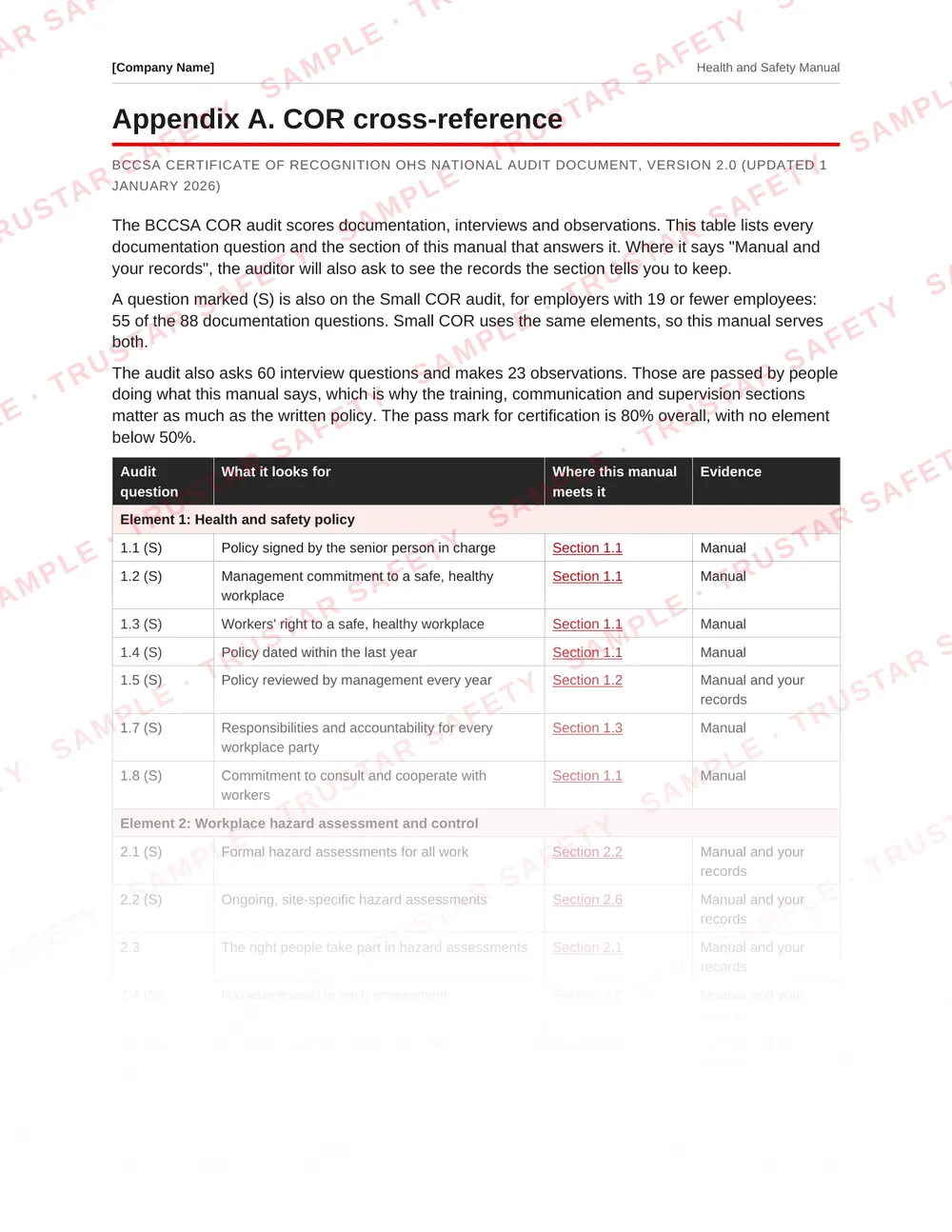
Appendix A. COR cross-reference
Every one of the 88 documentation questions in the BCCSA COR audit, what it looks for in plain words, the section that answers it, and whether the auditor will also want your records. The 55 questions on the Small COR audit are marked, and each entry links to its section.
Appendix B. Forms
27 print-ready forms that match the manual, each on one page with a form code: policy review, hazard assessments, critical tasks, subcontractor prequalification, procedures, discipline, PPE, maintenance, orientation, training, meetings, inspections, incidents, investigations, emergencies, statistics, work refusals and the committee.
Built around the BCCSA COR audit
The manual follows the 14 elements of the BCCSA COR audit (the Certificate of Recognition OHS National Audit Document, Version 2.0, January 2026) in the same order. BCCSA postpones an audit when the employer’s manual is missing an element, so every one is here, each in its own section.
The audit scores documents, interviews and observations. This manual answers each of the 88 documentation questions in writing, and Appendix A shows where. The 60 interview-scored questions and 23 observations are passed by your people doing what the manual says, which is why element 13, Legislation, is written for workers to read.
Certification needs 80% overall with no element below 50%. No template can guarantee that on its own, and we don’t claim to. What it gives you is a complete, audit-shaped program to put in place.
Written to BC law as it stands
Every requirement is cited to the Workers Compensation Act (with its current section numbers) or the OHS Regulation, checked in September 2026, including the first aid rules that changed in November 2024 and the hazardous-substance emergency planning rules in force since February 2025.
Where the law sets no number, such as how long to keep an orientation record, the manual says so and gives you a highlighted default to set yourself. When the Regulation changes, we update the template and you get the new edition free.
Who it is for
BC construction employers working toward COR with BCCSA, whether Large COR or Small COR (19 or fewer employees): the same manual serves both, with the Small COR questions marked. It also gives any BC employer the written program the Regulation requires at 20 or more workers where the hazard rating is moderate or high, as it is for construction.
If your certifying partner is not BCCSA, check the manual against your partner’s own audit tool.
Lifetime updates
When legislation or the audit changes, we publish a new edition and email everyone who bought the template. Every update is free, for as long as we publish it.
Version 1.0 September 30, 2026
- First edition, laid out on the 14 elements of the BCCSA COR OHS National Audit Document, Version 2.0 (January 2026).
- Written to the Workers Compensation Act and the OHS Regulation as consolidated to 22 September 2026.
Working in more than one province?
Buy templates together and save on the whole order: 2 for 10% off, 3 for 15% off, 4+ for 20% off.
Alberta
Alberta COR safety manual template
$249.95
Saskatchewan
Saskatchewan COR safety manual template
$249.95
Questions
What format is the manual in?
An editable Microsoft Word (.docx) file on US Letter pages. It works best in desktop Word for Windows or Mac. It also opens in Google Docs and Word on the web, where you use Find and replace to put your company name in.
Will this manual get us COR?
It gives you the written program the COR audit reviews, laid out on the BCCSA audit, with every documentation question answered and cross-referenced. Certification also depends on your records, worker interviews and what the auditor observes on site, so no template can promise a pass. If you want help putting it in place, or a gap analysis before your audit, our team does that too.
Does it work for Small COR?
Yes. Small COR uses the same 14 elements with fewer questions, and Appendix A marks the 55 documentation questions it scores, so you can see exactly what your audit will look at.
Do I need a written health and safety program in BC?
Under the OHS Regulation, an employer with 20 or more workers and at least one workplace rated moderate or high hazard, which includes construction, needs a formal program; so does any employer with 50 or more workers. Smaller employers need a less formal program built on monthly safety meetings. COR requires a documented program whatever your size.
How do I get the file after I pay?
Your download is on the confirmation page the moment payment goes through, and we email you a download link as well.
What happens when the legislation or the audit changes?
We update the template, and you get every update free for as long as we publish it: lifetime updates at no extra charge. We email you when a new edition is ready, with what changed and a link to download it.
Does it work with TruStar Connect?
Yes. The manual rates risk on the same 5 × 5 matrix TruStar Connect uses for its hazard register and investigations, so if you run your program in Connect, your ratings, bands and actions carry straight over.
Can I use it for more than one company?
Each purchase is licensed to one company. Consultants setting up programs for several clients should contact us.
Want it built for you?
Our safety advisors tailor programs to your operations and take you through COR from gap analysis to audit day.
COR and SECOR preparedness