Incident investigation in Alberta OHS starts with section 33 of the Occupational Health and Safety Act. If a serious injury, illness or incident happens, the prime contractor (or the employer, if there is no prime contractor) must report it to OHS as soon as possible, investigate it, and write a report on what happened and how to stop it happening again. Potentially serious incidents (near misses that could have seriously hurt someone) must be investigated too, and then submitted online.
This guide walks through what counts as serious versus potentially serious, who reports, what the internal investigation has to contain, and how to close the loop with corrective actions that actually work.
What section 33 of the OHS Act covers
Section 33 of the Occupational Health and Safety Act sets out three jobs for the party in charge of the work site:
- Report serious injuries, illnesses and incidents to an OHS Director as soon as possible.
- Preserve the scene of those serious incidents until you are allowed to disturb it.
- Investigate serious and potentially serious incidents, prepare a written report, and share and keep it.
Alberta OHS explains these duties in its bulletin LI016: Incident reporting and investigation, last updated in April 2025. If your procedures were written before then, check them against the current version.
Serious incident reporting in Alberta: what you must call in
Under section 33(2), you must call the OHS Contact Centre as soon as possible when there is:
- an injury, illness or incident that results in the death of a worker
- an injury, illness or incident where there is reason to believe a worker has been or will be admitted to hospital
- an unplanned or uncontrolled explosion, fire or flood that causes a serious injury or illness, or has the potential to
- the collapse or upset of a crane, derrick or hoist
- the collapse or failure of any component of a building or structure necessary for its structural integrity
One detail trips people up: hospital admission does not include treatment at an emergency room or urgent care centre, according to Alberta.ca. A worker who is stitched up in emergency and sent home is not, on that basis alone, a section 33(2) report. A worker who is kept in hospital is.
Also note that crane, hoist and structural failures are reportable whether or not anyone was hurt, and an explosion, fire or flood is reportable if it had the potential to cause a serious injury or illness.
How to report a serious incident
The report is a phone call, and it covers the time, place and nature of the injury or incident. The OHS Contact Centre is staffed 24 hours a day:
- Toll free: 1-866-415-8690
- Edmonton: 780-415-8690
Mine and mine site incidents listed in section 544 of the OHS Code are reported online through the OHS incident portal, and a death, serious injury, illness or incident at a mine site is also phoned in.
Who reports: prime contractor or employer
The prime contractor reports. If there is no prime contractor, the employer reports. On a multi-employer site, that means subcontractors need a clear, written path for getting incident information to the prime contractor immediately, so the prime can make the call. Put it in your site orientation and your emergency response plan, not just your binder.
Do not disturb the scene
For the serious incidents listed in section 33(2), you cannot disturb the scene, meaning the immediate area where the incident happened. You also cannot alter, move or remove equipment, documentation or other information related to it.
You may disturb the scene only to:
- attend to a person who is ill, injured or killed
- prevent further injuries, illnesses or incidents
- protect property endangered by the incident
- act with permission from an OHS officer or a police officer
Alberta's scene-disturbance rules changed in April 2025, and LI016 was updated to reflect them. Train supervisors on the current rule: rescue and make safe, then stop, barricade and wait.
The scene of a potentially serious incident does not have to be secured, but good practice is still to photograph it and gather evidence before conditions change.
What is a potentially serious incident in Alberta?
Section 33(5) gives the two tests. A potentially serious incident (PSI) is reportable when:
- the incident had a likelihood of causing a serious injury or illness, and
- there is reasonable cause to believe that corrective action may need to be taken to prevent it happening again.
Alberta OHS asks you to weigh the actual circumstances (person, place, time, work practices), the hazards present, the controls in place, and whether slightly different circumstances, such as timing, distance or body position, could have resulted in a serious injury (Alberta.ca: Report potentially serious incidents).
A few examples of the kind of thinking this calls for:
- A load drops from a hoist and lands in an empty laydown area. Nobody was there, but workers walk through that area every shift.
- A worker's lanyard catches a fall that would otherwise have been from height.
- A pickup backs through a flagged zone seconds after a spotter stepped out of it.
In each case, nobody was hurt. In each case, a small change in timing or position means a very different outcome.
How PSIs are reported
PSIs are not phoned in. Under section 33(6), you complete your investigation first, then submit the PSI through the online service. PSI reports are not admissible as evidence in a trial arising out of the incident, except in a prosecution for perjury or for giving contradictory evidence, which gives employers room to be candid.
What an incident investigation must contain
For both serious incidents and PSIs, the prime contractor (or employer) must:
- Investigate the incident, involving the joint health and safety committee or health and safety representative if there is one.
- Prepare a written report covering the circumstances of the incident and what, if anything, can be done to prevent it happening again, including any corrective actions taken.
- Share the report with the committee or representative. If there is neither, make it available to workers.
- Provide it to OHS: to an OHS officer on request, and to a Director where required (PSI reports are submitted online).
- Keep a copy readily available for at least two years.
A practical investigation checklist
The law sets the minimum. A report that holds up to an OHS officer, a COR or SECOR auditor, and your own crew usually includes:
- Date, time, exact location and weather or lighting conditions
- The task being done and who was doing it (roles, not blame)
- The hazard assessment and procedures that applied to that task
- Photos, sketches and measurements of the scene
- Witness statements taken separately and as soon as possible
- Equipment involved, with inspection and maintenance records
- Training and competency records for the workers involved
- A timeline of events leading up to and after the incident
- Immediate causes and underlying root causes
- Corrective actions, each with an owner and a due date
Finding root causes, not just who
"Worker not paying attention" is not a root cause. Ask why the conditions allowed the mistake. Was the hazard assessment done for this task? Was the procedure realistic for the time available? Was the equipment right for the job? Was the worker trained and supervised? Methods such as the "5 Whys" or a simple cause map help a crew get past the first answer. The goal is to fix the system so the next person in the same spot is protected.
Corrective actions: closing the loop
LI016 is direct about this: corrective actions should tie to the root causes, be specific, and either put new controls in place or improve existing ones. They must follow the hierarchy of controls in section 9 of the OHS Code: elimination or engineering controls first, then administrative controls, then PPE, or a combination.
And a corrective action only counts once it is done. Alberta OHS tells employers to assign specific action items to individuals, follow up to make sure they are carried out, and share the changes with workers.
Step by step: from report to verified fix
- Assign every action to a named person with a due date.
- Track it openly so supervisors can see what is overdue.
- Close it with evidence: a photo of the new guard, the revised procedure, the training sign-off.
- Review effectiveness after a set period. Is the control still in place? Is it being used? Has anything similar happened since?
- Tell the crew what changed and why, at the next toolbox talk.
That last review step is where many programs stop short. A corrective action marked "complete" that nobody checks a month later is how the same incident happens twice.
Frequently asked questions
Do I have to report a worker who went to emergency but was not admitted?
Not as a section 33(2) serious injury on that basis alone. Alberta OHS states that hospital admission does not include treatment at an emergency room or urgent care centre. You should still assess whether it meets the potentially serious incident test and investigate it under your own program. WCB reporting is a separate obligation.
Who reports an incident when a subcontractor is involved?
The prime contractor reports serious incidents to OHS and is responsible for the investigation. If there is no prime contractor, the employer does. Subcontractors should notify the prime contractor immediately.
How long do I have to submit a PSI report?
The Act ties PSI submission to the investigation: the report is submitted after the investigation is complete. Investigate promptly, while evidence and memories are fresh, and submit when the report is done.
How long do I keep incident investigation reports?
At least two years, and readily available to give an OHS officer on request.
Can I clean up the scene after a serious incident?
Only to help an injured person, prevent further injuries, protect endangered property, or with permission from an OHS or police officer. Otherwise, secure the scene and leave equipment and documents where they are.
How TruStar can help
TruStar Safety helps Alberta contractors turn section 33 from a scramble into a routine:
- Investigation training for supervisors and safety committee members, so the first hour after an incident goes right.
- Root-cause facilitation on serious incidents and PSIs, with a report that stands up to OHS and your COR or SECOR auditor.
- Post-incident program review to update hazard assessments, procedures and emergency response plans after an incident.
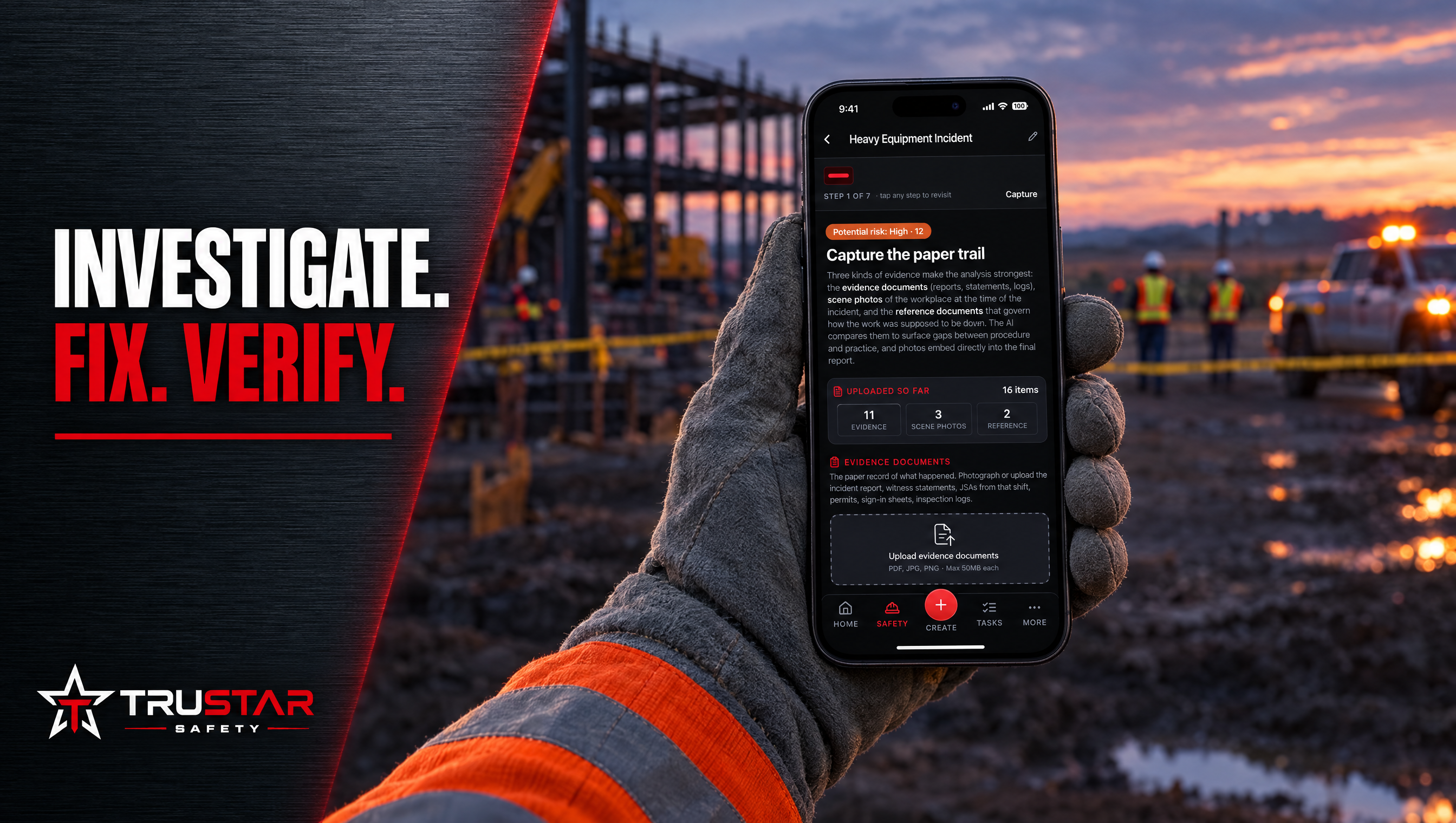
TruStar Connect puts the whole chain in one app. Investigation Capture records the facts, photos and statements in the field; Corrective Actions assigns each fix to an owner with a due date; and Effectiveness Review confirms the fix is still working weeks later.
Talk to TruStar Safety about your incident investigation process, or start a free trial of TruStar Connect.
This article is general information, not legal advice. Always check the current OHS Act, Regulation and Code and Alberta OHS guidance for your situation.