

Telecom tower and rooftop safety manual template
A complete written health and safety program for contractors whose crews build, modify and maintain telecom towers, rooftop antenna sites, small cells and broadcast structures in every province and territory. It is laid out on the 14 national COR elements and written for the work: climbing with 100 percent tie-off, rescue at height, rooftop edges and hatches, RF exposure under Safety Code 6 and power-downs, gin poles and capstan hoists, cranes, structural modifications and guy wires, electrical and battery plants, dropped objects, and weather. Section 15 sets out the law of every province and territory, and federal workplaces, side by side, with each jurisdiction’s fall protection, rescue and RF exposure rules. It arrives as an editable Word file you make your own.
A look inside
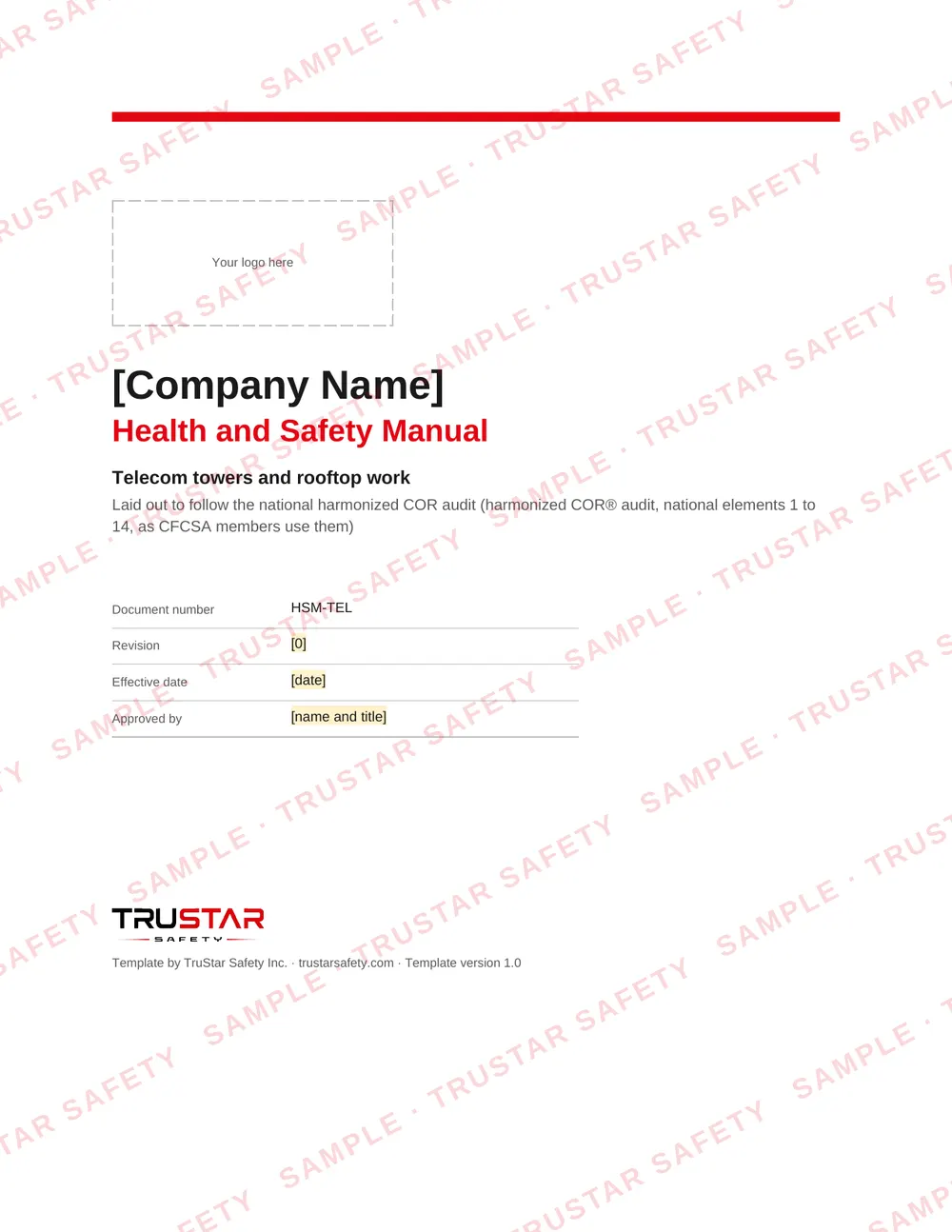
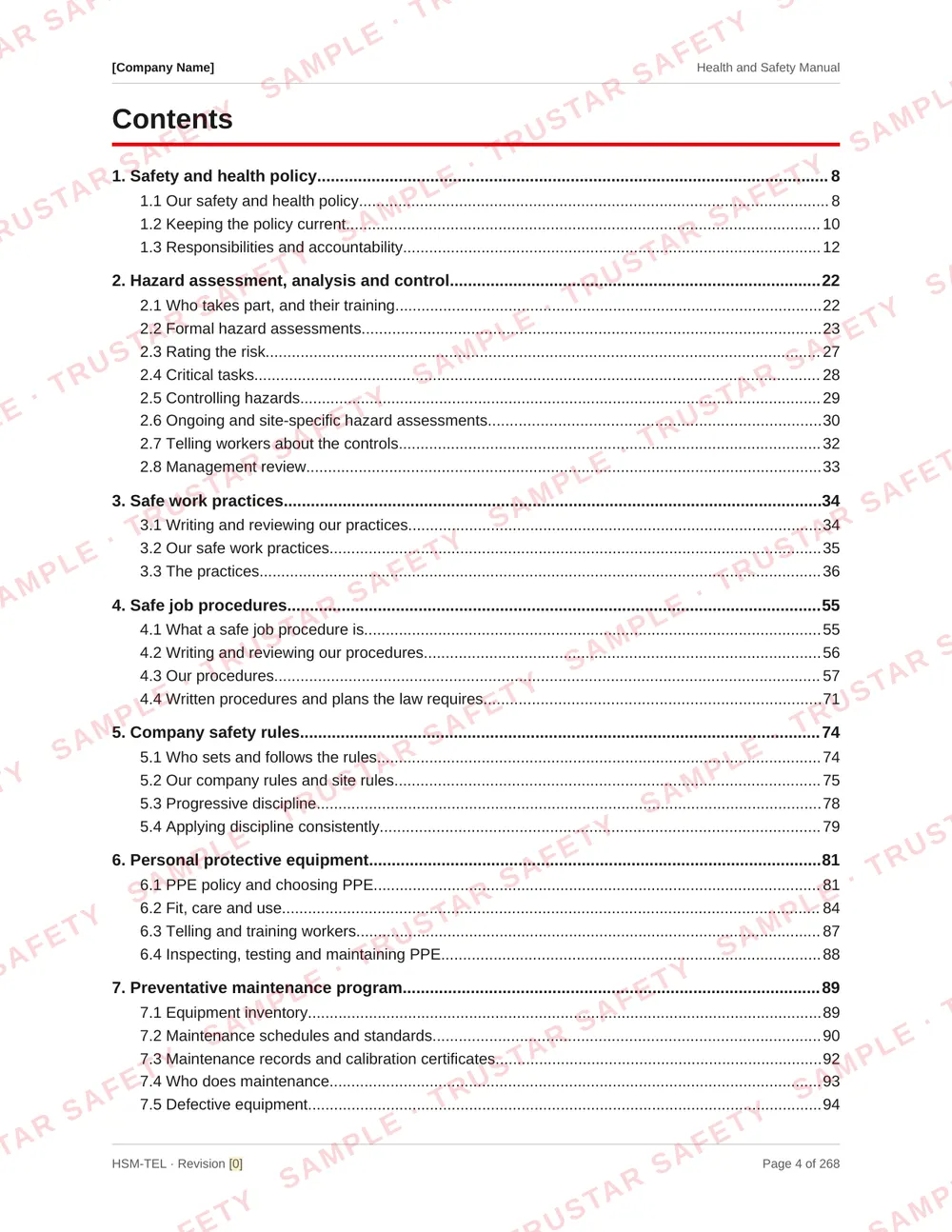
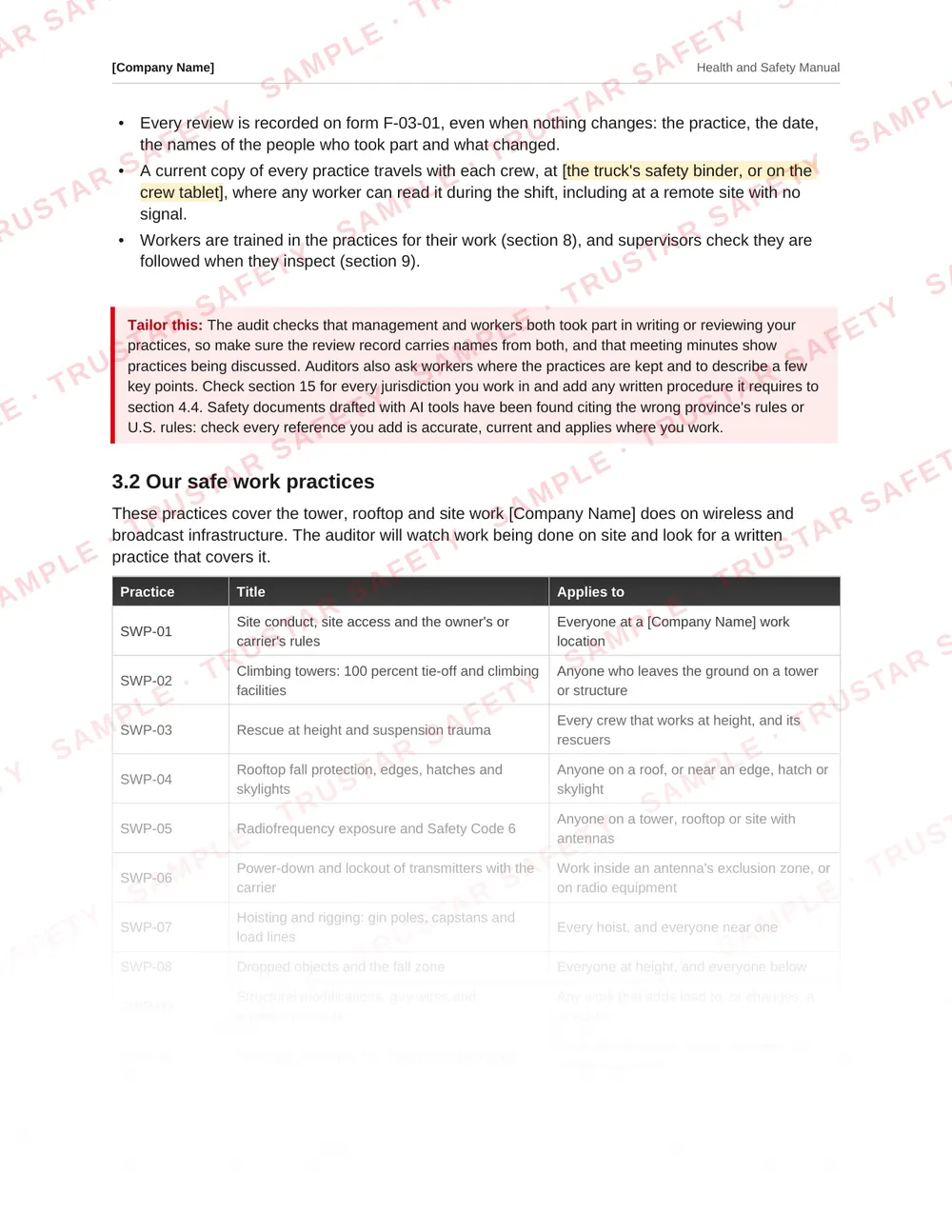
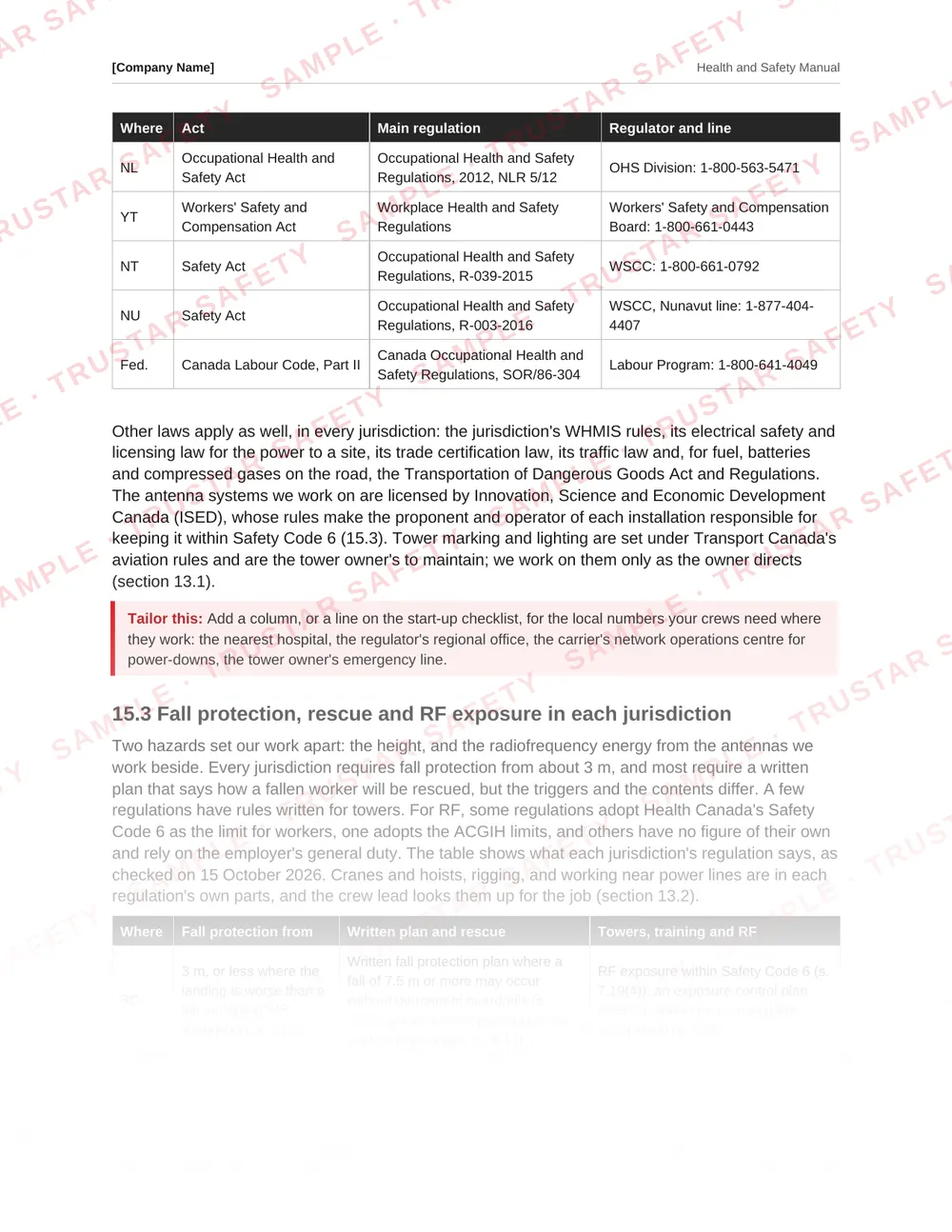
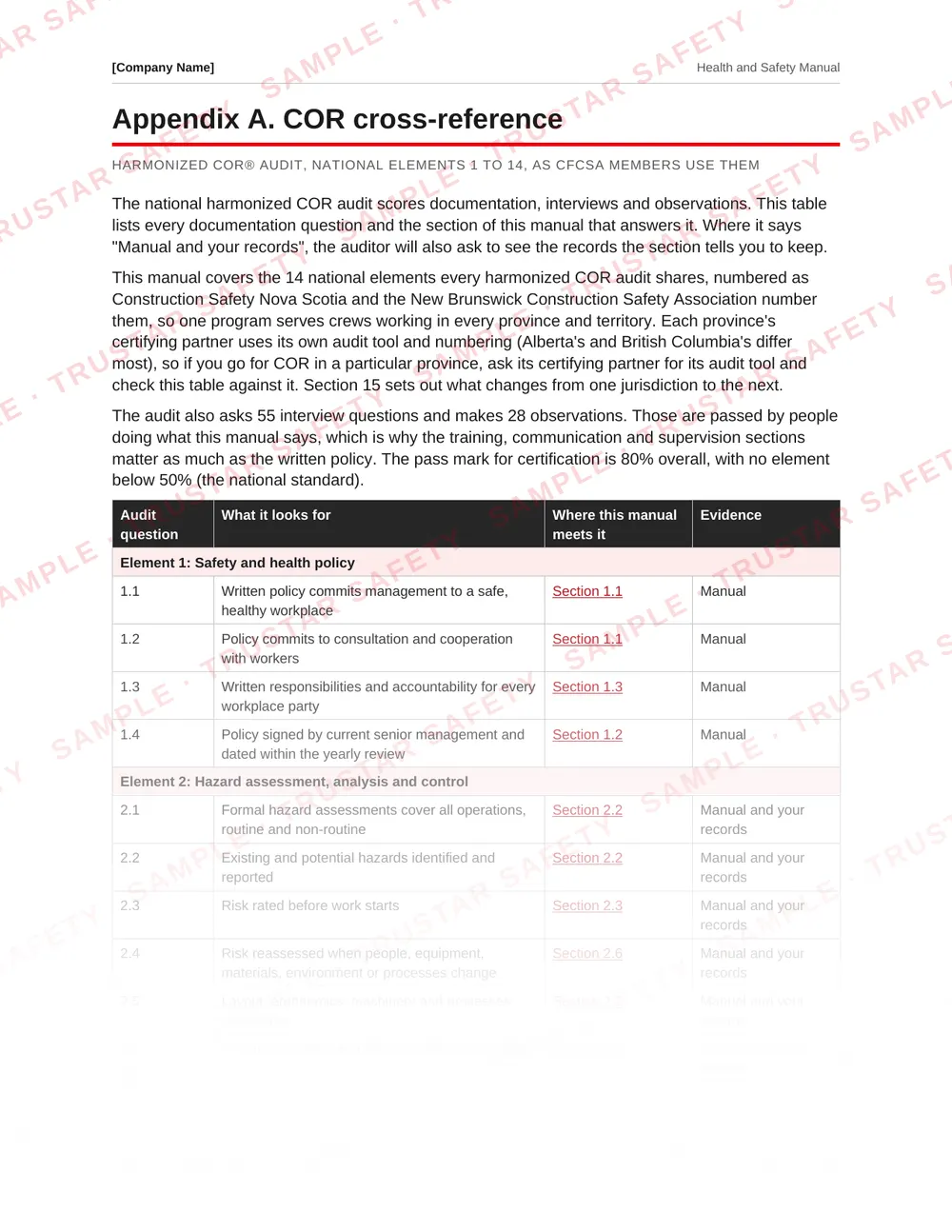
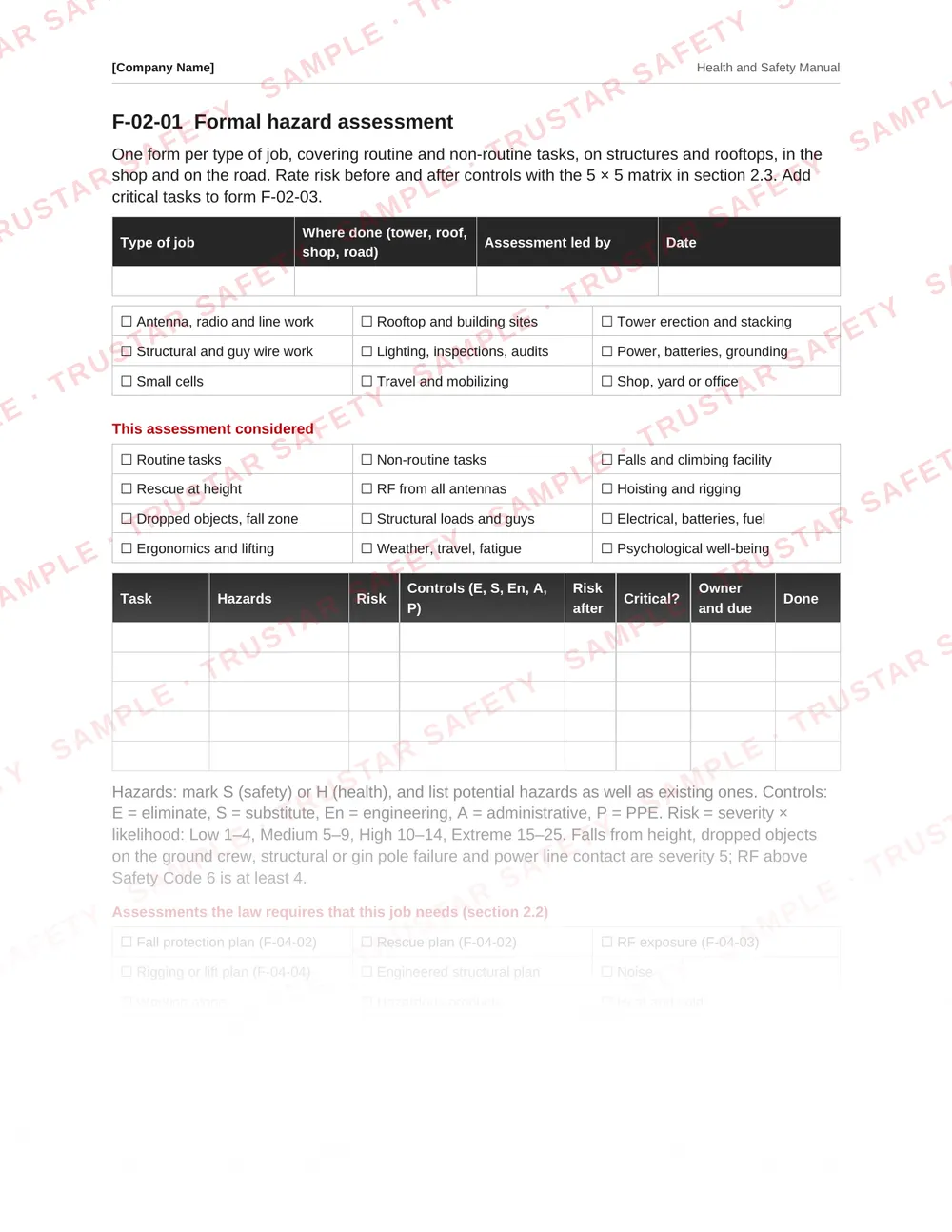
Sample pages from the manual, marked and cut short. Your copy has no watermark.
What’s in the manual
1. Safety and health policy
A signed, dated policy, the written program, and responsibilities for management, crew leads, authorized and competent climbers, ground crew and an RF safety lead per crew, and how we work under the tower owner’s and carrier’s rules.
2. Hazard assessment, analysis and control
Formal hazard assessments by type of tower and rooftop work, the 5 × 5 risk matrix, a critical task inventory, and the tower site hazard assessment redone whenever power-downs, weather or the structure change.
3. Safe work practices
Eighteen practices for tower crews: site access, climbing with 100 percent tie-off, rescue at height, rooftop edges, RF exposure, gin poles and hoisting, cranes, structural work and guy wires, electrical and batteries, dropped objects, weather, driving, fatigue and tools.
4. Safe job procedures
Step-by-step procedures for inspecting a tower before the climb, climbing and transitioning at the top, rescuing a suspended climber, arranging an RF power-down, rigging a gin pole, hoisting with a capstan, rooftop work near edges and antennas, and stopping for lightning, wind or ice.
5. Company safety rules
Life-saving rules for tower crews (always tied off, no climb without a rescue plan, no RF exposure unchecked), working under the stricter of our rules and the owner’s or carrier’s, and a progressive discipline process applied the same way every time.
6. Personal protective equipment
Harnesses, twin lanyards and self-retracting devices, safety climb sleeves, rescue kits, RF monitors, electrical and battery PPE, and cold-weather gear fitted around the harness.
7. Preventative maintenance program
Fall protection and rescue kits, gin poles and capstan hoists, load lines and rigging, RF monitors and testers, vehicles, and what to do about defects in the owner’s climbing facility.
8. Training and communication
Climber levels from ground crew to competent climber, tower rescue, RF awareness and power-downs, rigging, and tailboards before every climb.
9. Inspections
The structure and climbing facility before every climb, rescue kits, RF monitors, gin poles and hoists, and special inspections after an arrested fall, a dropped object or a lightning strike.
10. Investigations and reporting
Falls, dropped objects and RF monitor alarms reported to the owner, the carrier and the regulator where they happened, and investigations.
11. Emergency preparedness
Rescuing a suspended climber within minutes, injuries at height, dropped objects, falling ice, RF overexposure, electrical shock, lightning, structural failure and remote medical evacuation.
12. Statistics, records and document control
Rescue plans, RF power-down records, rigging plans, climbing equipment inspections and training, kept for the longest period any jurisdiction requires.
13. Legislation
OHS law where the tower is, Safety Code 6 and the federal rules for antenna sites, the standards and guidance the manual follows, and the right to refuse a climb.
14. Procurement and contractor management
Working for carriers and tower owners, subcontracted climbers and crane services, and buying fall protection, rescue kits and rigging fit for the work.
15. Working across Canada
Whose law applies, including carrier and broadcast work, then every province and territory and federal workplaces side by side: the act and regulation, the regulator, each jurisdiction’s fall protection, rescue and RF exposure rules, serious incidents to report and how fast, and the other rules that change at the border.
Appendix A. COR cross-reference
Every one of the 74 documentation questions in the 14 national COR elements, what it looks for in plain words, the section that answers it, and whether the auditor will also want your records.
Appendix B. Forms
36 print-ready forms that match the manual, each with a form code: among them the tower site hazard assessment, rescue plan for work at height, RF power-down and exposure record, rigging plan and gin pole checklist, and climbing equipment inspection.
Written for the work, not just the province
A tower crew’s risks are above the ground and invisible: a missed connection on the transition at the top, an antenna that was never powered down, a gust on a large load, a rescue that has to start in minutes, far from help. This manual is written around them, practice by practice and procedure by procedure.
You work under the tower owner’s and carrier’s rules. The manual says how yours and theirs fit together, and the stricter rule always wins.
One program for every province you work in
Your crews follow the occupational health and safety law of the province or territory where the tower is, not where your office is. The manual sets your company’s rules once and gathers what changes at each border into section 15, so a supervisor starting work in a new province looks up what applies there.
It is laid out on the 14 national COR elements, so it suits a COR audit wherever you certify. Each certifying partner uses its own audit tool, so check it against yours; our provincial manuals follow each province’s audit exactly. No template can guarantee a certificate on its own, and we don’t claim to.
Who it is for
Telecom tower, rooftop antenna and small cell contractors, broadcast tower crews and the tower erection and modification companies that work with them.
A template is a starting point, not legal or engineering advice: a qualified person must adapt it to your work and your carriers’ rules before you issue it.
Lifetime updates
When the law changes, we publish a new edition and email everyone who bought the template. Every update is free, for as long as we publish it.
Version 1.0 October 16, 2026
- First edition, written for telecom tower and rooftop crews and laid out on the 14 national elements of the harmonized COR audit.
- Section 15 sets out the law and the fall protection, rescue and RF exposure rules of every province and territory and federal workplaces, checked against the legislation in force on 15 October 2026.
Add the exposure control plans for this work
Buy templates together and save on the whole order: 2 for 10% off, 3 for 15% off, 4+ for 20% off.
All provinces, territories and federal
Noise exposure control and hearing conservation plan template$119.95
Questions
Which province’s law is it written to?
All of them. Your crews follow the law of the province or territory where the tower is, so the manual sets your company’s rules once and section 15 sets out, jurisdiction by jurisdiction, what the law there adds. Federally regulated workplaces are in it too.
Will it get us COR?
It is laid out on the 14 national elements every harmonized COR audit shares, with all 74 documentation questions cross-referenced. Each province’s certifying partner uses its own audit tool, so check the manual against the one you are certifying with. The audit also interviews workers and observes work, so no template can promise a pass.
What format is the manual in?
An editable Microsoft Word (.docx) file on US Letter pages. It works best in desktop Word for Windows or Mac. It also opens in Google Docs and Word on the web, where you use Find and replace to put your company name in.
What happens when the legislation changes?
We update the template, and you get every update free for as long as we publish it: lifetime updates at no extra charge. We email you when a new edition is ready, with what changed and a link to download it.
Can I use it for more than one company?
Each purchase is licensed to one company. Consultants setting up programs for several clients should contact us.
Want it tailored to your work?
Our safety advisors can fit the manual to your crews, your carriers’ rules and the provinces you work in.
OHS program development