

Working at heights safe work practices and procedures
Fall protection plans, ladders, fall arrest, scaffolds, aerial work platforms, roofs, dropped objects and rescue at height. This pack holds 9 safe work practices and 4 safe job procedures: practices that set out the rules, and procedures that give the steps, task by task. Each is an editable Word document written once for all of Canada, with the law of every province and territory and federal workplaces set out in it, and Prepared by, Approved by and worker sign-off tables, ready to put your company name on and add to your safety program.
A look inside
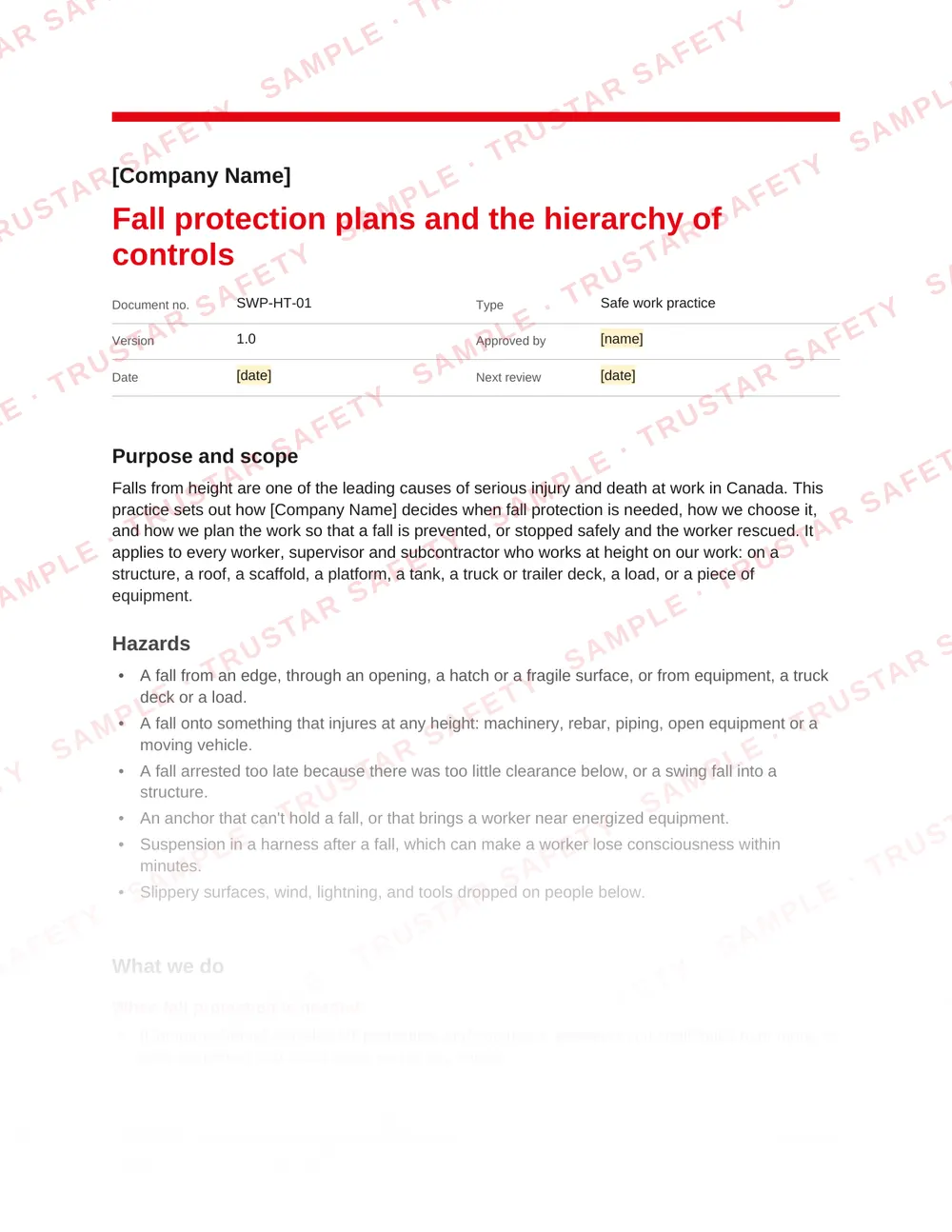
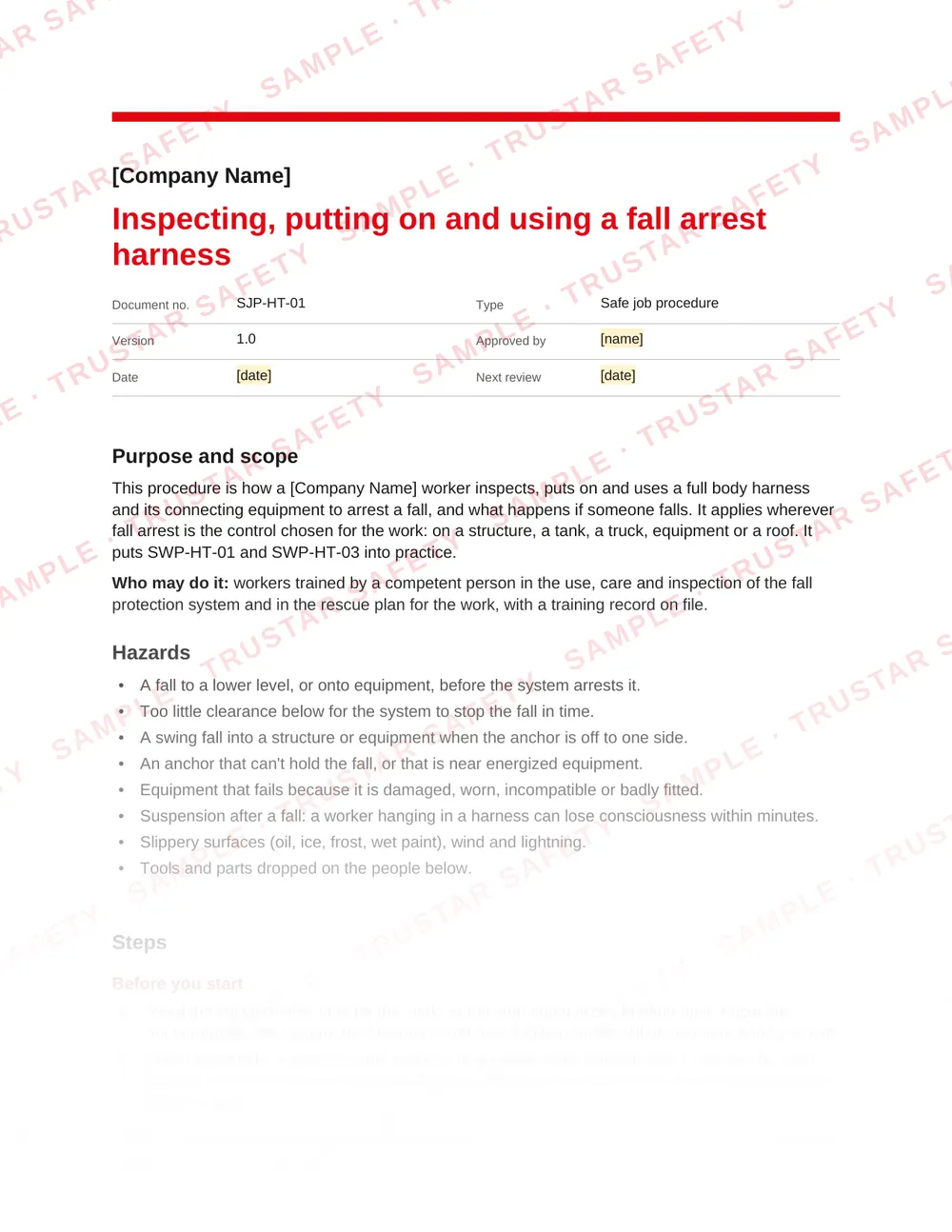
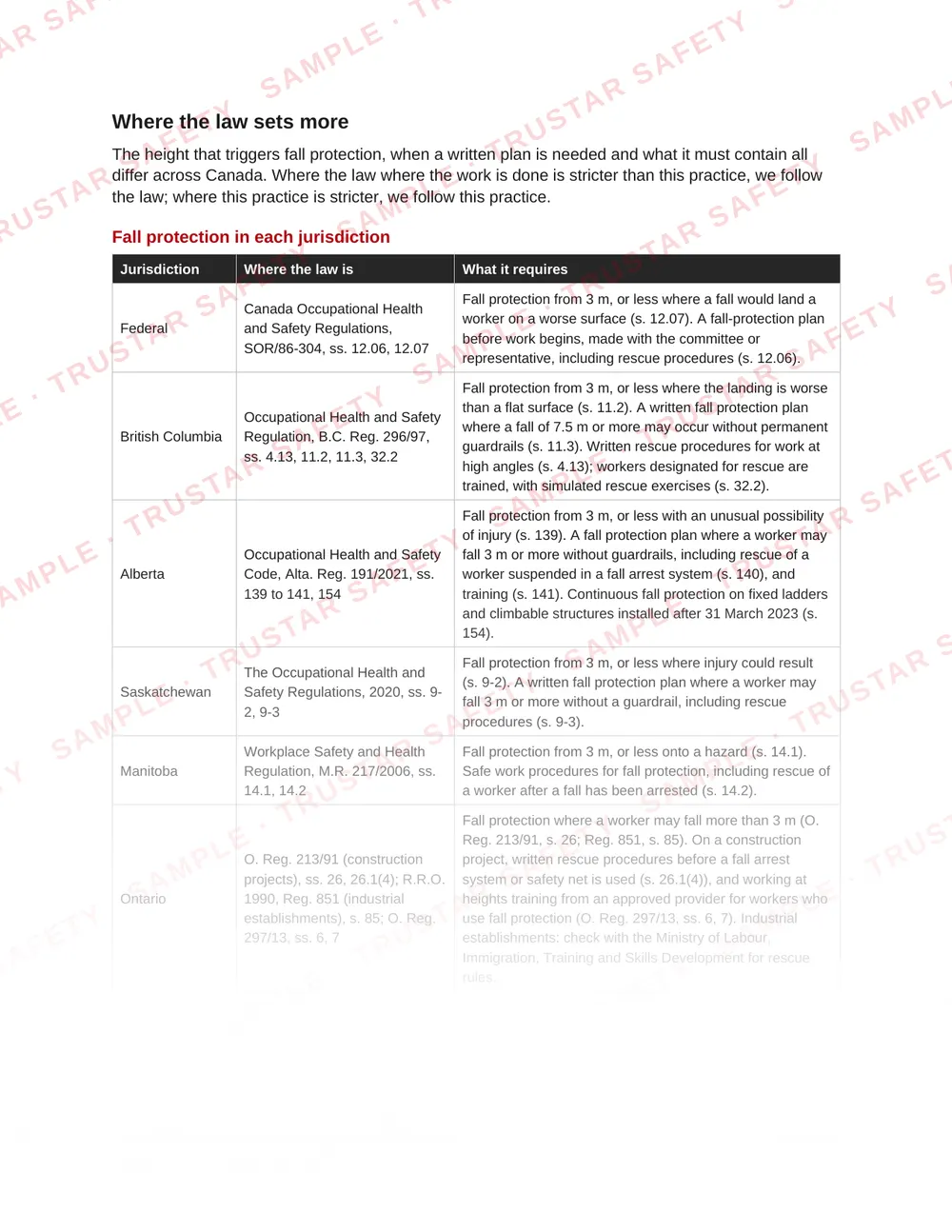
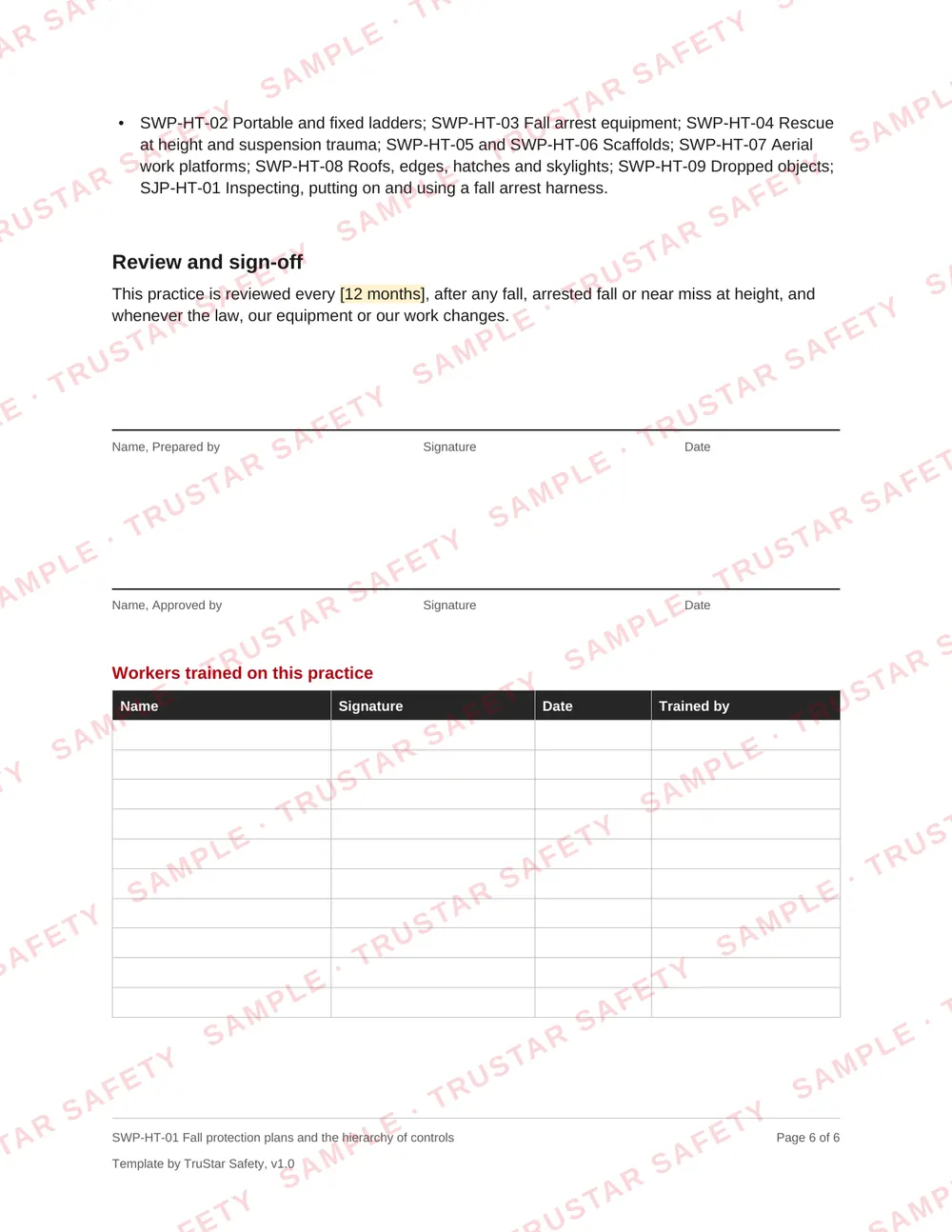
Sample pages from the pack, marked and cut short. Your copy has no watermark.
What’s in the pack
SWP-HT-01 Fall protection plans and the hierarchy of controls
Safe work practice. Trigger heights differ by jurisdiction, guardrails before travel restraint before fall arrest, written plans, clearance calculations. Includes work on equipment, trucks, tanks and loads.
SWP-HT-02 Portable and fixed ladders
Safe work practice. Selection (CSA Z11), inspection, set-up angle, three-point contact, carrying tools, fixed ladders with cages or ladder safety systems.
SWP-HT-03 Fall arrest equipment: harnesses, lanyards, lifelines and anchors
Safe work practice. CSA Z259 equipment, pre-use and documented periodic inspection, anchor strength, compatibility, removal from service after a fall.
SWP-HT-04 Rescue at height and suspension trauma
Safe work practice. A rescue plan before work starts, rescue kits, response times, suspension intolerance signs and aftercare.
SWP-HT-05 Scaffolds: erecting, altering and dismantling
Safe work practice. Competent erectors, load classes, engineered scaffolds, bracing and ties, rolling, suspended and cantilevered scaffolds, continuous fall protection while erecting.
SWP-HT-06 Scaffold inspection, tagging and safe use
Safe work practice. Tag system (green, yellow, red), inspection before each shift and after weather, rules for users, no unauthorized alterations.
SWP-HT-07 Aerial work platforms: scissor and boom lifts
Safe work practice. CSA B354 training and familiarization, pre-use inspection, ground conditions, tie-off in booms, overhead hazards, occupants below.
SWP-HT-08 Roofs, edges, hatches and skylights
Safe work practice. Warning lines, guardrails, covers for openings and skylights, roof access, weather.
SWP-HT-09 Dropped objects, tool tethering and exclusion zones
Safe work practice. Tethering, toe boards, netting, barricaded drop zones, securing material at height.
SJP-HT-01 Inspecting, putting on and using a fall arrest harness
Safe job procedure. Inspection, donning and adjustment, connecting, checking clearance.
SJP-HT-02 Erecting, altering and dismantling a system scaffold
Safe job procedure. Base, first lift, bracing, tie-off while erecting, handover for tagging; rolling scaffold variant as a short step set.
SJP-HT-03 Inspecting and tagging a scaffold
Safe job procedure. Inspection checklist and tag decision, record keeping.
SJP-HT-04 Rescuing a worker suspended in a harness
Safe job procedure. Rescue steps with a pre-rigged kit or aerial device, calling for help, aftercare for suspension intolerance.
Read me first
An index of the pack’s documents, with how to put your company name in, tailor each one, and approve, issue and train on it.
Practices and procedures
The 9 practices set out the rules for working at heights: the hazards, what we do, the protective equipment, and the training and competency it takes. The 4 procedures give the steps for a single task, in order, stage by stage, and name the practices they carry out.
Every document has the same sections, so your workers know where to look in any of them, and lists related documents by number under References.
Written for every province and territory
Your crews follow the law of the province or territory where the work is done. Each document sets your company’s rule once and sets out, in a table under “Where the law sets more”, what the law requires in each of the 14 jurisdictions, federal workplaces included, citing the regulation and section where it was confirmed in the official text.
Where the law, the owner or your client sets a stricter rule than the document, the stricter rule applies, and the document tells your workers so.
Make them your own
Put your company name in on page 1 of each document and desktop Word carries it through. Shaded Tailor notes say what to check or change for your work, and highlighted placeholders mark the dates, names and numbers you fill in.
Each ends with Prepared by and Approved by signatures and a table for every worker trained on it to sign, so the document is also your training record.
Lifetime updates
When the law changes, we publish a new edition and email everyone who bought the pack, on its own or in the Complete safe work practice and procedure library. Every update is free, for as long as we publish it.
Version 1.0 October 16, 2026
- First edition: 9 safe work practices and 4 safe job procedures, each with the law of every province and territory and federal workplaces set out in it.
More safe work practice packs
Get all 18 in the Complete safe work practice and procedure library for $399.95, $859.15 less than buying them separately. Or buy templates together and save on the whole order: 2 for 10% off, 3 for 15% off, 4+ for 20% off.
All provinces, territories and federal
Hazardous energy and lockout safe work practices and procedures$69.95
All provinces, territories and federal
General site rules and PPE safe work practices and procedures$69.95
Questions
What is the difference between a safe work practice and a safe job procedure?
A safe work practice sets out the rules for a kind of work: what we do, the equipment and protection it takes, and who may do it. A safe job procedure gives the steps for one task, in order, stage by stage, and names the practice it carries out. Practices are numbered SWP and procedures SJP.
What is in the pack, and what format is it?
One .zip download holding 13 editable Microsoft Word (.docx) files on US Letter pages, 9 safe work practices and 4 safe job procedures, and a Read me first index. They work best in desktop Word for Windows or Mac. They also open in Google Docs and Word on the web, where you use Find and replace to put your company name in. On an iPad or iPhone, the Files app opens the .zip with a tap.
Which province’s law are they written to?
All of them. Each document is written once for all of Canada and sets out, under “Where the law sets more”, what the law requires in every province and territory and in federally regulated workplaces, with the regulation and section where they were confirmed in the official text. Where the law where you work, your client or the owner sets a stricter rule than the document, the stricter rule applies, and the document says so.
Can I buy a single document?
Not yet: the documents are sold in topic packs, and as the complete library. Single documents are coming later.
Should I buy the pack or the library?
A pack is $69.95. The complete library holds all 18 packs, 216 documents in all, for $399.95, and goes on sale once every pack is written. Up to 7 packs cost less bought on their own, with the multi-template discount; for more, the library costs less.
Is this legal advice? Will it make us compliant?
No. They are templates, not legal advice: complete documents written with the law of every jurisdiction set out, as a starting point. A practice or procedure works once a competent person has fitted it to your work and your workers are trained on it and follow it, so no template can promise compliance.
What happens when the law changes?
We update the documents it affects, and you get every update free for as long as we publish it: lifetime updates at no extra charge. We email you when a new edition of the pack is ready, with what changed and a link to download it.
Can I use it for more than one company?
Each purchase is licensed to one company. Consultants setting up programs for several clients should contact us.
Want them fitted to your work?
Our safety advisors can tailor practices and procedures to your equipment, your clients’ rules and the provinces you work in, and build the rest of your safety program around them.
OHS program development