

Asbestos exposure control plan template
A complete written plan for asbestos, in 14 editions: one for each province and territory and one for federally regulated workplaces. It covers both halves of the job: managing asbestos in buildings and equipment you own or work in, and doing work that disturbs it safely, sorted into low, moderate and high risk. Each edition sets out the law that applies there, with pinpoint citations. Every purchase includes all 14, in English and in French: 28 editable Word files you make your own.
A look inside
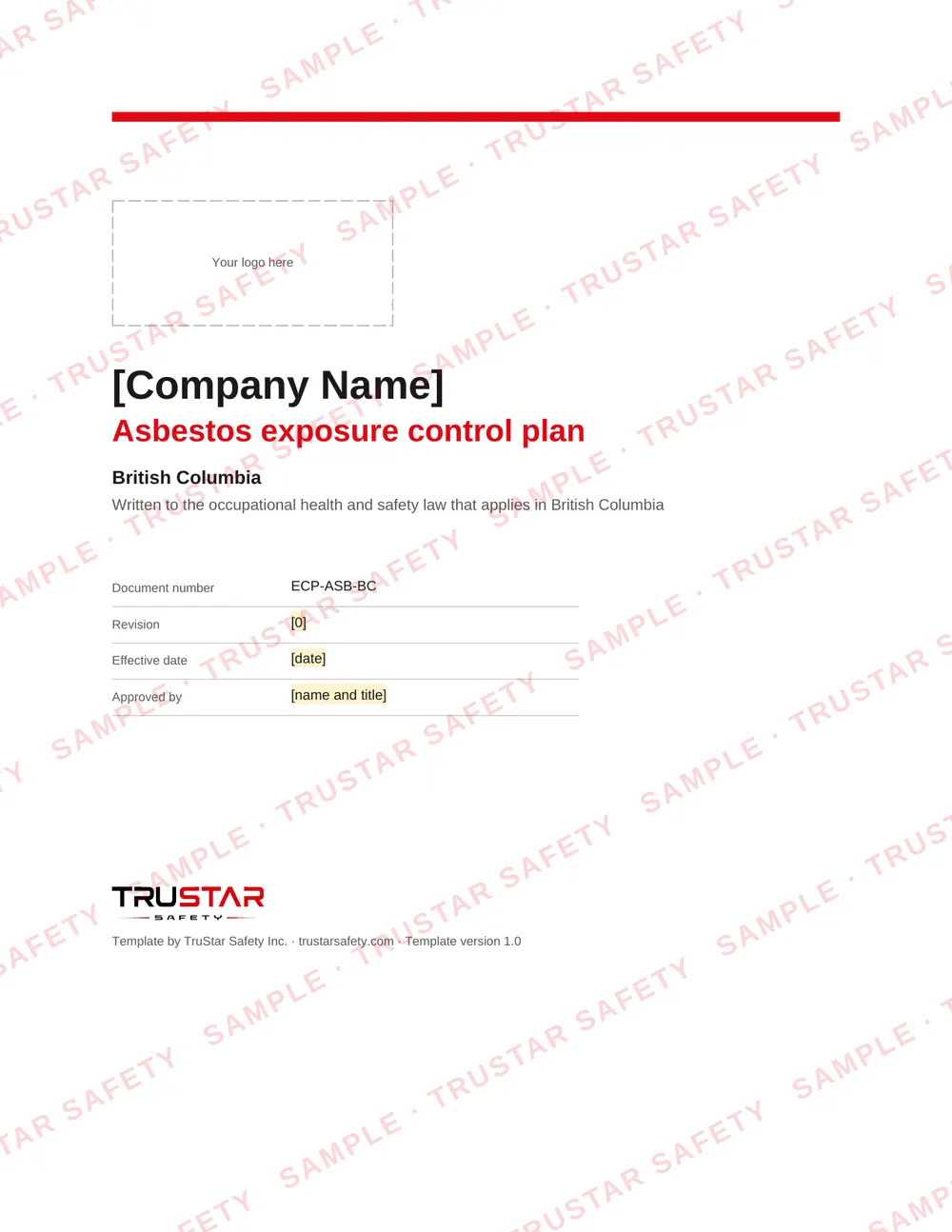
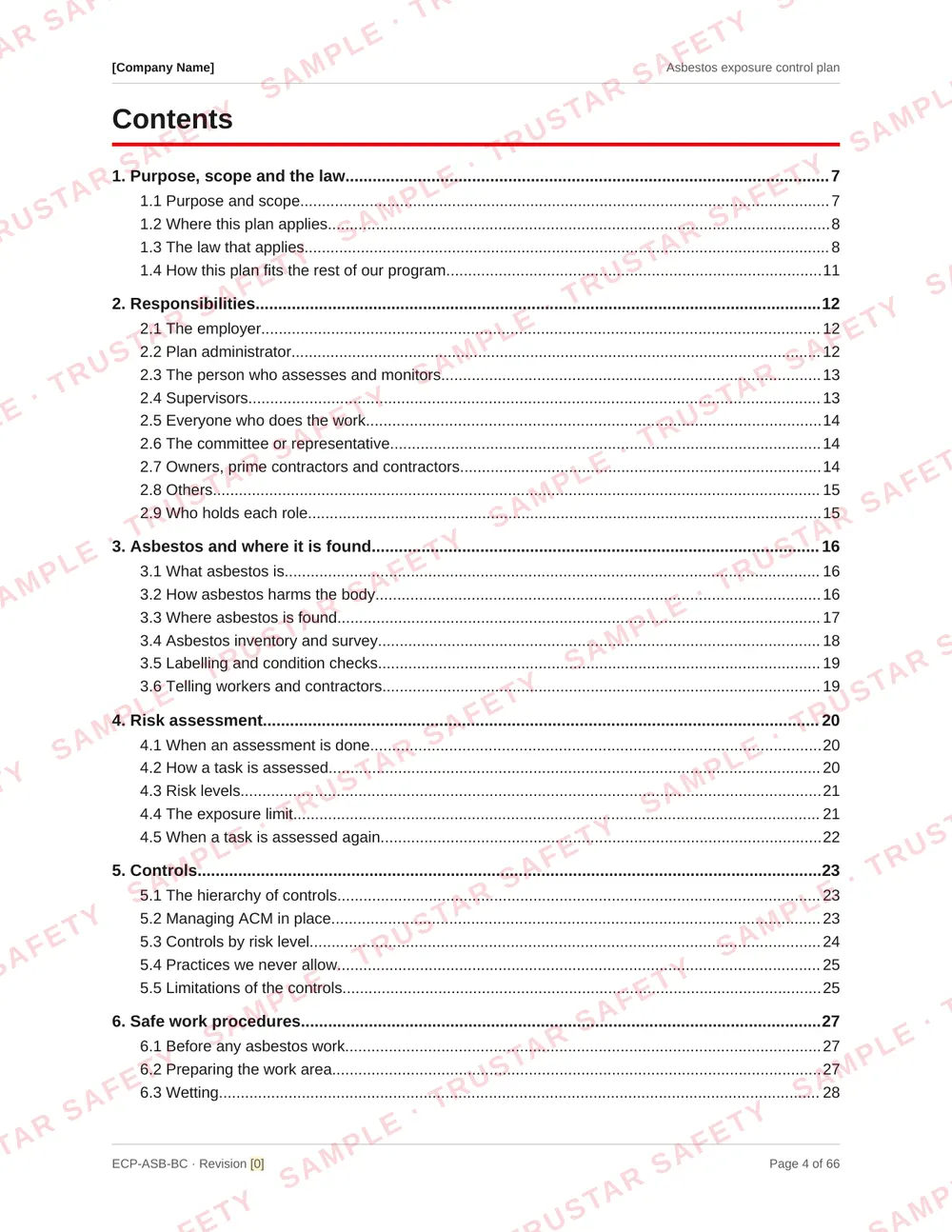
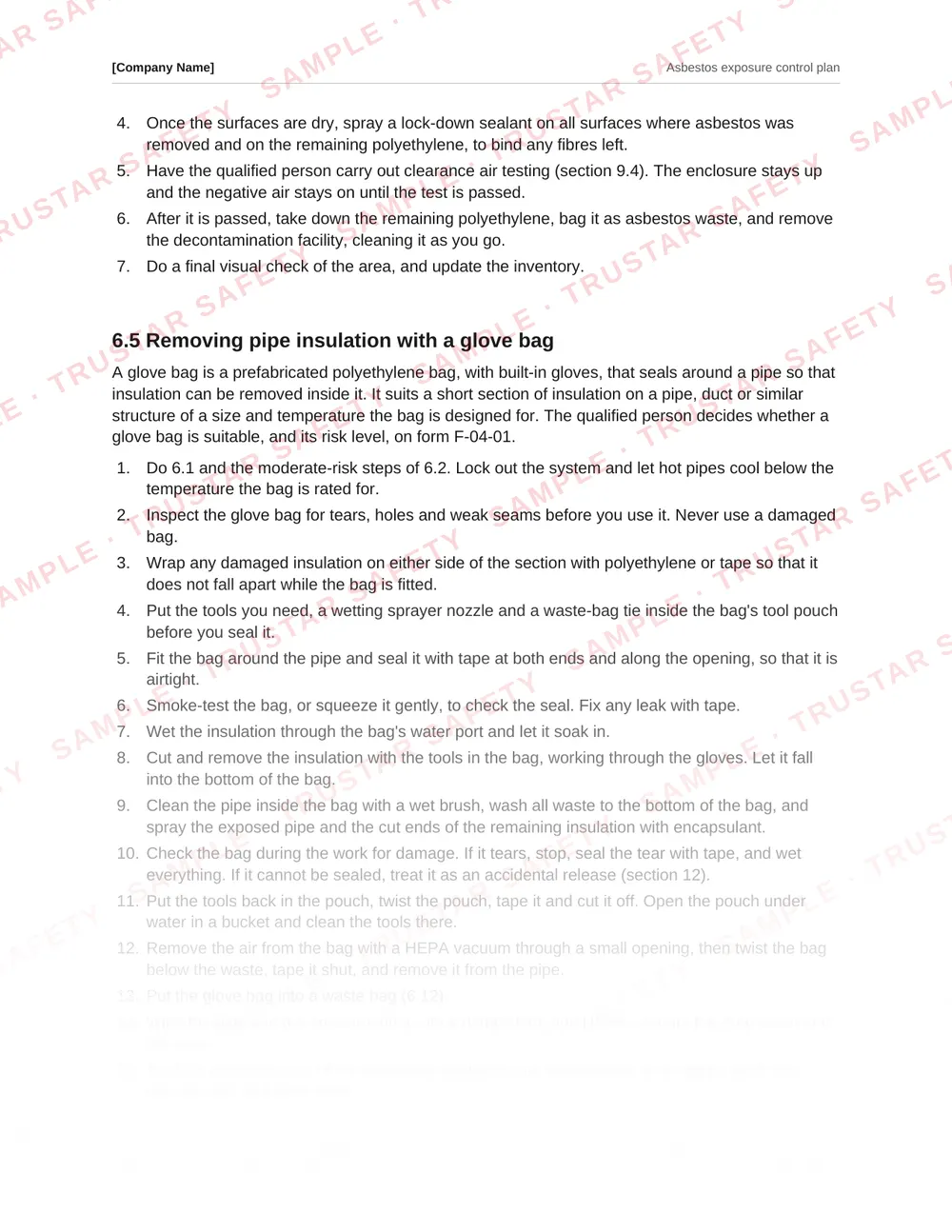
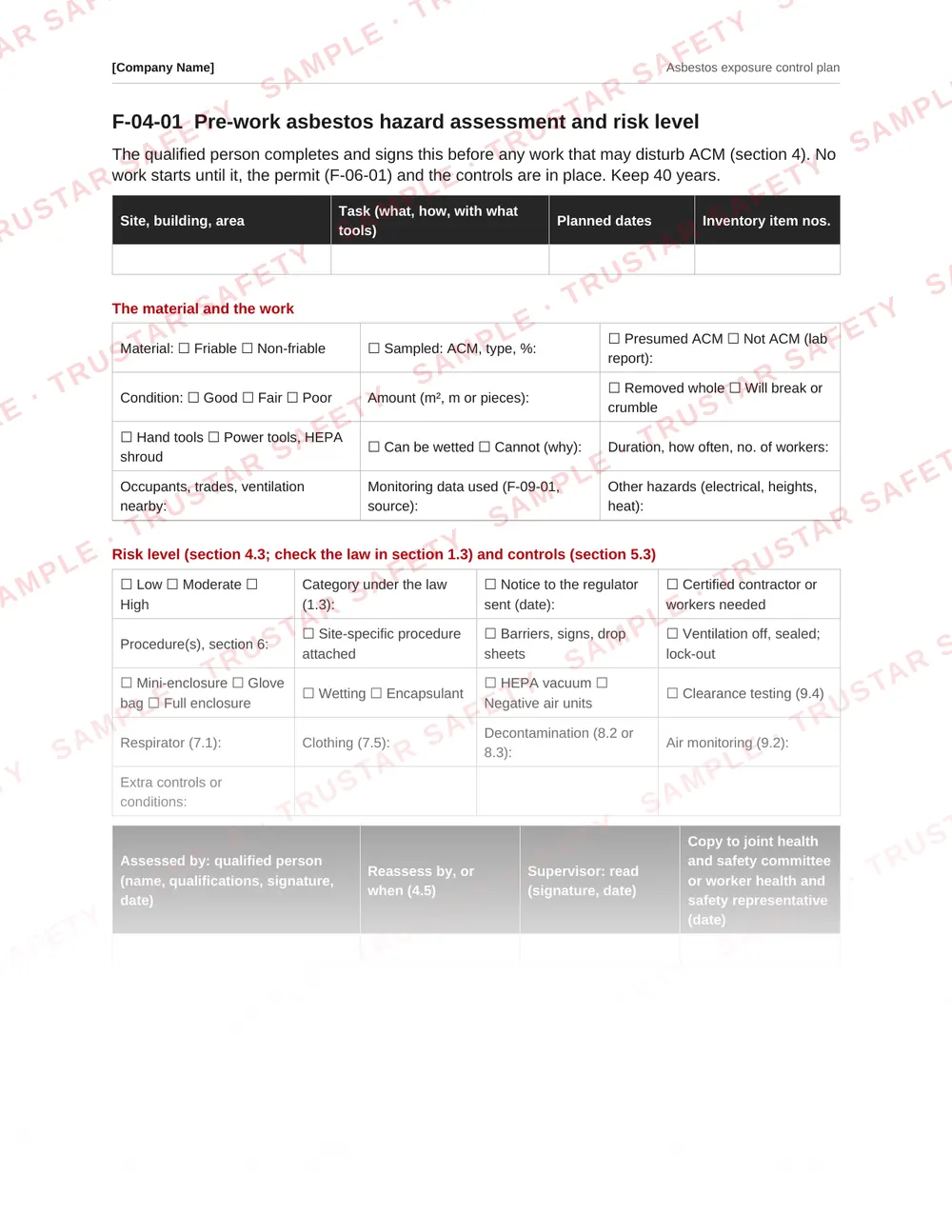
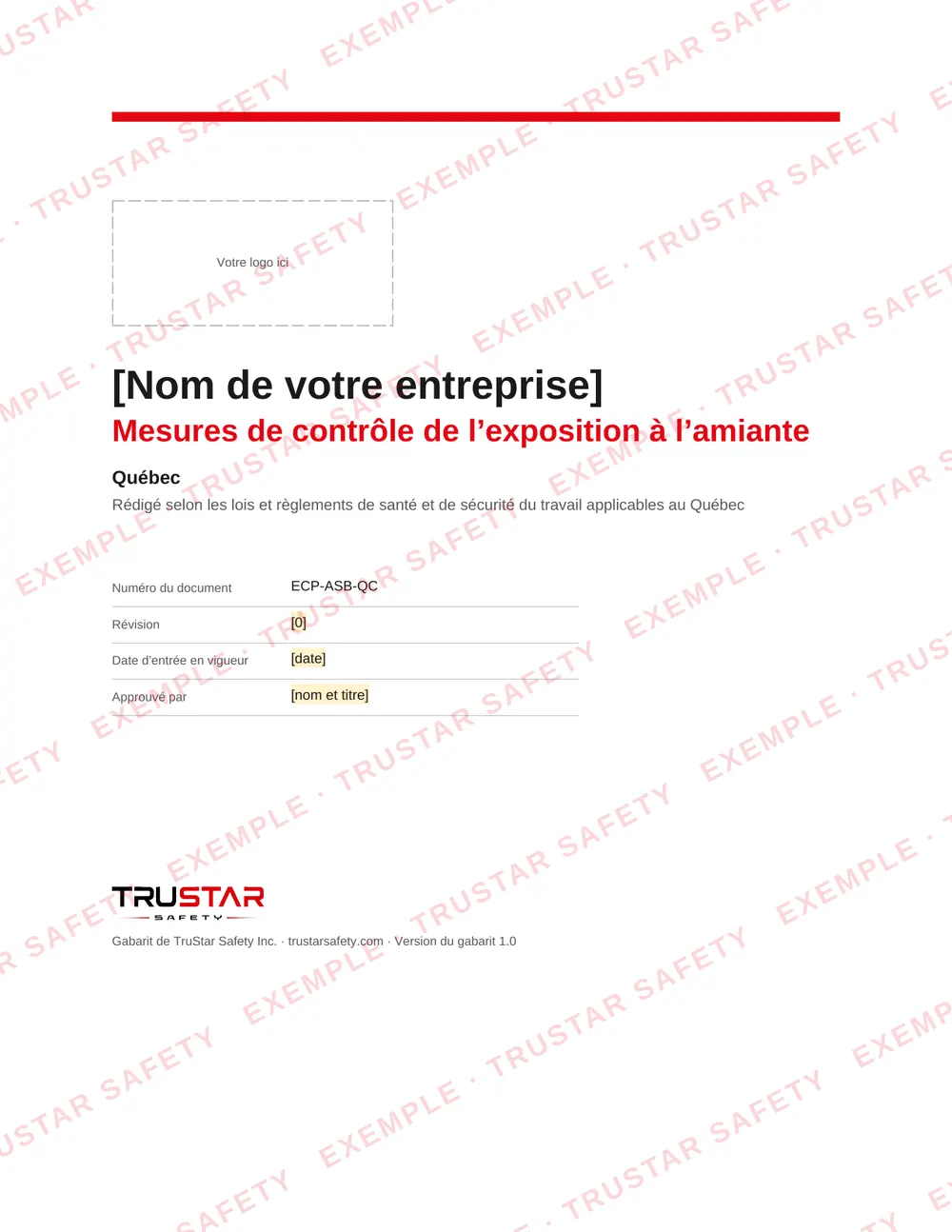
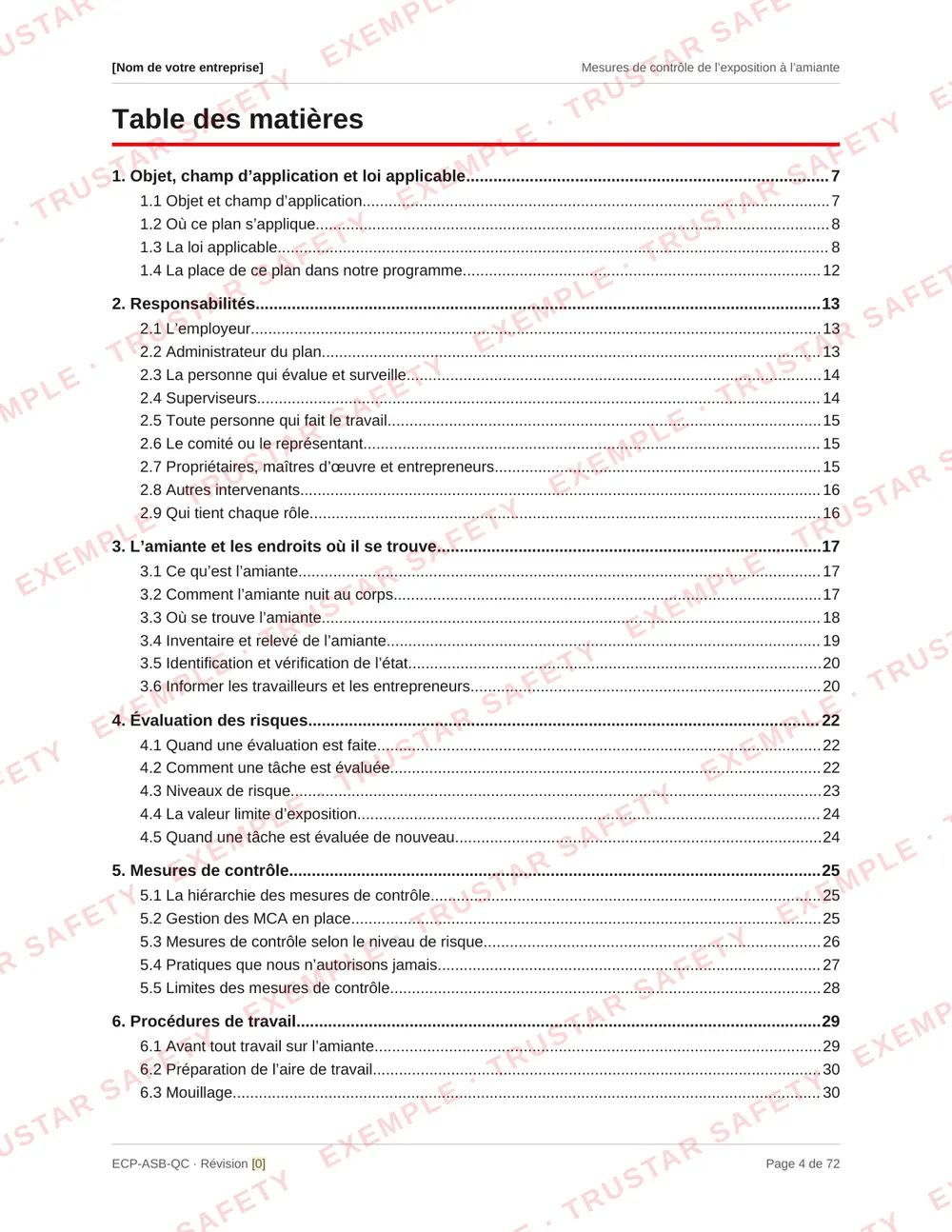
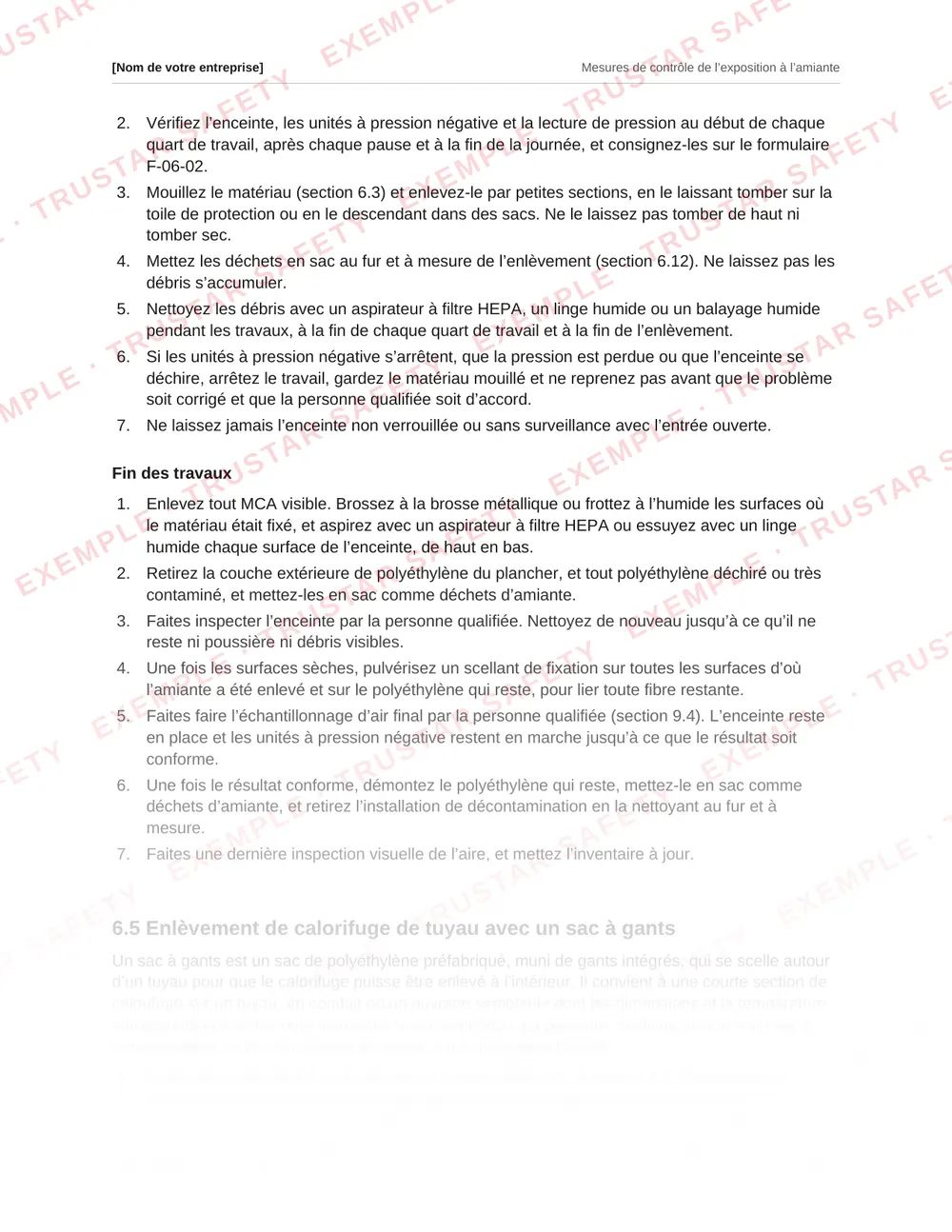
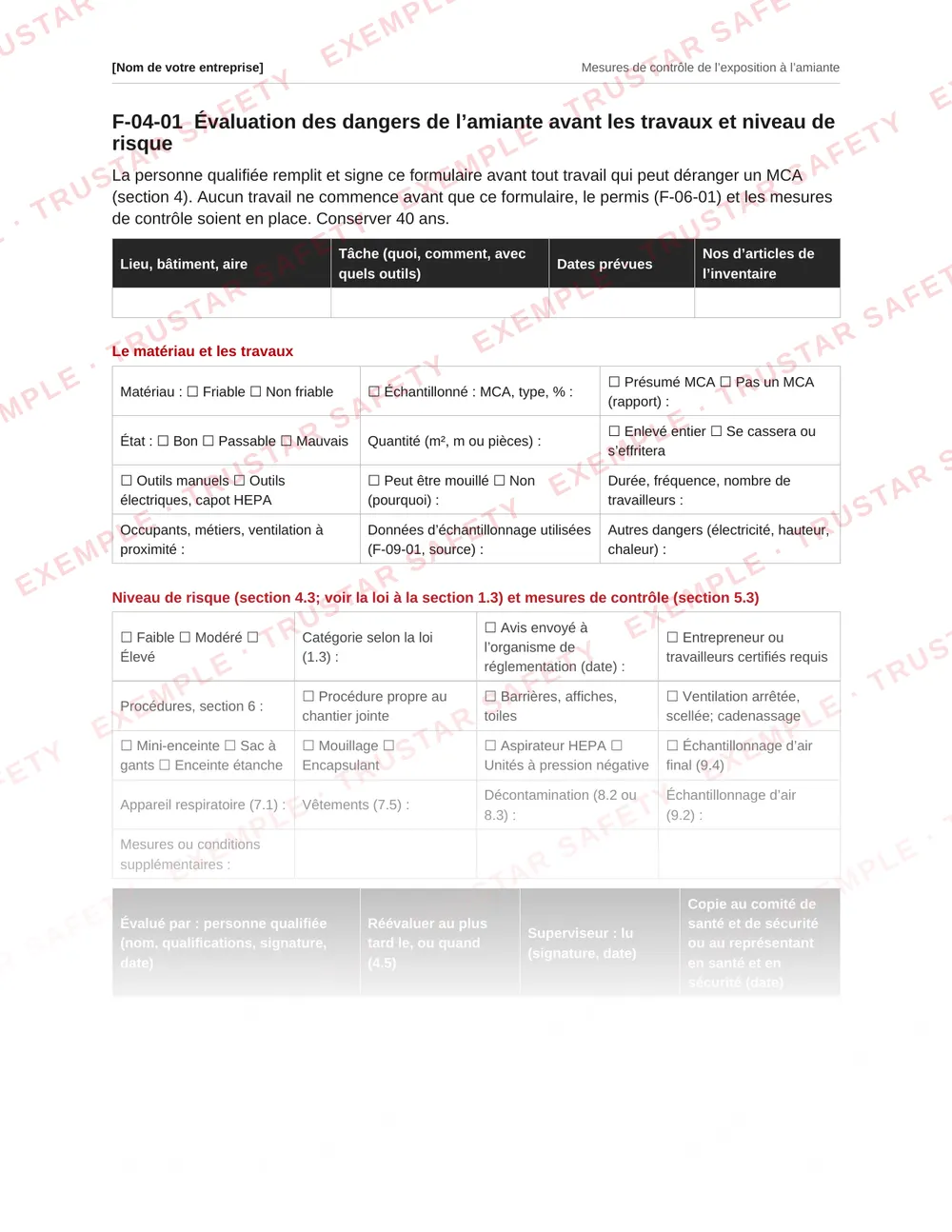
Sample pages from the plan, marked and cut short. Your copy has no watermark.
What’s in the plan
1. Purpose, scope and the law
The plan’s two parts, managing asbestos in place and work that disturbs it, where it applies and the tasks it covers, the law that applies in your jurisdiction with pinpoint citations (section 1.3), and how it fits the rest of your program.
2. Responsibilities
The employer, the plan administrator, the person who assesses and monitors, supervisors, everyone who does the work, the committee or representative, owners, prime contractors and contractors, and a table of who holds each role.
3. Asbestos and where it is found
What asbestos is and how it harms the body, where it is found, the asbestos inventory and survey, labelling and condition checks, and telling workers and contractors before they start.
4. Risk assessment
When and how a task is assessed, the three risk levels (low, moderate and high) with typical tasks for each, the exposure limit, and when a task is assessed again. Where your law draws the levels differently, the law decides.
5. Controls
The hierarchy of controls, managing asbestos-containing material in place, the controls for each risk level, practices never allowed, and the limits of the controls.
6. Safe work procedures
Before any asbestos work, preparing the work area and wetting, then enclosure and negative air for high-risk work, glove bag removal, vinyl floor tiles and sheet flooring, drywall with asbestos joint compound, pipe, boiler and duct insulation, drilling and small repairs, brake and clutch service, asbestos cement pipe and panels, and waste packaging and disposal.
7. Respiratory protection and protective clothing
Respirators by risk level, fit testing and fitness to wear one, use, checks and care, the respiratory protection program, and protective clothing and other equipment.
8. Hygiene facilities and decontamination
Hygiene rules for every asbestos job, leaving a low or moderate-risk work area, the decontamination facility for high-risk work, cleaning tools and equipment, laundry, and emergencies inside a work area.
9. Air monitoring and clearance testing
How samples are taken and analysed, when, acting on the results, clearance testing after high-risk work, and sharing results.
10. Health monitoring
When health monitoring is required, how it works, and its records.
11. Education and training
Who is trained, in what and when, what the training covers, and training records.
12. Accidental disturbance and other emergencies
What counts as an asbestos emergency, the first steps (stop, warn, isolate, report), assessment and cleanup, exposed people, reporting and investigation, and other emergencies during asbestos work.
13. Records, communication, consultation and review
Records, communication, consulting your committee or representative, review and approval of the plan.
Appendix A. Regulatory cross-reference
Every provision of your jurisdiction’s law the plan is written to meet, in plain words, with the section that meets it and whether an inspector will also want your records. Each entry links to its section.
Appendix B. Forms
8 print-ready forms, each with a form code: the asbestos inventory and condition record, the pre-work hazard assessment and risk level, the asbestos work notice and permit, the daily work checklist, the air monitoring and clearance record, the training record, the accidental disturbance and exposure incident report and the plan review record.
One plan, 14 editions
Each plan is written once and fitted to the law of each of Canada’s 14 jurisdictions: the ten provinces, the three territories and federally regulated workplaces under the Canada Labour Code. Each edition takes the name its law gives the document, and its own limits, terms and citations.
Every purchase includes all 14, each in English and in French: 28 Word files. The French editions follow the English section for section and form for form, and their cross-reference matches row for row. Laws published only in English keep their English titles.
Written to the law where you work
Section 1.3 of each edition sets out the law that applies there, with pinpoint citations: what that law calls the plan (an exposure control plan, an asbestos management plan or program, a code of practice), the exposure limit, how it sorts asbestos work, and what it adds, such as notices, certified workers, clearance levels or records. Appendix A lists every provision the plan is written to meet, in plain words, with the section that meets it and whether an inspector will also want to see your records. Each entry links to its section.
Every legal reference was checked against the official texts between September 30 and October 3, 2026, and each edition lists its sources and the date each was checked. A template can’t make you compliant on its own, and we don’t claim it does: the plan works once a qualified person adapts it to your work.
Who it is for
Owners and managers of buildings, plants and equipment that contain asbestos, and employers whose work may disturb it: renovation and demolition, building maintenance, plumbing, heating, electrical and insulation trades, fleet service on brakes and clutches, and municipal work on asbestos cement pipe.
If you only manage buildings and hire contractors for the work that disturbs asbestos, a Tailor note says which sections are the core of your plan.
Lifetime updates
When the law changes, we publish a new edition and email everyone who bought the template, on its own or in the Core 5 exposure control plans. Every update is free, for as long as we publish it.
Version 1.0 October 3, 2026
- First edition, in 14 jurisdiction editions (one for each province and territory, and one for federally regulated workplaces), each in English and French.
- Every legal reference checked against the official texts between September 30 and October 3, 2026. Each edition lists its sources and the date each was checked.
More exposure control plans
Get all five in the Core 5 exposure control plans for $449.95, $149.80 less than buying them separately. Or buy templates together and save on the whole order: 2 for 10% off, 3 for 15% off, 4+ for 20% off.
All provinces, territories and federal
Core 5 exposure control plans (silica, asbestos, lead, noise, infectious disease)$449.95
All provinces, territories and federal
Noise exposure control and hearing conservation plan template$119.95
Questions
Which edition do I use?
The one for the law that covers the workplace: the province or territory where the work is done, or the federal edition if your business is federally regulated under Part II of the Canada Labour Code (for example, interprovincial trucking, airlines, railways, banks and telecommunications). If you are not sure which law covers you, confirm it with your regulator before you rely on an edition. All 14 come with every purchase, in English and French, so you never pay twice for the right one.
Is this legal advice? Will it make us compliant?
No. It is a template, not legal advice: a complete plan written to the law with every requirement cited, as a starting point. The plan only works once a qualified person adapts it to your work (your tasks, your materials and the exposure your own assessment finds) and you put it in place and follow it, so no template can promise compliance. If you want help with that, our team does it too.
Does it cover my province’s own rules?
Yes. Section 1.3 of each edition sets out the law that applies there, with pinpoint citations: what that law calls this document, the exposure limit, and what the law adds to the plan, such as monitoring, health checks, notices, records or training. Where the law changes something in the plan’s general text, section 1.3 says what and where. Appendix A then lists every provision the plan is written to meet, with the section of the plan that meets it.
What if we work in more than one province?
Use the edition for each place you work: every purchase includes all 14. Each edition is complete on its own, and they share the same sections and form codes, so crews moving between provinces work to the same plan and only what the law changes is different.
What format is it in, and can I edit it?
Editable Microsoft Word (.docx) files on US Letter pages: 28 of them, one for each of the 14 jurisdictions in English and in French. Type your company name once and desktop Word puts it on the cover, in every header and through the text. Shaded “Tailor” notes say what to check or change in each section, and highlighted placeholders mark every name, date and place you fill in. The files also open in Google Docs and Word on the web, where you use Find and replace to put your company name in.
What happens when the law changes?
We update the plan, and you get every update free for as long as we publish it: lifetime updates at no extra charge, for all 14 editions in both languages. We email you when a new edition is ready, with what changed and a link to download it.
Can I use it for more than one company?
Each purchase is licensed to one company. Consultants setting up programs for several clients should contact us.
Want it built for you?
Our safety advisors assess the hazards in your work and help you tailor the plan to it, from the risk assessment to the procedures your crews follow and the controls behind them.
Hazard assessments and control