














Residential construction and framing safety manual template
A complete written health and safety program for custom and production home builders, framing and sheathing crews, finishing carpenters and small general contractors building houses, townhouses and low-rise wood-frame buildings, wherever in Canada the site is. It is laid out on the 14 national COR elements and written for the work: fall protection planning, guardrails and floor openings, fall arrest and travel restraint on wood frame, raising walls, setting trusses, roof sheathing, ladders, ladder jacks and pump jacks, scaffolds, saws, nailers and powder-actuated tools, telehandlers, deliveries, basements and backfill, temporary heat and power, silica and noise, weather, subtrades and the public. Section 15 sets out the law of every province and territory, and federal workplaces, side by side, with each jurisdiction’s fall protection height and written plan, scaffold rules, notice of project, prime contractor duties and young workers on site. It arrives as an editable Word file you make your own.
A look inside
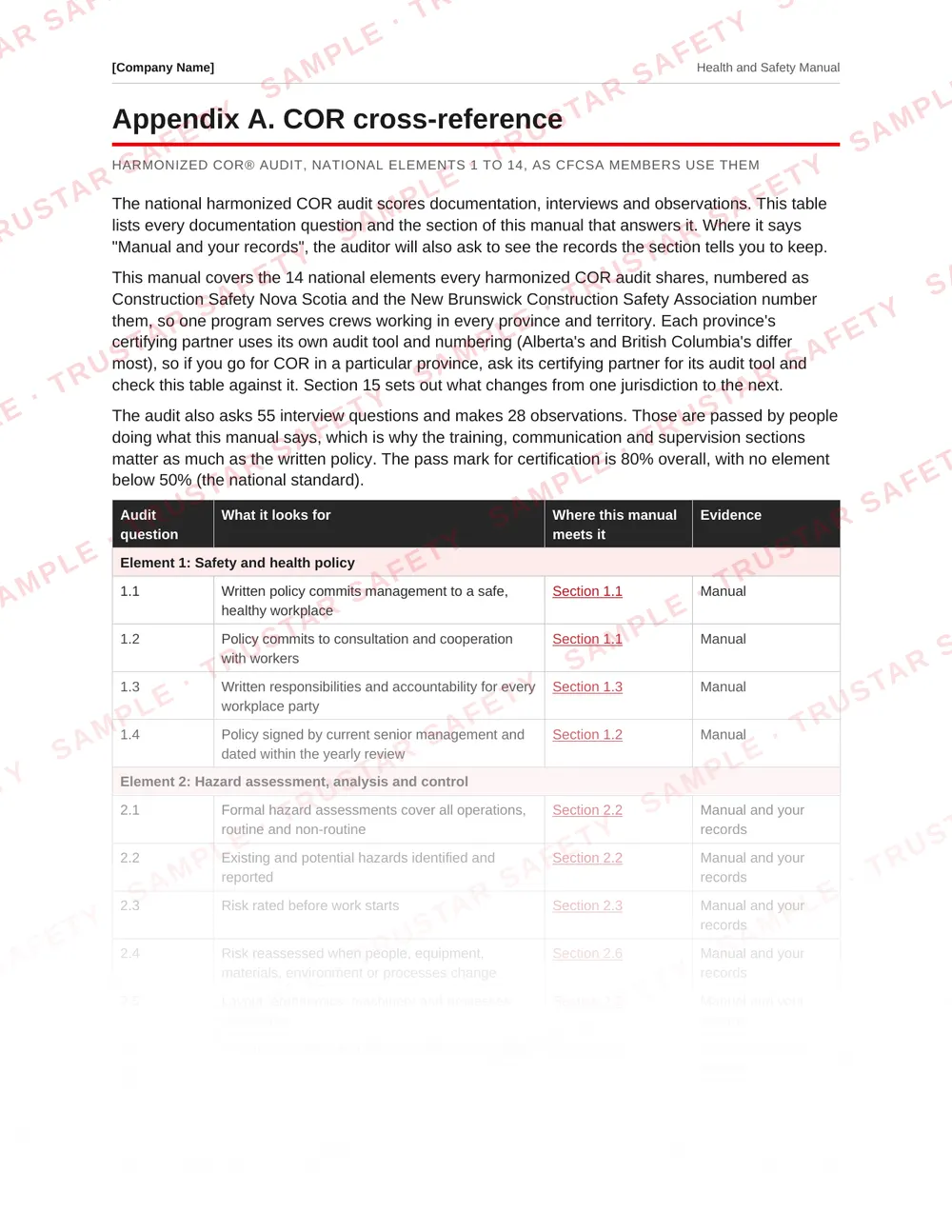
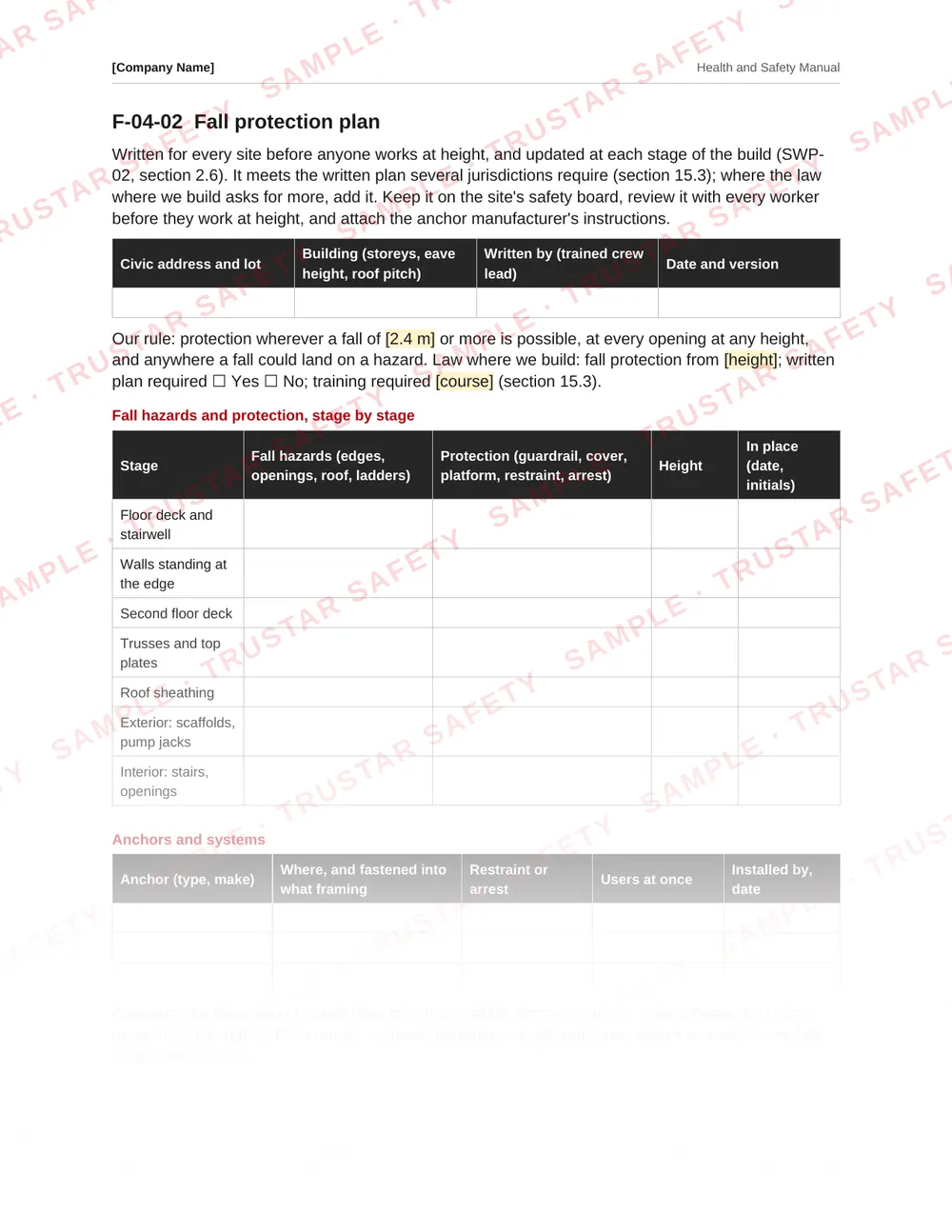
Sample pages from the manual, marked and cut short. Your copy has no watermark.
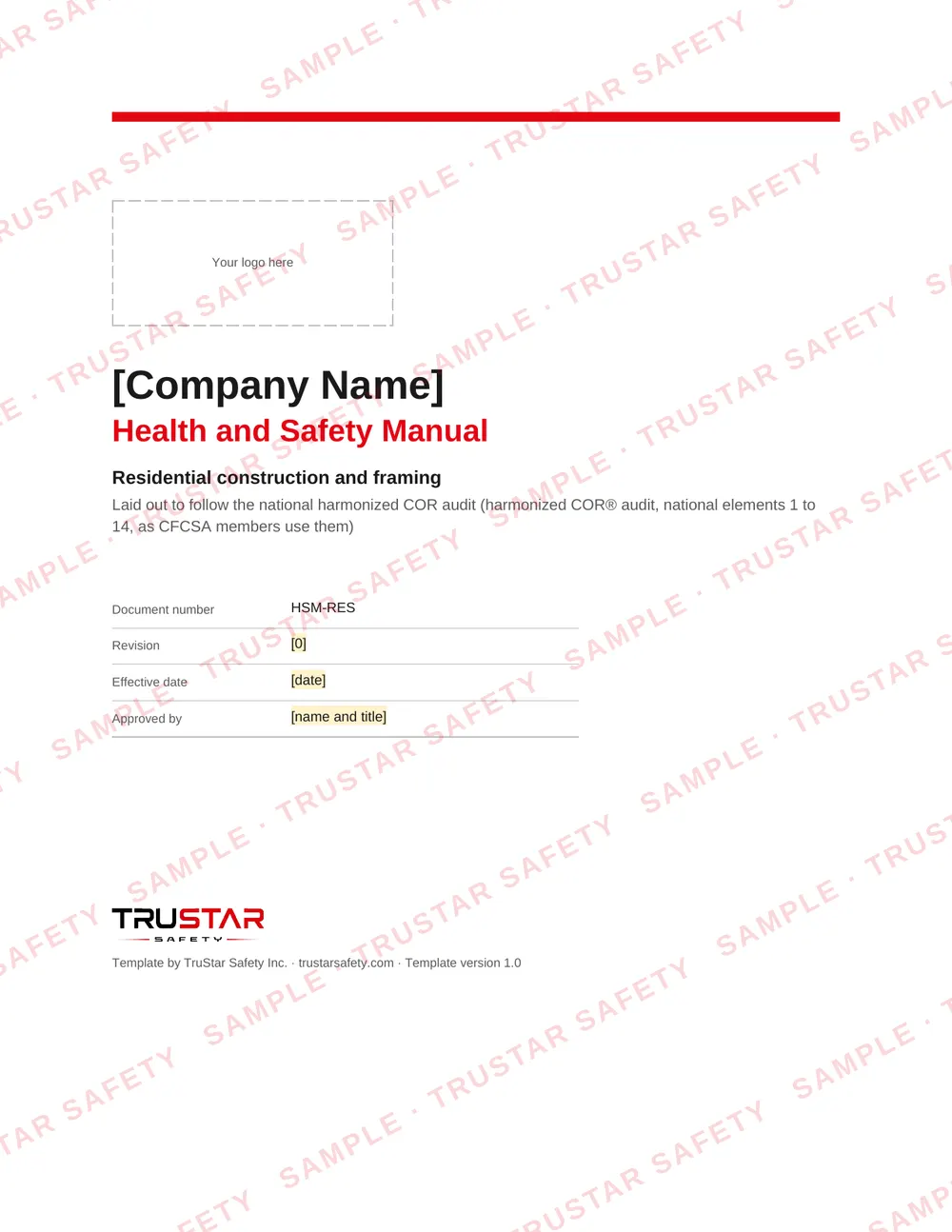
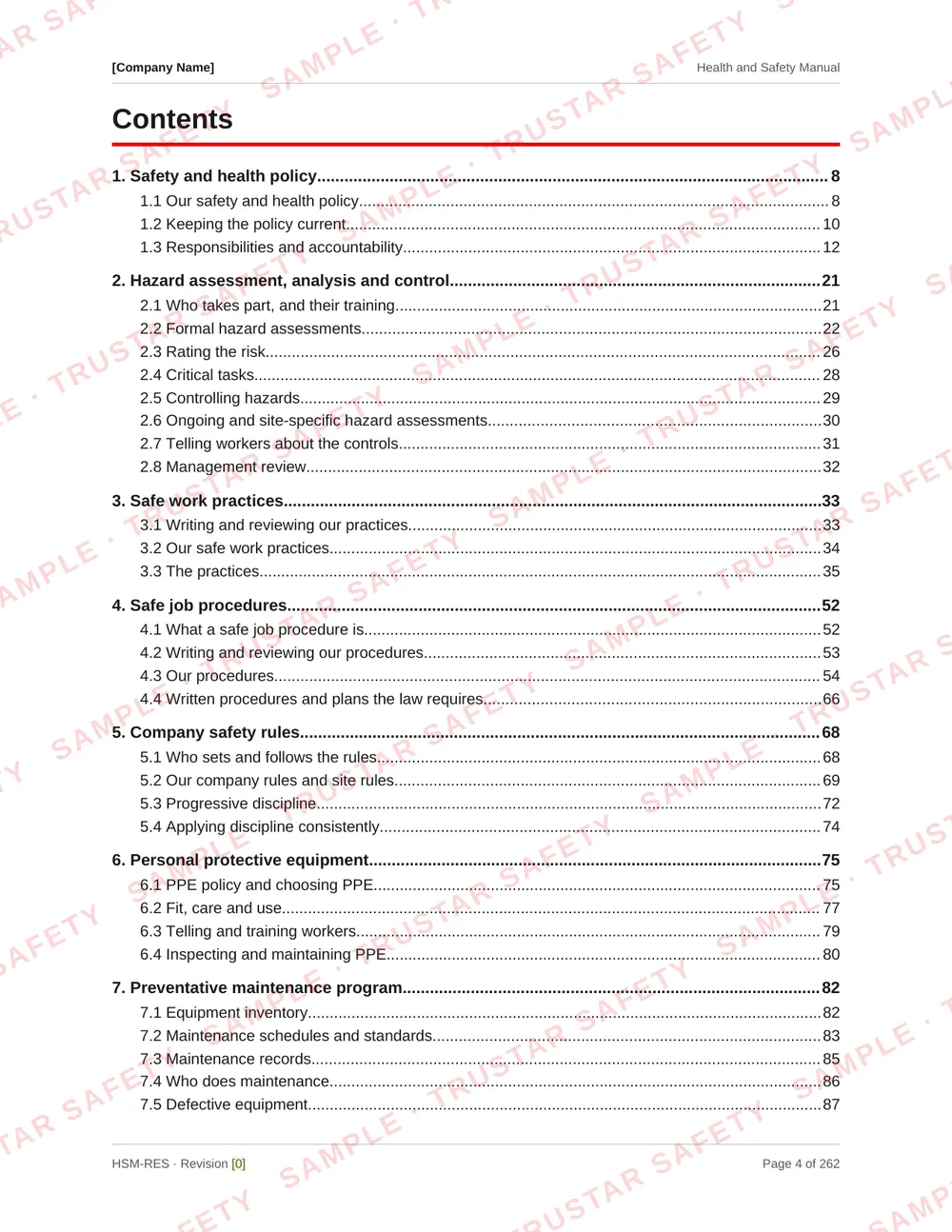
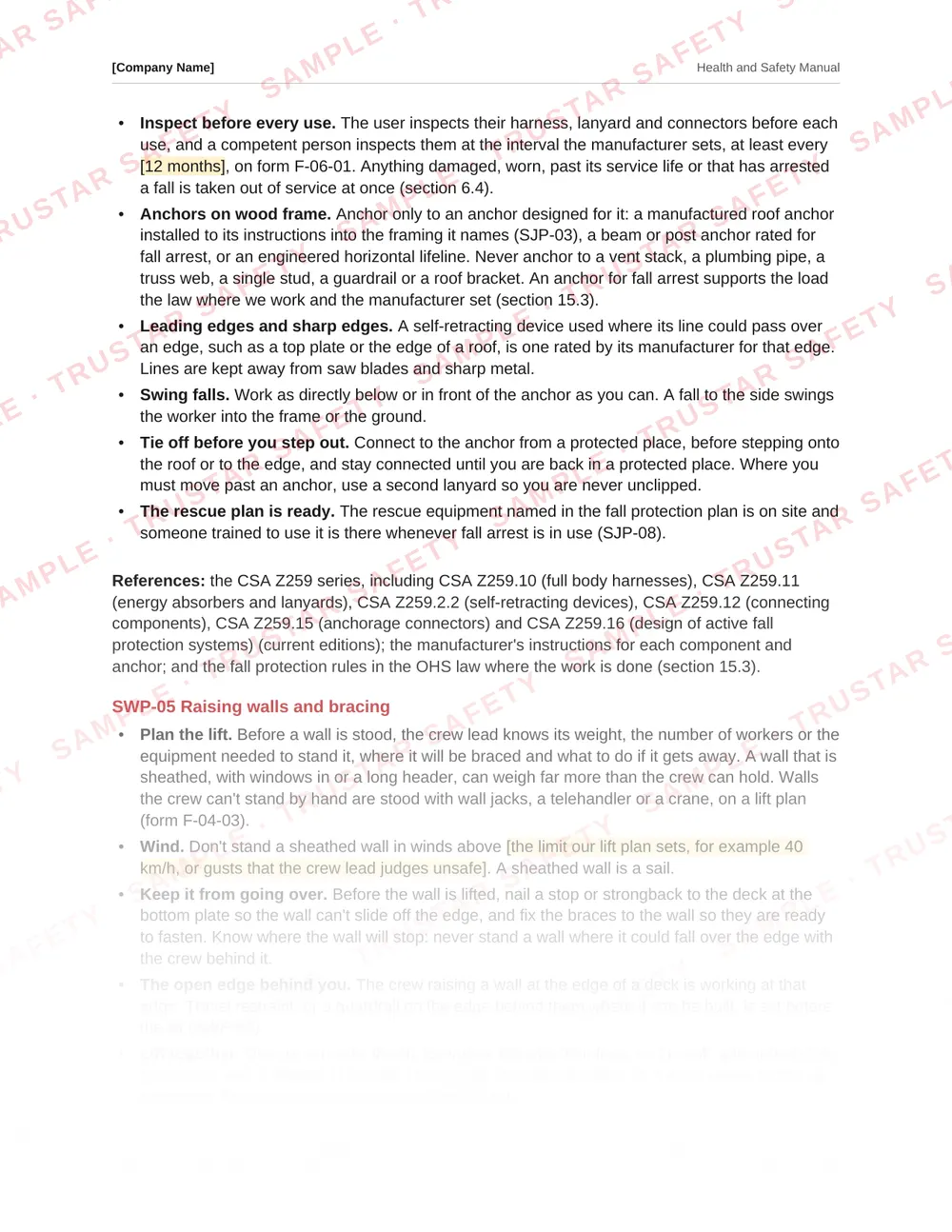
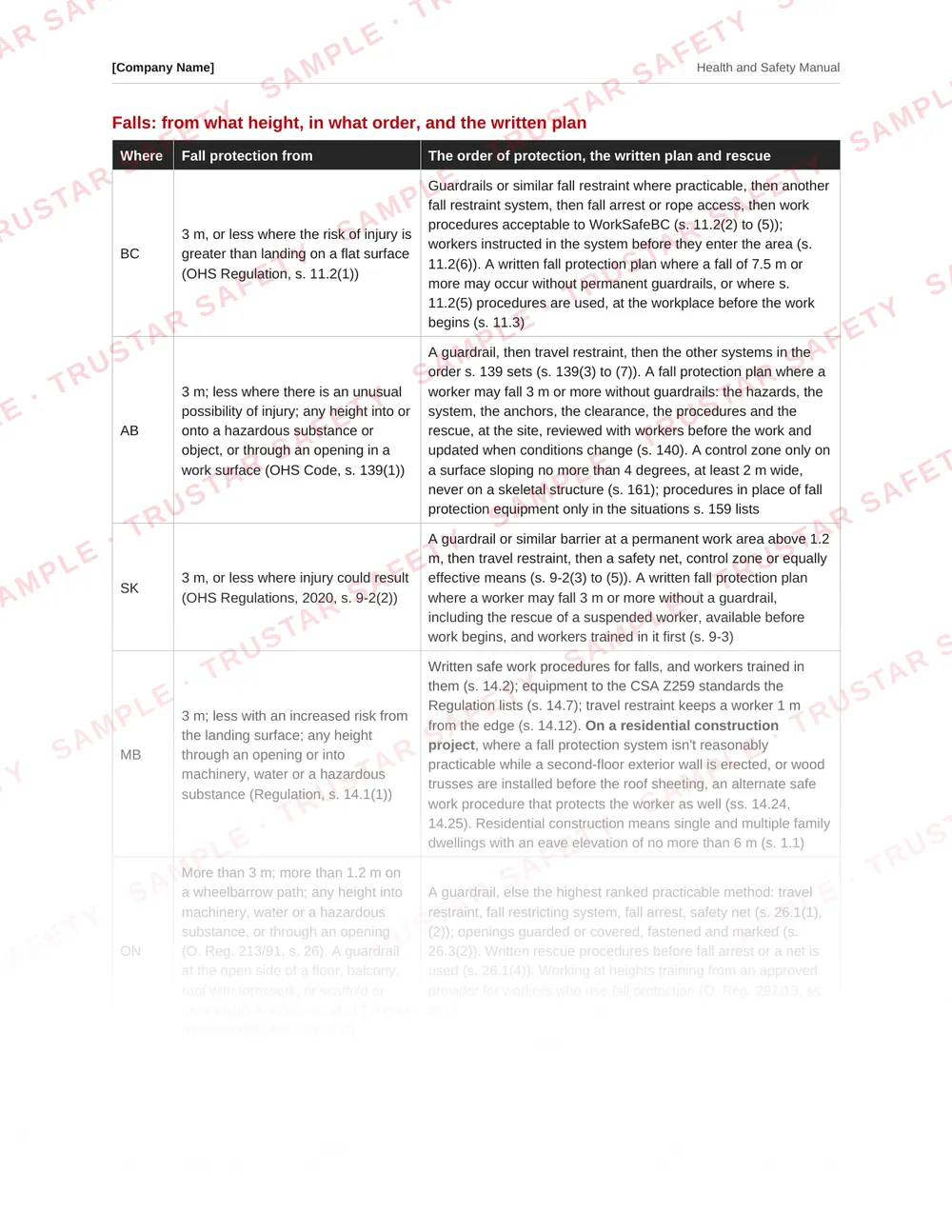
What’s in the manual
1. Safety and health policy
A signed, dated policy, the written program, and responsibilities for management, site supervisors, framers, carpenters, labourers, apprentices and equipment operators, and the builder’s duties as prime contractor.
2. Hazard assessment, analysis and control
Formal hazard assessments by stage of the build, the 5 × 5 risk matrix, a critical task inventory, and the site hazard assessment for a residential build.
3. Safe work practices
Twenty practices for the site: orientation and the prime contractor’s rules, fall protection planning, guardrails and openings, fall arrest on wood frame, raising walls, setting trusses, roof sheathing, ladders and jacks, scaffolds, saws, nailers, telehandlers, deliveries, basements, temporary heat and power, dust and noise, weather, subtrades and the public, and young workers.
4. Safe job procedures
Step-by-step procedures for standing a wall, setting trusses with a crane or telehandler, installing and using a roof anchor, guarding floor openings, clearing a jammed nailer, a pump jack scaffold, temporary heat in winter and rescuing a worker suspended in a harness.
5. Company safety rules
Life-saving rules for framing (protected above the trigger height, every opening covered or guarded, no riding loads, nailers never pointed or bump-fired near anyone), and a progressive discipline process applied the same way every time.
6. Personal protective equipment
Harnesses, lanyards and self-retracting devices and their inspection, eye and hearing protection, respirators for cutting fibre cement, and the rest of the basic PPE.
7. Preventative maintenance program
Fall protection and anchors, ladders, jacks and scaffolds, saws and nailers, telehandlers, heaters and temporary power.
8. Training and communication
Fall protection and rescue, telehandler operators, scaffold erectors, subtrade orientation, and supervision of apprentices and young workers.
9. Inspections
Site inspections at each stage with an end-of-day close-up, scaffold tags, harnesses checked before use, and telehandlers checked before each shift.
10. Investigations and reporting
Falls and arrested falls, wall and truss collapses, nailer injuries and near misses reported and investigated.
11. Emergency preparedness
A fall, a suspended worker, a collapse, carbon monoxide from a heater, a fire, and first aid on every site.
12. Statistics, records and document control
Fall protection plans, lift plans, scaffold logs, subtrade orientations and the notice of project, kept for the longest period any jurisdiction requires.
13. Legislation
OHS law and its construction rules, the CSA fall protection, ladder and scaffold standards, the construction safety association’s guidance as guidance, and the right to refuse.
14. Procurement and contractor management
Subtrades, crane and truss suppliers, and buying fall protection, scaffolds and equipment.
15. Working across Canada
Whose law applies, then every province and territory and federal workplaces side by side: the act and regulation, the regulator, the fall protection height and written plan, rescue, scaffolds, the notice of project, the prime contractor’s duties, young workers on site, and serious incidents to report and how fast.
Appendix A. COR cross-reference
Every one of the 74 documentation questions in the 14 national COR elements, what it looks for in plain words, the section that answers it, and whether the auditor will also want your records.
Appendix B. Forms
37 print-ready forms that match the manual, each with a form code: among them the residential site hazard assessment, fall protection plan, truss and wall raising lift plan, scaffold inspection log, subtrade orientation record and telehandler inspection.
Written for the work, not just the province
Falls are the injury that defines residential construction: from an open edge, through a stairwell, off a truss, down a ladder. This manual is written around them and the rest of the build, practice by practice and procedure by procedure.
Every site gets a written fall protection plan with its rescue, and the builder’s duties as prime contractor, from subtrade orientation to the notice of project, are set out plainly.
One program for every province you work in
Your crews follow the occupational health and safety law of the province or territory where the site is, not where your office is. The manual sets your company’s rules once and gathers what changes at each border into section 15, so a supervisor starting work in a new province looks up what applies there.
It is laid out on the 14 national COR elements, so it suits a COR audit wherever you certify. Each certifying partner uses its own audit tool, so check it against yours; our provincial manuals follow each province’s audit exactly. No template can guarantee a certificate on its own, and we don’t claim to.
Who it is for
Custom and production home builders, framing and sheathing contractors, finishing carpenters and small general contractors. Roofing, electrical, mechanical, excavation, concrete and demolition have their own manuals.
A template is a starting point, not legal or engineering advice: a qualified person must adapt it to your sites and the provinces you build in before you issue it.
Lifetime updates
When the law changes, we publish a new edition and email everyone who bought the template. Every update is free, for as long as we publish it.
Version 1.0 October 29, 2026
- First edition, written for home builders, framing contractors and small general contractors and laid out on the 14 national elements of the harmonized COR audit.
- Section 15 sets out the law and the fall protection, scaffold, notice of project, prime contractor and young worker rules of every province and territory and federal workplaces, checked against the legislation in force on 29 October 2026.
Add the exposure control plans for this work
Buy templates together and save on the whole order: 2 for 10% off, 3 for 15% off, 4+ for 20% off.
All provinces, territories and federal
Construction exposure control plan pack (silica, asbestos, lead, noise, heat stress, respiratory protection)$449.95
All provinces, territories and federal
Noise exposure control and hearing conservation plan template$119.95
Questions
Which province’s law is it written to?
All of them. Your crews follow the law of the province or territory where the site is, so the manual sets your company’s rules once and section 15 sets out, jurisdiction by jurisdiction, what the law there adds. Federally regulated workplaces are in it too.
Will it get us COR?
It is laid out on the 14 national elements every harmonized COR audit shares, with all 74 documentation questions cross-referenced. Each province’s certifying partner uses its own audit tool, so check the manual against the one you are certifying with. The audit also interviews workers and observes work, so no template can promise a pass.
What format is the manual in?
An editable Microsoft Word (.docx) file on US Letter pages. It works best in desktop Word for Windows or Mac. It also opens in Google Docs and Word on the web, where you use Find and replace to put your company name in.
What happens when the legislation changes?
We update the template, and you get every update free for as long as we publish it: lifetime updates at no extra charge. We email you when a new edition is ready, with what changed and a link to download it.
Can I use it for more than one company?
Each purchase is licensed to one company. Consultants setting up programs for several clients should contact us.
Want it tailored to your work?
Our safety advisors can fit the manual to your sites, your subtrades and the provinces you work in.
OHS program development