

Wood dust exposure control plan template
A complete written plan for protecting workers from wood dust, in 14 editions: one for each province and territory and one for federally regulated workplaces. It covers hardwood dust that can cause nasal cancer, western red cedar and other species that cause asthma, MDF and other boards, and the dust extraction that controls them, from cabinet shops to sawmills and construction sites. Each edition sets out the law that applies there, with pinpoint citations and its limits for each kind of wood. Every purchase includes all 14, in English and in French: 28 editable Word files you make your own.
A look inside
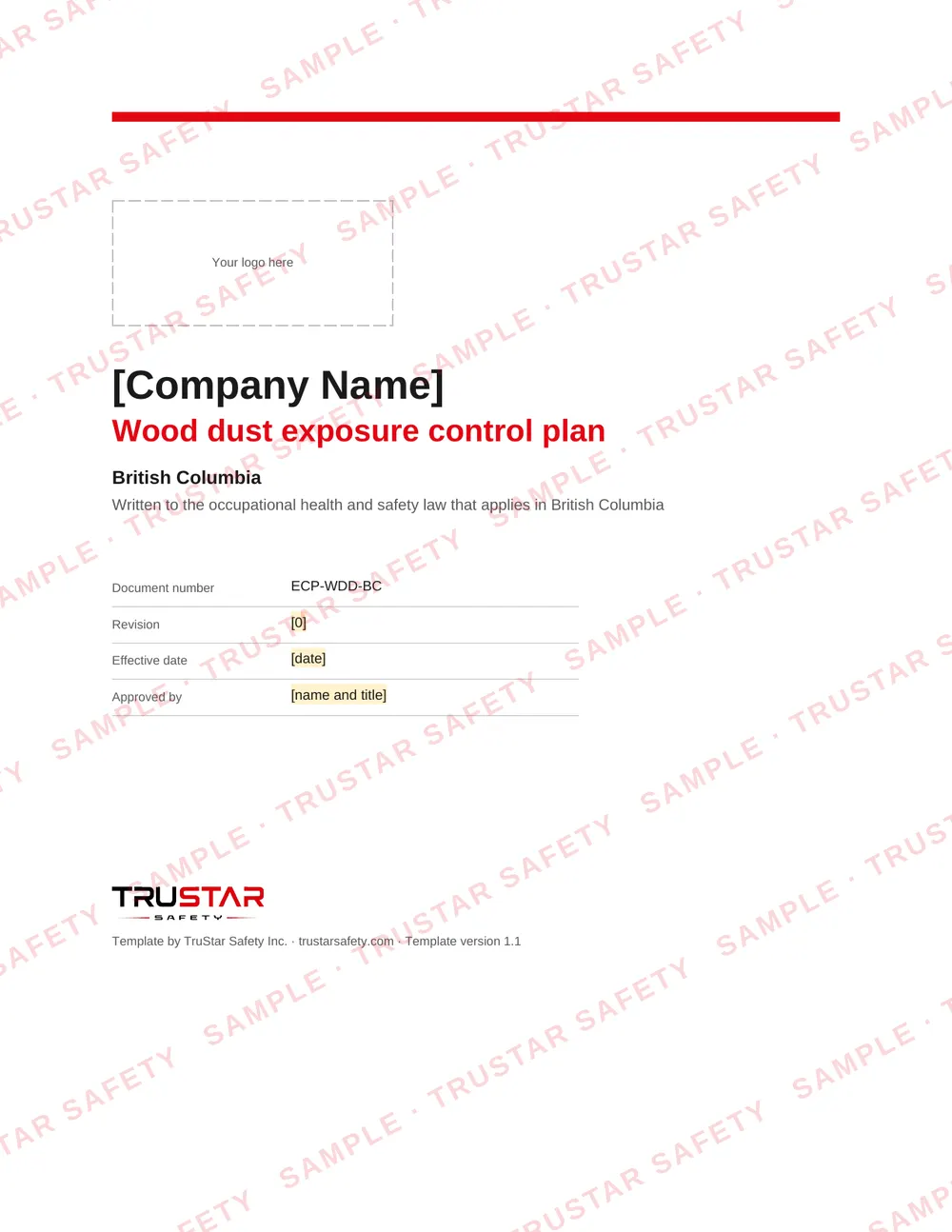
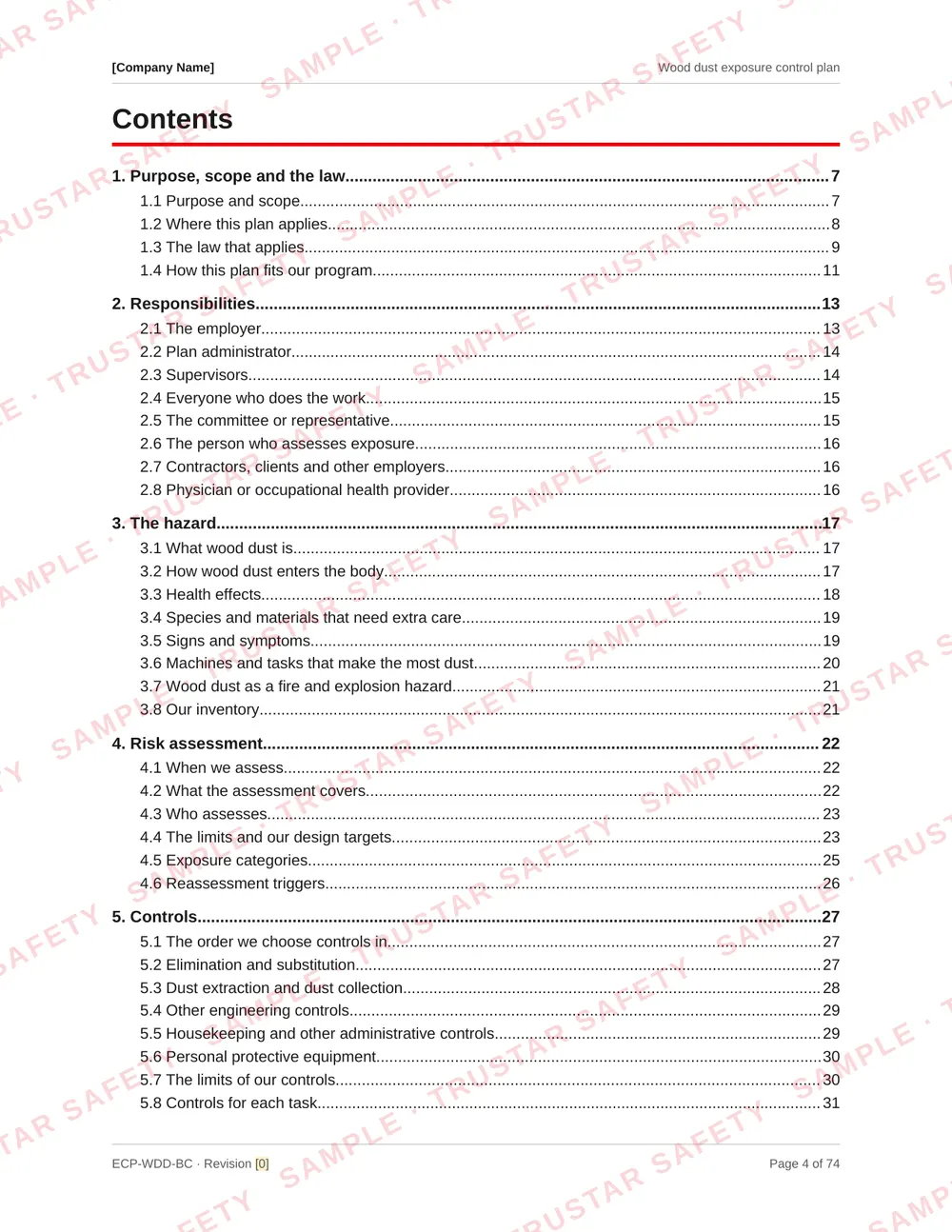
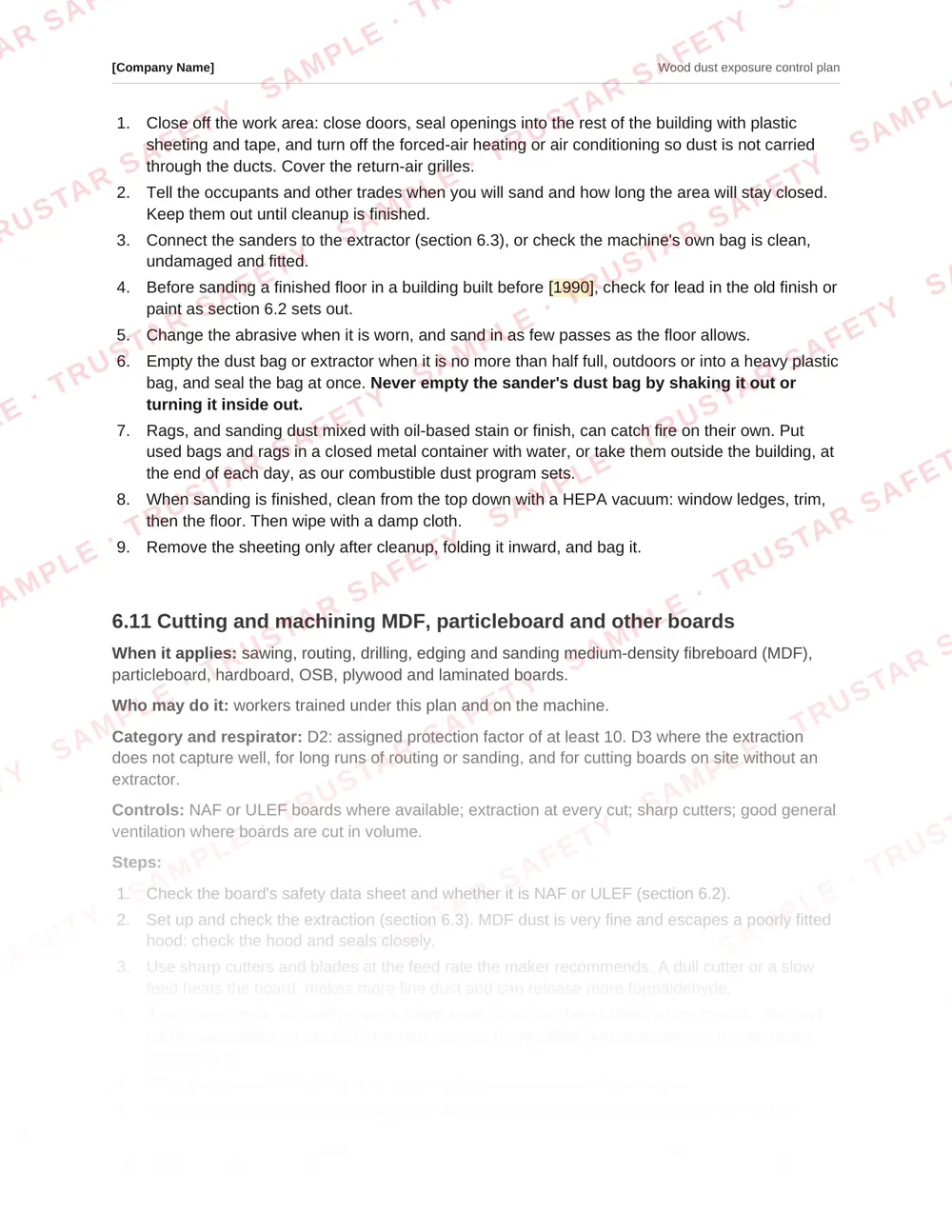
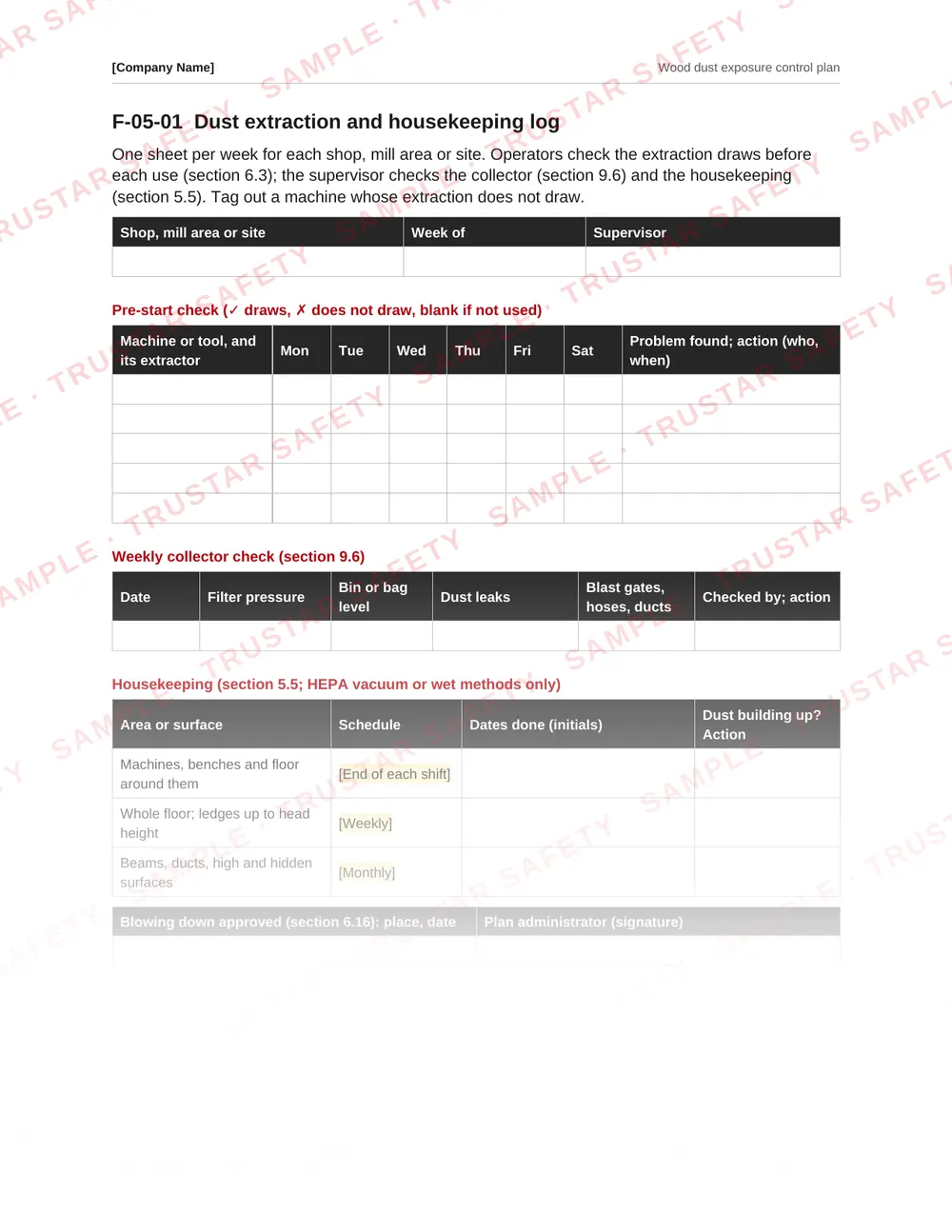
Sample pages from the plan, marked and cut short. Your copy has no watermark.
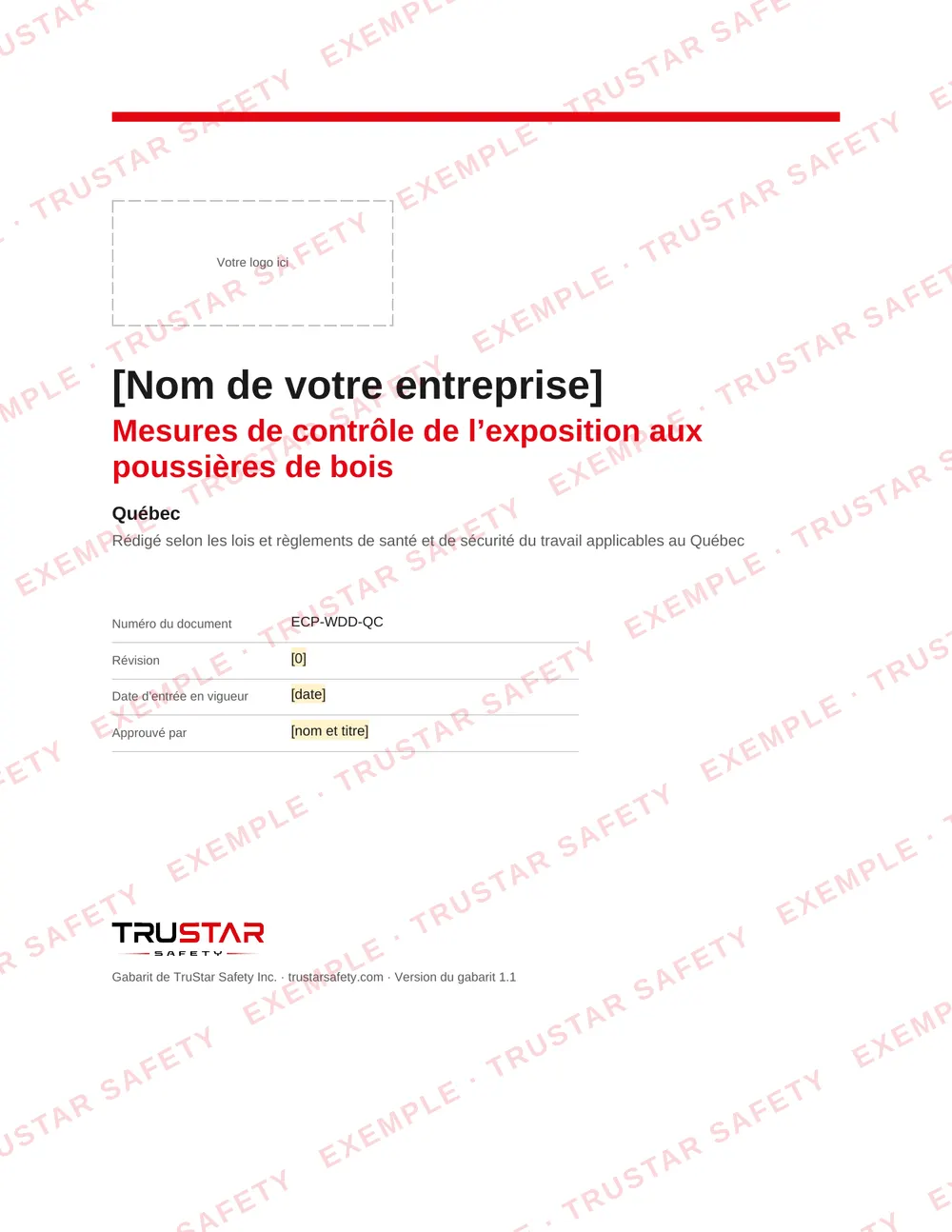
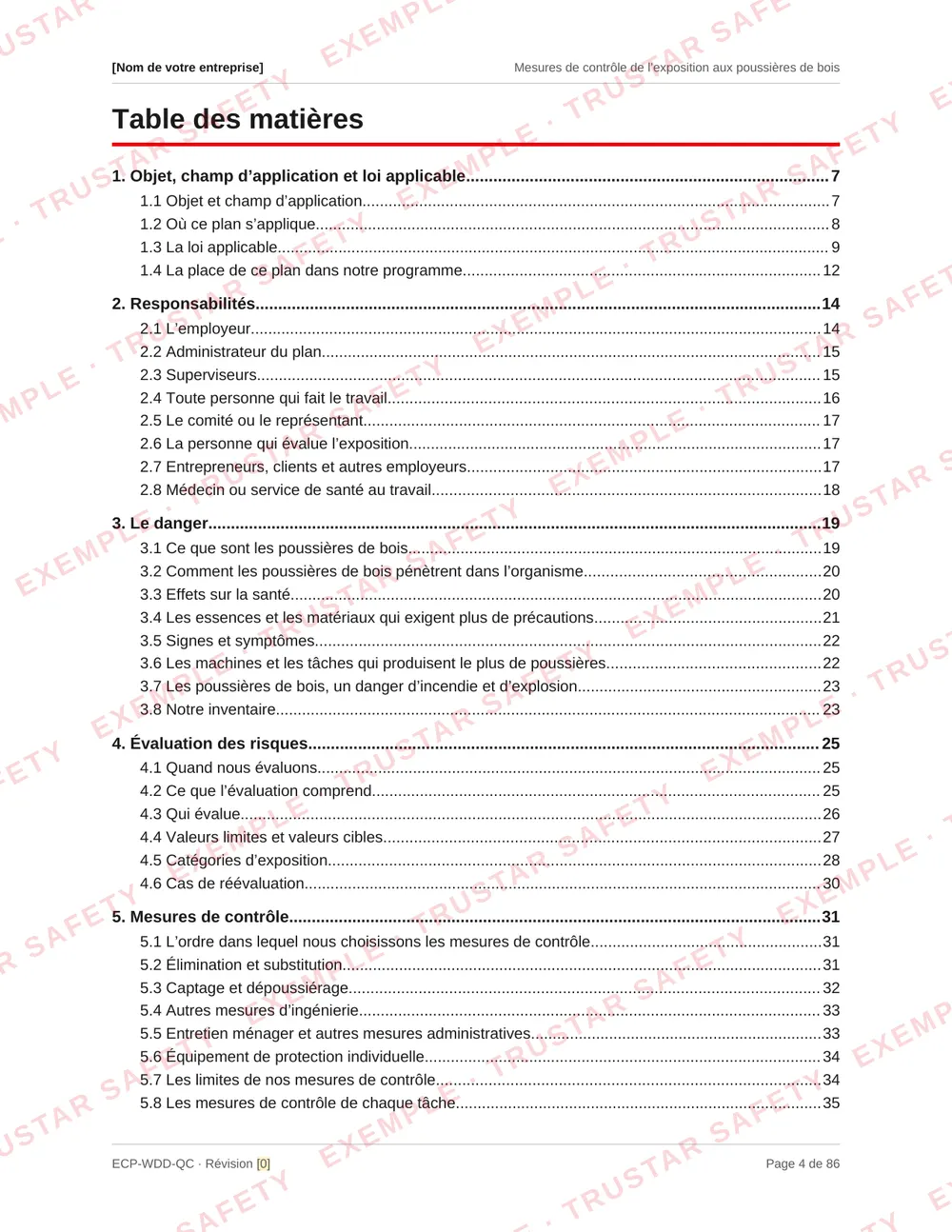
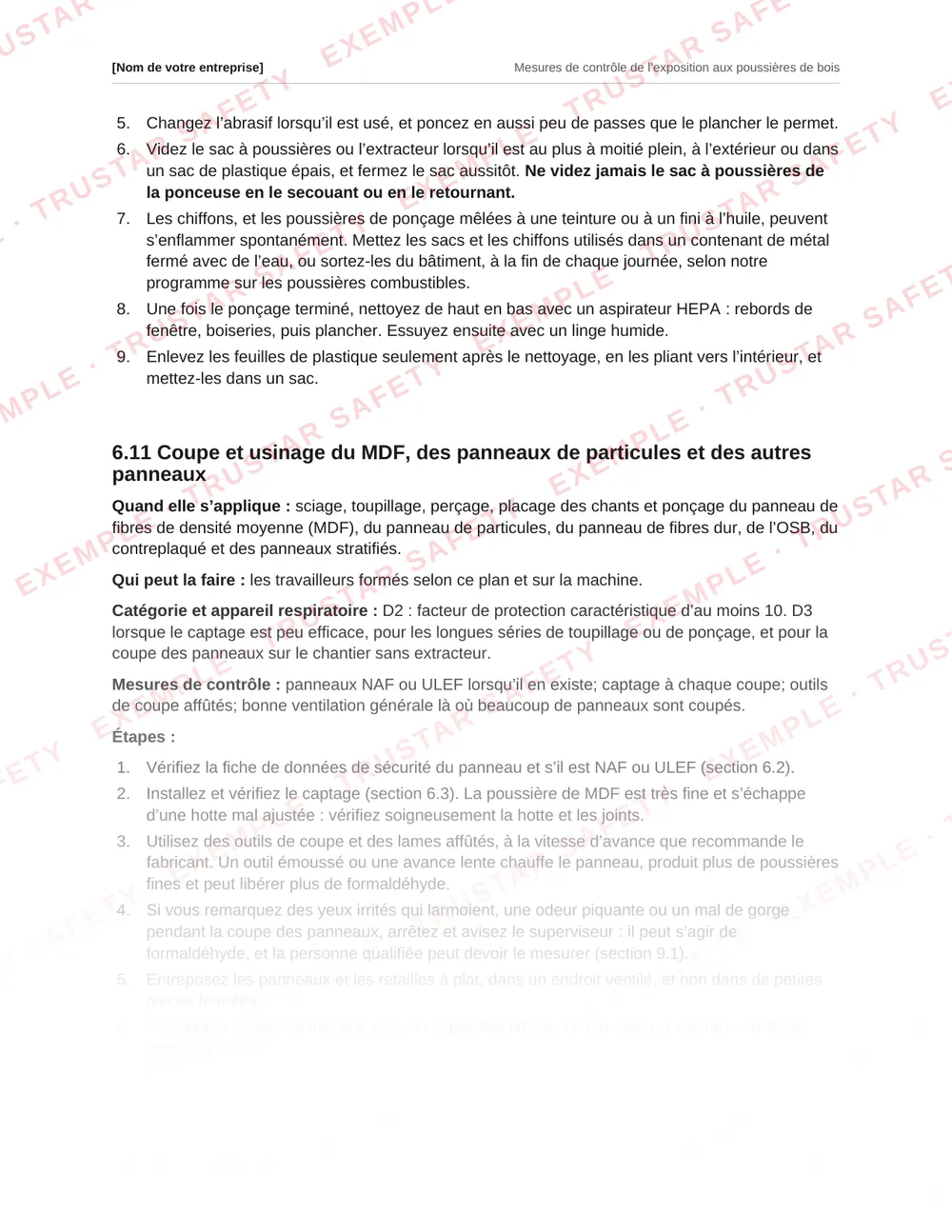
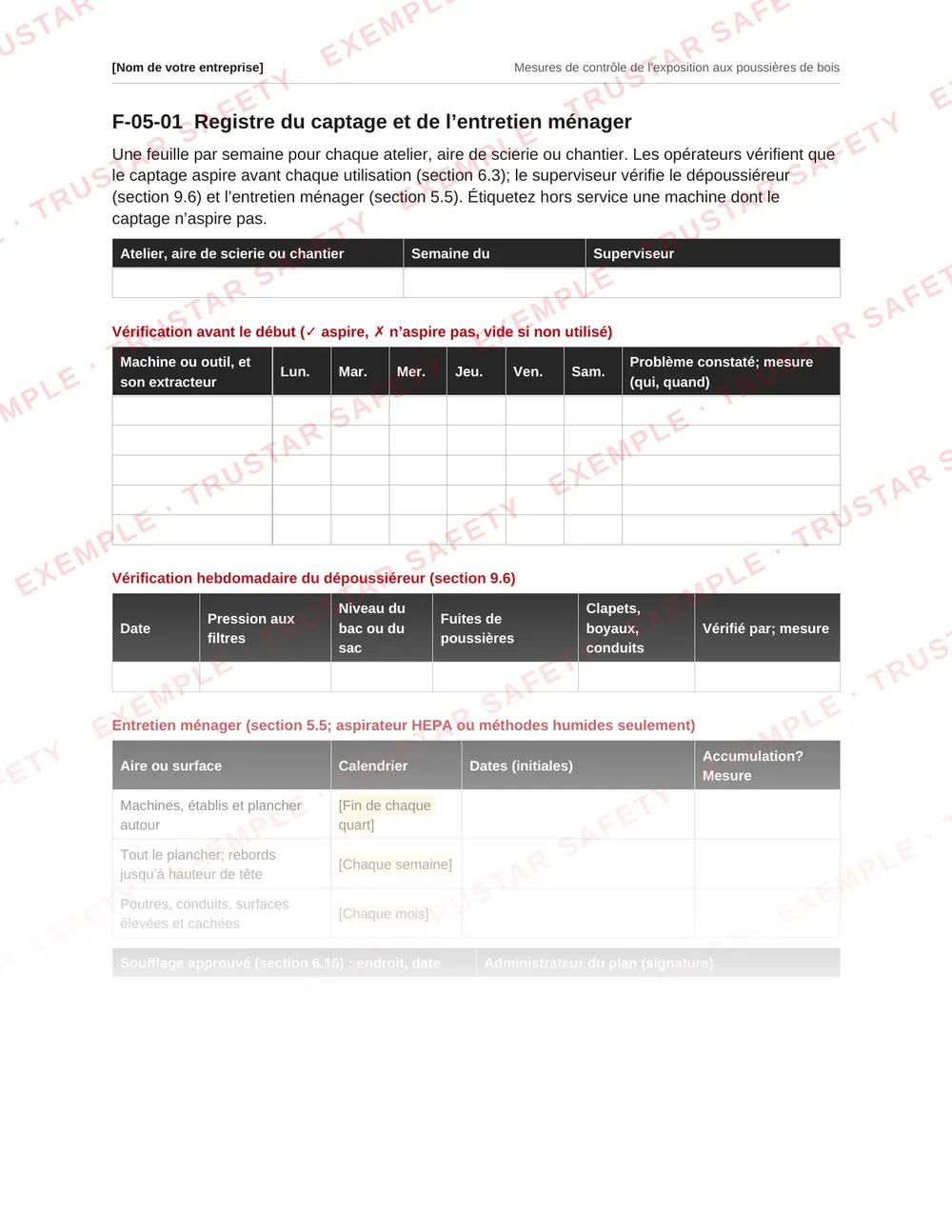
What’s in the plan
1. Purpose, scope and the law
The work the plan covers, the law that applies in your jurisdiction with pinpoint citations and a table of its limits for each kind of wood dust (section 1.3), and how the plan fits your program.
2. Responsibilities
The employer, the plan administrator, supervisors, everyone who does the work, the committee or representative, the person who assesses exposure, contractors and clients, and the physician or occupational health provider.
3. The hazard
What wood dust is, how it enters the body and what it does, the species and boards that need extra care, signs and symptoms, the machines and tasks that make the most dust, fire and explosion, and your inventory.
4. Risk assessment
How each task is assessed, the limits and our design targets, exposure categories that set the extraction, the respirator and the monitoring, and when you reassess.
5. Controls
Controls chosen in order, from less hazardous species and pre-cut stock to dust extraction on every machine, collectors, housekeeping without compressed air or dry sweeping, and PPE, what they cannot do, and a table of the controls for each task.
6. Safe work procedures
Rules for every task and 16 procedures: checking wood and boards, setting up extraction, table, panel and mitre saws, routers and CNC, planers and moulders, stationary and hand sanding, floor sanding, MDF and boards, western red cedar, construction sites, sawmills and pallets, emptying collectors, cleanup and maintenance.
7. Respiratory protection and PPE
When respirators are used and how they are chosen, fit testing and medical fitness, use and care, and eye and skin protection.
8. Hygiene facilities and decontamination
Hygiene rules, facilities, skin care, work clothing and laundry, and clean areas and vehicles.
9. Exposure monitoring
What is measured, who measures and how, when, working out and acting on the results, sharing them, and checking dust extraction and collectors.
10. Health monitoring
Where the law requires it, who is offered it, what it includes, results, and what is done about asthma, lasting nose problems and skin allergy.
11. Education and training
Who is trained and when, what the training covers, how it is given and checked, and training records.
12. Emergencies and exposure incidents
What counts as an exposure incident, what to do at once, first aid, collector fires and explosions, reporting and investigation, and follow-up.
13. Records, communication, consultation and review
The records you keep, sharing the plan, consulting your committee or representative, and reviewing the plan.
Appendix A. Regulatory cross-reference
Every provision of your jurisdiction’s law the plan is written to meet, in plain words, with the section that meets it and whether an inspector will also want your records. Each entry links to its section.
Appendix B. Forms
8 print-ready forms, each with a form code: the inventory of species, boards and machines, the task risk assessment, the dust extraction and housekeeping log, the exposure monitoring record, the health monitoring tracker, the training record, the exposure incident report and the plan review record.
One plan, 14 editions
Each plan is written once and fitted to the law of each of Canada’s 14 jurisdictions: the ten provinces, the three territories and federally regulated workplaces under the Canada Labour Code. Each edition takes the name its law gives the document, and its own limits, terms and citations.
Every purchase includes all 14, each in English and in French: 28 Word files. The French editions follow the English section for section and form for form, and their cross-reference matches row for row. Laws published only in English keep their English titles.
Written to the law where you work
Section 1.3 of each edition sets out the law that applies there, with pinpoint citations: what that law calls the plan, its limits for hardwood, softwood, western red cedar and other species, and what the law adds, such as rules for returning filtered air, sensitizer policies, showers or keeping exposure as low as possible. Appendix A lists every provision the plan is written to meet, in plain words, with the section that meets it and whether an inspector will also want to see your records. Each entry links to its section.
Every legal reference was checked against the official texts between September 30 and October 4, 2026, and each edition lists its sources and the date each was checked. A template can’t make you compliant on its own, and we don’t claim it does: the plan works once a qualified person adapts it to your work.
Who it is for
Employers whose workers cut, shape, sand or clean up wood and wood-based boards: cabinet, furniture and millwork shops, sawmills and planer mills, pallet makers, flooring installers, construction carpentry and finishing, and school woodworking shops.
You tick the tasks you do in section 1.2 and delete the procedures you never need. A Tailor note shows how to add a procedure for a task that isn’t there, under the same headings.
Lifetime updates
When the law changes, we publish a new edition and email everyone who bought the template. Every update is free, for as long as we publish it.
Version 1.1 October 4, 2026
- Federal: from January 30, 2027, the record of hazardous substances is kept 30 years after a substance was last used, produced, handled or stored, the full wording of the amended rule.
- Federal: from January 30, 2027, new ventilation may also be designed to Part 6 of the National Building Code, beside the ACGIH manuals and ANSI Z9.2.
- Federal edition in French: the coming amendments to the Canada Occupational Health and Safety Regulations (SOR/2026-10) now use their official French wording.
Version 1.0 October 5, 2026
- First edition, in 14 jurisdiction editions (one for each province and territory, and one for federally regulated workplaces), each in English and French.
- Every legal reference checked against the official texts between September 30 and October 4, 2026. Each edition lists its sources and the date each was checked.
More exposure control plans
Buy templates together and save on the whole order: 2 for 10% off, 3 for 15% off, 4+ for 20% off.
All provinces, territories and federal
Vibration exposure control plan template (hand-arm and whole-body)$119.95
Questions
Which edition do I use?
The one for the law that covers the workplace: the province or territory where the work is done, or the federal edition if your business is federally regulated under Part II of the Canada Labour Code (for example, interprovincial trucking, airlines, railways, banks and telecommunications). If you are not sure which law covers you, confirm it with your regulator before you rely on an edition. All 14 come with every purchase, in English and French, so you never pay twice for the right one.
Is this legal advice? Will it make us compliant?
No. It is a template, not legal advice: a complete plan written to the law with every requirement cited, as a starting point. The plan only works once a qualified person adapts it to your work (your tasks, your materials and the exposure your own assessment finds) and you put it in place and follow it, so no template can promise compliance. If you want help with that, our team does it too.
Does it cover my province’s own rules?
Yes. Section 1.3 of each edition sets out the law that applies there, with pinpoint citations: what that law calls this document, the exposure limit, and what the law adds to the plan, such as monitoring, health checks, notices, records or training. Where the law changes something in the plan’s general text, section 1.3 says what and where. Appendix A then lists every provision the plan is written to meet, with the section of the plan that meets it.
What if we work in more than one province?
Use the edition for each place you work: every purchase includes all 14. Each edition is complete on its own, and they share the same sections and form codes, so crews moving between provinces work to the same plan and only what the law changes is different.
What format is it in, and can I edit it?
Editable Microsoft Word (.docx) files on US Letter pages: 28 of them, one for each of the 14 jurisdictions in English and in French. Type your company name once and desktop Word puts it on the cover, in every header and through the text. Shaded “Tailor” notes say what to check or change in each section, and highlighted placeholders mark every name, date and place you fill in. The files also open in Google Docs and Word on the web, where you use Find and replace to put your company name in.
What happens when the law changes?
We update the plan, and you get every update free for as long as we publish it: lifetime updates at no extra charge, for all 14 editions in both languages. We email you when a new edition is ready, with what changed and a link to download it.
Can I use it for more than one company?
Each purchase is licensed to one company. Consultants setting up programs for several clients should contact us.
Want it built for you?
Our safety advisors assess the hazards in your work and help you tailor the plan to it, from the risk assessment to the procedures your crews follow and the controls behind them.
Hazard assessments and control