












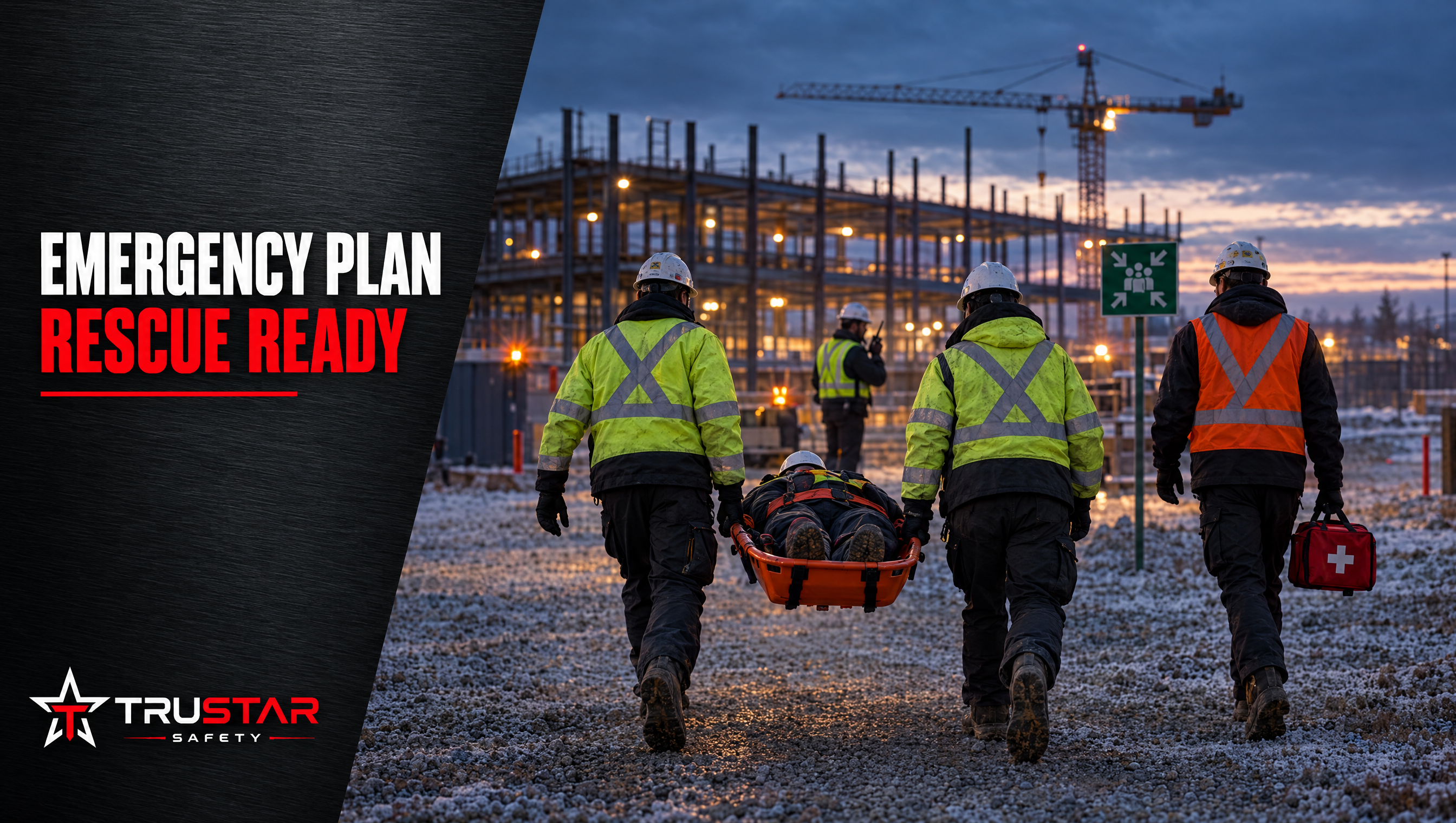
Every Alberta employer needs a written emergency response plan for any emergency that could require rescuing or evacuating workers. Under Part 7 of the OHS Code (sections 115 to 118), that plan has to be built from your hazard assessment, cover ten minimum elements, name the workers who will lead rescue and evacuation, and be practised with drills.
That sounds simple until winter shows up. Daylight is short, roads get slower, and a site that is fifteen minutes from an ambulance in August can be forty-five minutes away in January. This guide walks through what the Code actually requires, when calling 911 is enough and when it is not, how to build a site-specific emergency plan, and a one-page checklist you can use before your next pre-job meeting.
What OHS Code Part 7 requires for an emergency response plan in Alberta
Part 7 of the Alberta OHS Code is short, just four sections, but every one of them carries weight in an inspection or a COR audit.
Section 115: the plan itself
Section 115 requires an employer to establish an emergency response plan for responding to an emergency that may require rescue or evacuation. It also requires the employer to involve affected workers in establishing the plan and to keep the plan current.
Section 8 of the OHS Regulation adds that where the Code requires a plan, it must be in writing and available to workers. Alberta's Part 7 Explanation Guide makes two more points worth remembering:
- The plan must address the emergencies identified in your Part 2 hazard assessment.
- The plan establishes what the employer must do until emergency services personnel arrive.
Section 116: the ten required contents
Section 116 sets out the minimum contents. An emergency response plan must include:
- The identification of potential emergencies.
- Procedures for dealing with the identified emergencies.
- The identification of, location of and operational procedures for emergency equipment and personal protective equipment.
- The emergency response training requirements.
- The location and use of emergency facilities.
- The fire protection requirements.
- The alarm and emergency communication requirements.
- The first aid services required.
- Procedures for rescue and evacuation.
- The designated rescue and evacuation workers.
The Explanation Guide is clear that these are minimums and that the plan must be site specific. A tilt-up job with a tower crane and an excavation needs more than an office does.
Section 117: designated workers, training and drills
Section 117 requires the employer to designate the workers who will provide rescue services and supervise evacuation, and to train them in emergency response appropriate to the work site and the emergencies in the plan. That training must include exercises that simulate the potential emergencies, and those exercises must be repeated often enough to keep the designated workers competent.
In other words, emergency drills are not optional extras. They are part of the legal training requirement.
Section 118: equipment for responders
Section 118 requires the employer to provide designated rescue and evacuation workers with equipment and PPE appropriate to the work site and the emergencies in the plan. Workers who respond to an emergency must wear and use it.
When 911 is enough, and when it isn't
This is the question we hear most from small contractors. The honest answer from Alberta's Explanation Guide: sometimes 911 is a legitimate part of the plan, but it never replaces the plan.
Where 911 can work
The Explanation Guide says that providing first aid and calling 911 may be the complete emergency response for some employers, mostly in urban areas where response times meet the intent of the requirement. Even then, you still have to identify potential emergencies, write the procedures (including when to call 911), cover fire protection and name who supervises evacuation. You also still need the first aid services and equipment required by Part 11 of the Code.
Fall arrest rescue and confined space rescue
For two situations, the Explanation Guide says calling 911 alone and waiting is an insufficient emergency response:
- Workers suspended after a fall. Where a fall protection plan is required, section 140 requires that plan to include the procedures used to rescue a worker who has fallen and is suspended in a personal fall arrest system. You need on-site rescue capability: the equipment, the method and trained people on shift.
- Confined and restricted spaces. Section 55 of Part 5 says a worker must not enter or remain in a confined or restricted space unless an effective rescue can be carried out. Your emergency procedures must be in place before anyone goes in.
The Guide also notes that in some cases rescue services may not have the equipment or skills to reach the worker at all, such as deep underground or high on a suspended platform. Then the site has to be close to self-sufficient in getting the worker back to ground level.
Remote sites and winter conditions
Part 11 also requires the prime contractor, or the employer if there is no prime contractor, to develop and implement an emergency transportation plan under section 180 before workers are sent to site. For rural and remote Alberta work, that plan and your ERP should be written together, with winter road conditions, darkness and cell coverage in mind.
How to build a site-specific emergency plan from your hazard assessment
A good site-specific emergency plan is not a template with the company name swapped in. Here is the process we use with clients.
- Start with the hazard assessment. Pull every hazard that could lead to a rescue or evacuation: falls from height, trench collapse, confined space entry, fire and hot work, chemical or gas release, mobile equipment incidents, severe weather, medical emergencies.
- Involve the crew. Section 115 requires affected workers to be involved. Walk the site with a foreman and a couple of experienced workers. They know where the access gets blocked and where there is no signal.
- Write a procedure for each emergency. Who raises the alarm, who calls for help, who goes to the gate to meet responders, who does the headcount, and where the muster point is.
- Map the equipment and facilities. Fire extinguishers, first aid kits and rooms, rescue kits, spill kits, AEDs, eyewash stations. Mark them on a site plan.
- Name the people. List designated rescue and evacuation workers and first aiders by shift, with backups for days off and rotations.
- Sort out communication. Radios, cell coverage, a satellite device for remote work, the site's legal land description or civic address, and directions for responders.
- Plan the rescues that 911 can't do. Fall arrest rescue method and kit, confined space rescue team or contracted service, and how long each takes.
- Train, drill and review. Train the designated workers, run the drill, write down what went wrong and fix it.
ERP template for construction: what to keep on one page
An ERP template for construction works best as a short front page posted at the site trailer and muster point, backed by the detailed procedures. The front page should carry the site address and directions, emergency numbers, muster point, designated workers and first aiders, the location of emergency equipment, and the nearest health care facility.
Emergency drills and records
Drills are where most plans fail quietly. The plan looks fine on paper, then the first drill shows the muster point is behind the equipment laydown, or nobody knows where the rescue kit is.
How often to drill
The Code does not set a fixed interval. Section 117 says exercises must be repeated at the intervals needed to keep designated workers competent. Base the frequency on the risk, crew turnover and how long a project runs, and drill again when the site layout or crew changes significantly.
What auditors look for
If you hold or are working toward COR through the Alberta Construction Safety Association, Element 8 (Emergency Response) of the 2023 ACSA Audit Instrument checks, among other things:
- Whether the ERP identifies the potential emergency scenarios for your operations.
- Whether it includes the ten legislated areas.
- Whether workers know and are trained in their emergency responsibilities.
- Whether you have a process to evaluate the plan, including testing at least annually and a way to identify and correct deficiencies.
- Whether that testing actually happens and deficiencies get corrected.
- Whether first aid training, equipment and supplies meet the legislation.
Keep a record of every drill: the date, the scenario, who took part, how long it took, what went wrong and the corrective actions with owners and due dates.
One-page emergency response plan checklist
Use this before a new project starts and again at each seasonal change.
- [ ] Hazard assessment reviewed and every rescue or evacuation scenario listed
- [ ] Affected workers involved in writing or reviewing the plan
- [ ] A written procedure for each identified emergency
- [ ] Emergency equipment and PPE identified, located and inspected
- [ ] Emergency facilities (first aid room, eyewash, shelter) located and signed
- [ ] Fire protection requirements covered
- [ ] Alarm and communication methods tested, including dead zones
- [ ] First aid services meet Part 11, with first aiders on every shift
- [ ] Emergency transportation plan in place for the site (Part 11, s.180)
- [ ] Rescue and evacuation procedures, including fall arrest and confined space rescue where they apply
- [ ] Designated rescue and evacuation workers named, trained and equipped
- [ ] Drill scheduled, run and recorded, with corrective actions tracked
- [ ] Plan posted, available to workers and reviewed when conditions change
Frequently asked questions
Is an emergency response plan mandatory in Alberta?
Yes. Section 115 of the OHS Code requires an employer to establish an emergency response plan for emergencies that may require rescue or evacuation, and section 8 of the OHS Regulation requires it to be in writing and available to workers.
Does every work site need its own emergency response plan?
The Explanation Guide says the plan must be site specific. A company-wide plan is a good base, but each site needs its own address, access, muster point, equipment locations, people and site-specific hazards.
Can I just call 911 for a fall arrest rescue?
No. Alberta's Explanation Guide says calling 911 alone and waiting is insufficient for a worker suspended after a fall or a worker in a confined space. You need an on-site rescue capability.
How often should we run emergency drills?
The Code requires drills to be repeated at intervals that keep designated workers competent. For COR, the ACSA audit instrument looks for a process that tests the ERP at least annually.
Who has to be trained under Part 7?
Workers designated to provide rescue services and supervise evacuation must be trained for the site and its potential emergencies, including simulated exercises. All affected workers should know the plan and their role in it.
How TruStar can help
TruStar Safety writes and reviews site-specific emergency response plans for Alberta contractors, builds fall arrest and confined space rescue plans, and runs drills with your crew so the plan works on a cold morning, not just in the binder. If a COR or maintenance audit is coming up, we can check your Element 8 evidence before the auditor does. Talk to us about your ERP.
TruStar Connect keeps the pieces the plan depends on in one place: field hazard assessments that feed your emergency scenarios, and the Training Matrix that shows who is trained for what, so drill records and responder training are easy to find when you need them. Start a free trial.