












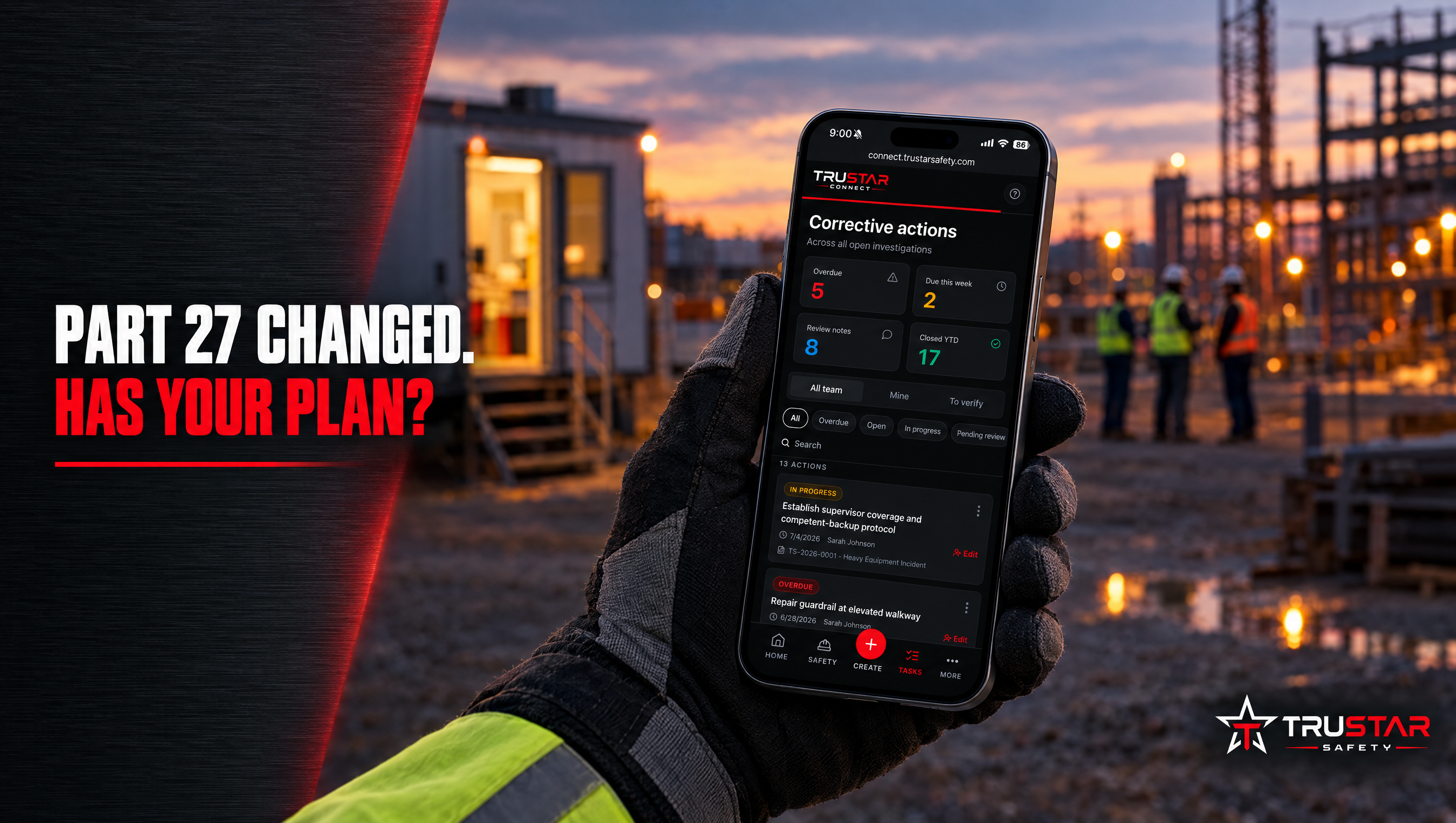
Every Alberta employer needs a written violence and harassment prevention plan under Part 27 of the OHS Code, and since the December 2024 amendments that means one consolidated plan built around section 390. If your harassment policy was written years ago and has not been opened since, it is almost certainly out of step with the current Code and due for a review.
Below: who needs a plan, what it must contain, what changed in 2024, how to investigate a complaint, and the training required. October is Canada's Healthy Workplace Month, a good time to put the plan back on the table.
Who needs a violence and harassment prevention plan in Alberta?
Every employer covered by Alberta's OHS legislation. Violence and harassment are defined in the Occupational Health and Safety Act, and the Act sets out general duties for employers, supervisors and workers to prevent them. Part 27 of the OHS Code then sets the technical requirements, including developing and implementing a violence and harassment prevention plan. The Government of Alberta summarizes this on its workplace violence and harassment page.
There is no small-business exemption: a five-person framing crew needs a plan as much as a large industrial contractor. Size changes the detail, not the obligation.
Two definitions are worth rereading with your supervisors:
- Violence covers threatened, attempted or actual conduct that could cause physical or psychological injury, and the definition includes domestic and sexual violence.
- Harassment covers a single incident or repeated incidents of objectionable or unwelcome conduct, comments, bullying or actions that a person knows or ought reasonably to know will cause offence or humiliation to a worker, or that adversely affect a worker's health and safety. Reasonable conduct by an employer or supervisor in managing workers is not harassment.
Read the exact wording in the Act before you rewrite your plan. Threats, intimidation and domestic violence that follows a worker to the site are all in scope.
Retail fuelling outlets and convenience stores have extra requirements in Part 27 (section 392.2 and nearby sections cover things like cash handling, visibility, video surveillance and emergency transmitters for workers alone). If that is you, those controls belong in your plan too.
What changed in Part 27 of the OHS Code in December 2024
The amendments came in through Ministerial Order 2024-12, published December 4, 2024. Ministerial Order 2024-16 gave employers a transition period to March 31, 2025, when they could follow either the old or the new wording. That transition is over: every Alberta employer must now meet the amended Code.
Alberta's bulletin LH009, 2024 Change highlights: Violence and harassment, Part 27 sets out the changes. The ones that matter most for a small or mid-sized contractor:
One consolidated plan instead of two
The old Code required a separate violence prevention plan and a harassment prevention plan, each with its own policy and procedures. Those separate requirements (the former sections 390, 390.1, 390.2 and 390.4 to 390.6) were repealed and replaced with a single violence and harassment prevention plan under section 390.
Separate policy statements are gone
The old requirements for stand-alone violence and harassment policies were repealed. The policy elements that are still needed now live inside the plan. If your manual has a two-page harassment policy and a separate violence policy, merge them into one plan that meets section 390.
Section 389 was repealed, but the hazard assessment duty was not
Section 389 used to state that violence and harassment are hazards for the purposes of Part 2. It was repealed because it duplicated Part 2. Alberta's bulletin is clear that violence and harassment are still hazards and must still be addressed under Part 2, like every other work site hazard. Keep them on your formal hazard assessments and, where they are a real risk on a given job, on your field level hazard assessments.
New review triggers in section 390.7
The plan must now be reviewed:
- when an incident of violence or harassment indicates a review is required (no longer after every single incident);
- when there is a change to the work or work site that could affect the potential for violence or harassment;
- when the joint health and safety committee or health and safety representative requests a review;
- in any other circumstance listed in section 390.7.
The review involves the joint health and safety committee or health and safety representative, or affected workers as far as reasonably practicable where there is neither. The employer must revise the plan as needed after a review.
Training every time the plan changes
Workers must be trained in the plan, and that now explicitly includes when revisions are made. A plan update is not finished until the crew has been trained on it.
What your violence and harassment prevention plan must contain
Section 390(1) of the OHS Code, Part 27 lists what the plan must include. Alberta's bulletin LI045, Violence and harassment in the workplace walks through it, and the government publishes a Word violence and harassment prevention plan template (TMP005) you can customize. Use this as a working checklist against the legislation:
- Hazard controls. Measures to eliminate violence and harassment hazards or, where that is not reasonably practicable, control them, consistent with Part 2 hazard assessment and control.
- Informing workers. Procedures to tell workers the nature and extent of violence and harassment hazards, including specific or general threats (for example, a known threat from a former partner or an aggressive member of the public at a site).
- Getting help. How a worker gets immediate assistance when violence or harassment happens.
- Reporting. How workers report incidents, including the procedures for reporting to OHS where section 33(1) of the OHS Act requires it.
- Complaints and investigations. Your internal complaint resolution process and how incidents are investigated.
- Confidentiality. Provisions protecting the confidentiality of everyone involved in a complaint or incident, except where disclosure is required by law or necessary to investigate.
- Corrective action. How the employer takes corrective action after an incident or complaint.
Check the full wording of section 390(1) and the template for every required element, and make the plan readily available to workers. A plan in a binder at head office that nobody on the job site has seen does not do the job.
Make it fit the work you actually do
A generic template is a starting point. Tailor it to your real exposures:
- crews working alone or in isolated areas (tie it to your Part 28 working alone procedures);
- work in occupied homes, businesses or public spaces where workers deal with clients or the public;
- camps, shared accommodation and travel;
- night shifts and cash handling;
- supervisors who are also owners, where a worker needs someone else to take a complaint to.
How to handle a workplace harassment complaint and investigation
The amended Code makes the employer's duty to investigate explicit, and the procedures belong in your plan. The steps below are good practice for small and mid-sized employers; your written procedures and the legislation govern.
1. Receive the complaint properly
Take every complaint seriously, however it arrives. Record what was reported, when and by whom, and explain what happens next and how confidentiality works.
2. Make the site safe first
If there is an ongoing risk, act now: separate the people involved, change schedules or crews, or bring in help. Where the incident involves violence that meets section 33 reporting criteria, report it as the Act requires.
3. Pick an investigator who is not involved
The investigator should be impartial and competent. In a small company the owner or supervisor may be involved or close to the people involved; that is when an external investigator makes sense.
4. Gather the facts
Interview the complainant, the respondent and witnesses separately. Collect texts, emails, photos, schedules and any site records. Give the respondent a fair chance to answer the allegations.
5. Decide and act
Decide on the facts whether the conduct happened and meets the Act's definition. Take fitting corrective action (coaching, discipline, changed work arrangements or site controls) and tell the parties the outcome while respecting confidentiality.
6. Close the loop
Check whether the incident indicates your plan needs a review under section 390.7. Keep records secure and limited to people who need them. Follow up with the complainant to confirm the behaviour has stopped and that there has been no retaliation.
Violence and harassment training under Part 27
Part 27 requires workers to be trained in the plan and in the appropriate response to violence and harassment, among other things. Read the training section of Part 27 for the full list. In practice, a good program includes:
- Orientation. Every new worker learns what the plan says, how to report and who to go to, before they start work.
- Supervisor training. Supervisors learn to recognize harassment, respond to a report, protect confidentiality and avoid retaliation. They are usually the first person a worker tells.
- Refreshers after changes. When the plan is revised, retrain the affected workers and record it.
Keep training records with names, dates and content. They are your evidence in a COR or SECOR audit or an OHS inspection, and an old manual still citing repealed sections is an easy audit finding to avoid.
Frequently asked questions
Do small businesses in Alberta need a violence and harassment prevention plan?
Yes. Part 27 of the OHS Code applies to employers regardless of size. A small contractor's plan can be short and practical, but it must cover the elements in section 390(1) and workers must be trained on it.
Is my old harassment policy still valid after the 2024 Part 27 changes?
Probably not as written. The separate policy requirements were repealed and replaced by one consolidated plan under section 390. The transition period ended March 31, 2025, so review and update the policy against the current Code.
How often do I have to review my violence and harassment prevention plan?
Section 390.7 sets the review triggers: when an incident indicates a review is needed, when changes to the work or site could affect the risk, when your joint health and safety committee or representative asks, and the other circumstances listed in that section. Retrain workers whenever the plan is revised.
Are violence and harassment still hazards under Part 2 of the OHS Code?
Yes. Section 389 was repealed because it was redundant, but Alberta's guidance confirms violence and harassment remain workplace hazards that must be addressed through Part 2 hazard assessment and control.
Who should investigate a harassment complaint in a small company?
Someone impartial and competent. If the owner or a supervisor is involved or too close to the people involved, bring in an external investigator so the process is fair and defensible.
How TruStar can help
TruStar Safety helps Alberta contractors bring their programs in line with the current Code without drowning them in paperwork:
- Plan review and rewrite. We review your existing violence and harassment policies against Part 27 and build one consolidated, site-specific plan that meets section 390.
- Investigation support. When a complaint comes in, we help you set up a fair, confidential process and see the investigation through.
- Supervisor and worker training. Practical sessions on recognizing, reporting and responding to violence and harassment, with records that stand up in an audit.
- COR and SECOR readiness. We make sure this element, and the rest of your program, is ready for audit.
For the day-to-day record keeping, TruStar Connect tracks training records and the corrective actions that come out of a plan review, so you can show what was fixed and when. Keep complaint details themselves restricted to the people who need them.
Contact TruStar Safety to book a Part 27 plan review, or start a free trial of TruStar Connect.
This article is general information, not legal advice. Always check the current OHS Act, Regulation and Code.