












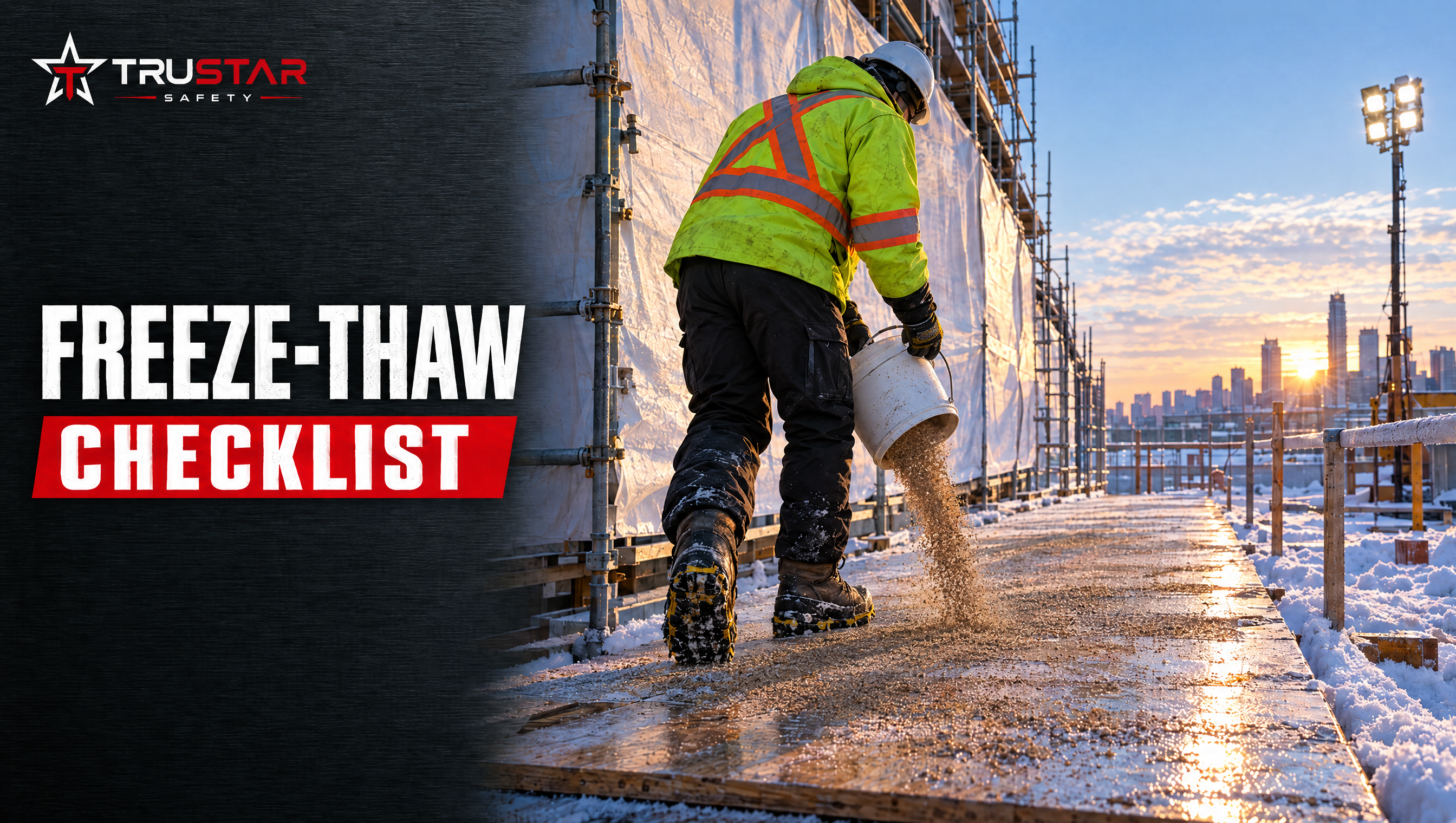
Winter construction safety in Alberta starts before the first hard freeze: review your hazard assessment now, because the fall-to-winter swing changes site conditions every day. Frost at 7 a.m., melt by noon and refreeze by the afternoon coffee break create hazards that a July assessment never had to deal with.
This guide walks through the freeze-thaw hazards Alberta crews run into from October to December, the control for each one, the part of the Occupational Health and Safety (OHS) Code behind it, and a pre-winter checklist you can take to your next safety meeting.
Why the shoulder season is riskier than deep winter
In January, everyone expects cold. Crews dress for it, equipment is winterized and supervisors plan around it. The shoulder season is different. Conditions change from one day to the next, and sometimes from one hour to the next:
- A walkway that was dry at lunch is glare ice at 4 p.m.
- Spoil piles freeze on the surface and stay soft underneath.
- The first snowfall hides openings, skylights and trip hazards that everyone knew about last week.
- Heaters come out of storage and go into enclosed spaces for the first time since spring.
- Shift starts and ends move into the dark.
Alberta's own guidance says this plainly. The government's Working in winter bulletin (GS014) notes that Alberta OHS law does not specifically address cold-weather work, but employers still have to protect workers under their general duty in section 3(1) of the OHS Act. The bulletin tells employers to review their hazard assessment before winter arrives.
What the Code expects from your winter hazard assessment
Under OHS Code section 7, an employer must assess a work site and identify existing and potential hazards before work begins, and repeat the assessment when work processes or operations change. Winter changes both. A winter hazard assessment should name each seasonal hazard, the control for it (following the order in section 9: eliminate, then engineering, then administrative, then PPE), and who checks it and when.
Workers have to be part of it. Section 8 requires worker participation in the hazard assessment, and the crew is usually first to notice where frost lingers.
Freeze-thaw hazards and their controls
1. Slips on frost and refrozen melt
Slips and falls on the same level are the most familiar winter hazard, and freeze-thaw makes them unpredictable. GS014 points out that frost lingers in shaded areas long after sunny areas have cleared, so the north side of a building or the shadow of a sea can may stay slick all morning.
Controls:
- Keep walkways, stairs, ramps and loading docks clear of ice and snow (section 121 covers walkways, runways and ramps).
- Plan drainage so melt does not run across walkways and refreeze.
- Stage sand or ice melt at every access point, not in one shed.
- Check again mid-afternoon, when melt starts to refreeze.
- Footwear with winter traction and ice cleats where the surface calls for them.
- Inspect ladder feet and roofing brackets for ice before use, as GS014 recommends.
2. Excavations and frozen ground
Frozen ground feels solid, and that is the problem. A frozen crust can hold a vertical face for a while, then fail as it thaws in the afternoon sun or around a heater.
OHS Code section 443(3) is clear: a person must not use natural freezing of the soil as an alternative or partial alternative to a temporary protective structure, or to stabilize the soil in an excavation. The Part 32 explanation guide explains which artificial stabilization methods are acceptable instead.
Controls:
- Shore, slope or bench as the soil type requires, whether the ground is frozen or not.
- Treat thaw as a change in conditions: re-inspect walls and spoil after a warm spell or after ground heaters come off.
- Watch frozen spoil piles. Chunks can roll back into the trench, and a frozen crust can hide soft material underneath.
- Keep ground-thawing equipment and its exhaust in the hazard assessment, not just the excavation.
3. Hoarded scaffolds and wind
Hoarding keeps the crew and the concrete warm, but it turns a scaffold into a sail. Under OHS Code section 324(1)(c), a hoarded scaffold needs one tie-in for each 3 metre vertical interval and one for each 3 metre horizontal interval, much tighter than the spacing for an unhoarded scaffold. The Part 23 explanation guide explains why: hoarding increases the wind load, so the number of tie-ins must increase too.
Controls:
- Add tie-ins before the tarps go up, not after.
- Have the scaffold re-inspected and the tag updated once it is hoarded.
- Check platforms and planks for ice and snow at the start of each shift.
- Set a wind limit for work on hoarded scaffolds and put it in the hazard assessment.
4. Snow-hidden roof openings and snow load
GS014 warns that snow can hide skylights and other openings. A roof that everyone walked safely in October can have a snow-covered opening in November.
Controls:
- Mark and secure covers over every opening before snow is forecast, so they stay visible and fixed in place.
- Fall protection where workers could fall 3 metres or more, as required by section 139, and a fall protection plan that covers snow clearing on the roof.
- Plan snow removal from roofs, temporary structures and stored materials. GS014 flags snow load as a hazard in its own right.
5. Ground under cranes, lifts and outriggers
Frozen ground can carry a crane or an elevating work platform in the morning and soften under it by afternoon. Frost heave and thaw also move the cribbing and mats you set last week.
Controls:
- Follow the manufacturer's specifications for setup and operating limits, including temperature (section 12).
- Check outrigger setup and ground support every shift. The Code addresses this in section 90 and section 92.2.
- Tower cranes have their own wind and temperature limitations under section 106.
- Re-check the ground after any thaw, and after heaters have run near footings.
6. Heaters and carbon monoxide
Fuel-fired heaters in hoarding, trailers and enclosed work areas are one of the biggest carbon monoxide hazards of the season. CO has no colour or smell, and early symptoms such as headache and drowsiness are easy to blame on a long cold day.
Controls:
- Use heaters as the manufacturer specifies, including ventilation and clearances.
- Test CO detectors before the season, as GS014 recommends, and put them where people work and rest.
- Keep fuel storage and refuelling out of enclosed areas.
- Name who checks heaters and ventilation each shift.
7. Dark shift starts and ends
Shorter days put the start and end of many shifts in the dark, when frost is at its worst and fatigue is setting in. Lighting that was fine in September may not reach the laydown yard, the parking area or the excavation edge in November.
Controls:
- Walk the site in the dark once as the days shorten and note where the light falls short.
- Add temporary lighting at access points, stairs, excavation edges and equipment travel routes.
- High-visibility clothing that works in the dark, not just in daylight.
- Review traffic control and spotters for equipment moving at shift change.
8. Cold stress
Cold stress builds slowly: numb fingers, shivering, then clumsiness and poor judgement. Wet clothing and wind make it worse at temperatures that do not feel extreme.
GS014 recommends a work and warm-up schedule and the buddy system so workers watch each other for early signs of cold stress.
Controls:
- A heated shelter close to the work, with time built into the schedule to use it.
- Layered clothing, spare dry gloves and liners, and warm drinks.
- Watch new and returning workers closely while they get used to the cold.
- Train the crew to recognize frostbite and hypothermia and what to do about them.
Pre-winter checklist for Alberta construction sites
Print this, take it to your next safety meeting, and assign a name and a date to each line.
Hazard assessment and planning
- Winter hazard assessment reviewed and updated, with workers involved.
- Daily freeze-thaw check assigned: who, when (start of shift and mid-afternoon) and where it is recorded.
- Wind, temperature and cold stress limits set for outdoor work, hoarded scaffolds and lifts.
- Work and warm-up schedule and buddy system in place.
Walkways, access and lighting
- Walkways, stairs, ramps and docks on a clearing schedule, with sand or ice melt staged at each access.
- Drainage checked so melt does not cross walkways.
- Temporary lighting walked at night and gaps fixed.
Excavations and ground
- Protective systems in place for every excavation; no reliance on frozen ground.
- Re-inspection trigger after thaw or ground heating.
- Crane, lift and outrigger ground support checked every shift.
Structures and roofs
- Hoarded scaffolds with added tie-ins, re-inspected and re-tagged.
- Roof and floor openings covered, secured and marked before snow.
- Snow removal plan for roofs, temporary structures and stored materials.
Heaters, equipment and people
- Heaters inspected, ventilation confirmed, CO detectors tested.
- Equipment winterized and started per manufacturer's instructions.
- First aid kits and supplies checked for winter needs.
- Crew briefed on cold stress signs, first aid and the emergency response plan in winter conditions.
Frequently asked questions
Does Alberta have a minimum temperature for outdoor work?
Alberta's OHS legislation does not set a specific cold-weather limit, according to the government's GS014 bulletin. Employers must still protect workers under the general duty in section 3(1) of the OHS Act, which in practice means a hazard assessment and cold stress controls such as a work and warm-up schedule.
Can frozen ground be used instead of shoring in an excavation?
No. OHS Code section 443(3) says natural freezing of the soil must not be used as an alternative or partial alternative to a temporary protective structure, or to stabilize the soil.
How many tie-ins does a hoarded scaffold need in Alberta?
Under OHS Code section 324(1)(c), one tie-in for each 3 metre vertical interval and one for each 3 metre horizontal interval when the scaffold is hoarded.
When should we update our hazard assessment for winter?
Before winter conditions arrive, and again whenever conditions or work processes change. Section 7 of the OHS Code requires the assessment to be repeated when work processes or operations change, and GS014 specifically recommends a review before winter.
What should a daily freeze-thaw inspection cover?
Walkways and access, excavation walls and spoil, scaffold platforms and hoarding, roof openings and snow, ground under cranes and lifts, heater ventilation and CO detectors, and lighting. Check at the start of the shift and again when melt starts to refreeze.
How TruStar can help
TruStar Safety helps Alberta contractors get ready for winter before it arrives. We can review your safety program and update your hazard assessments for winter conditions, build the freeze-thaw inspection into your routine, and make sure your COR or SECOR documentation reflects how you actually work in the cold. If you need someone to own it, our fractional safety managers can run it with your supervisors through the season.
For the daily check itself, TruStar Connect puts the Hazard Assessment and Inspections forms on the crew's phones, so the morning and mid-afternoon freeze-thaw checks are done on site and kept on record, not on a clipboard left in the truck.
Book a pre-winter program review or start a free TruStar Connect trial.