

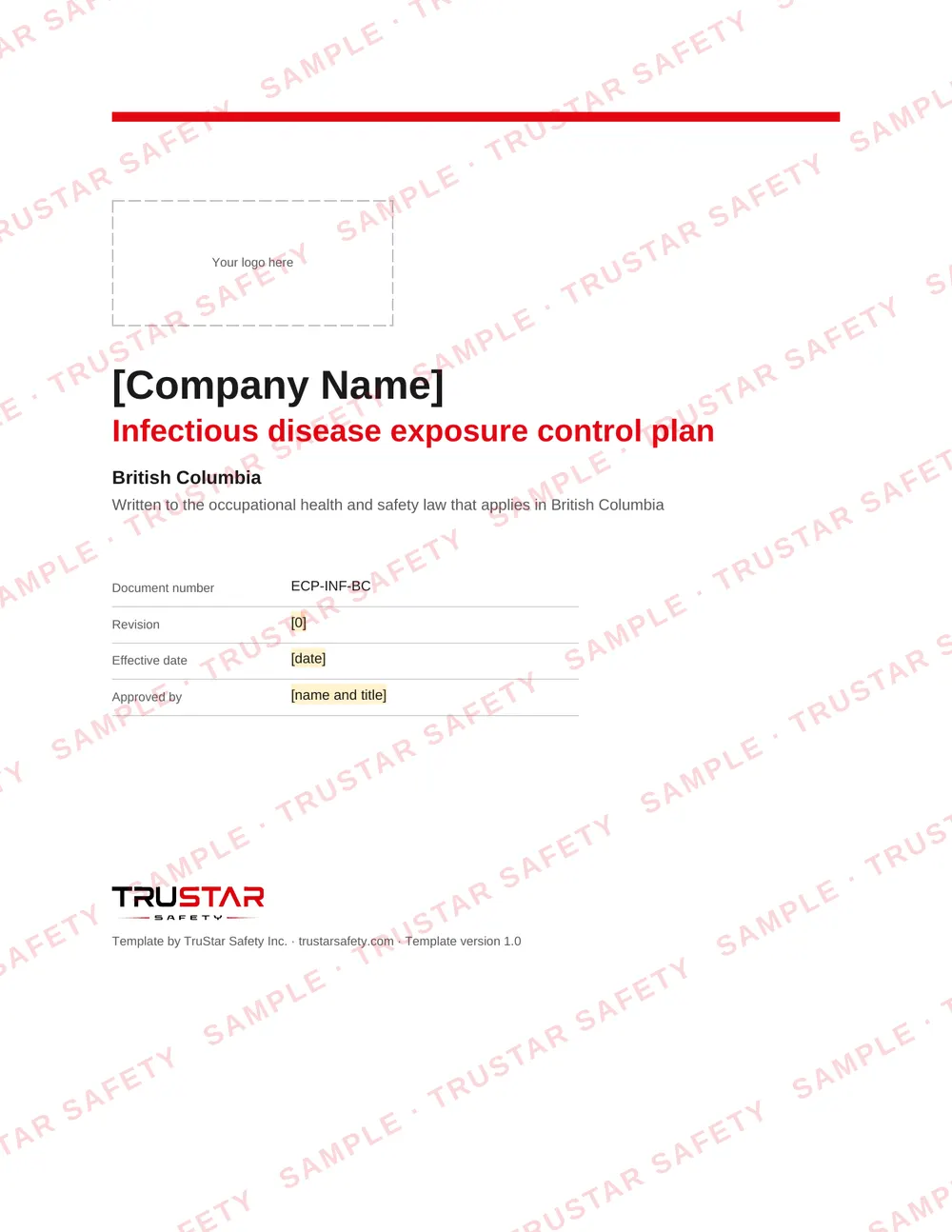
Infectious disease exposure control plan template
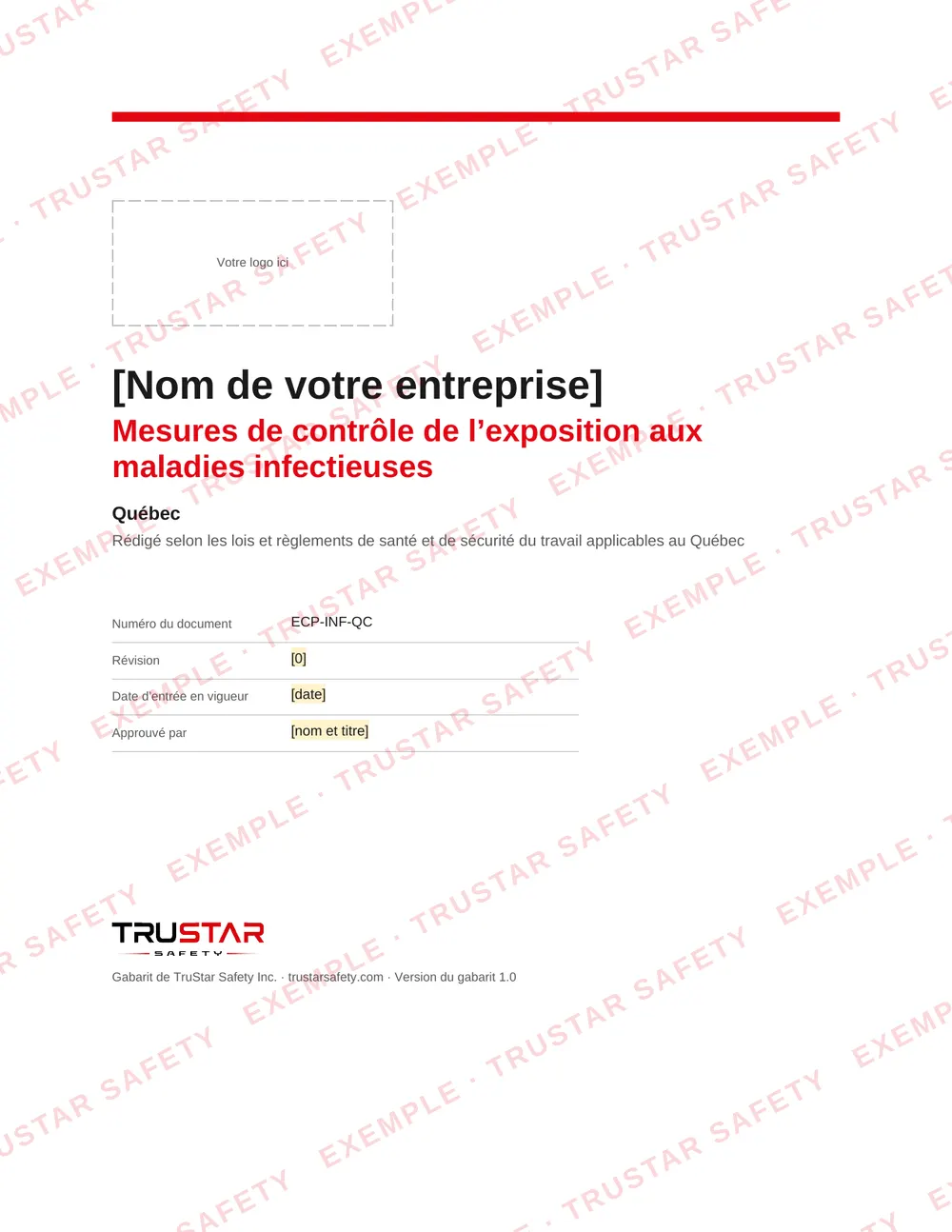
A complete written plan for protecting workers from infections caught at work, blood-borne, respiratory and spread by contact, in 14 editions: one for each province and territory and one for federally regulated workplaces. It is written for health care and for the many other jobs where exposure happens, from first aid and policing to cleaning, waste, labs and childcare. Each edition sets out the law that applies there, with pinpoint citations. Every purchase includes all 14, in English and in French: 28 editable Word files you make your own.
A look inside
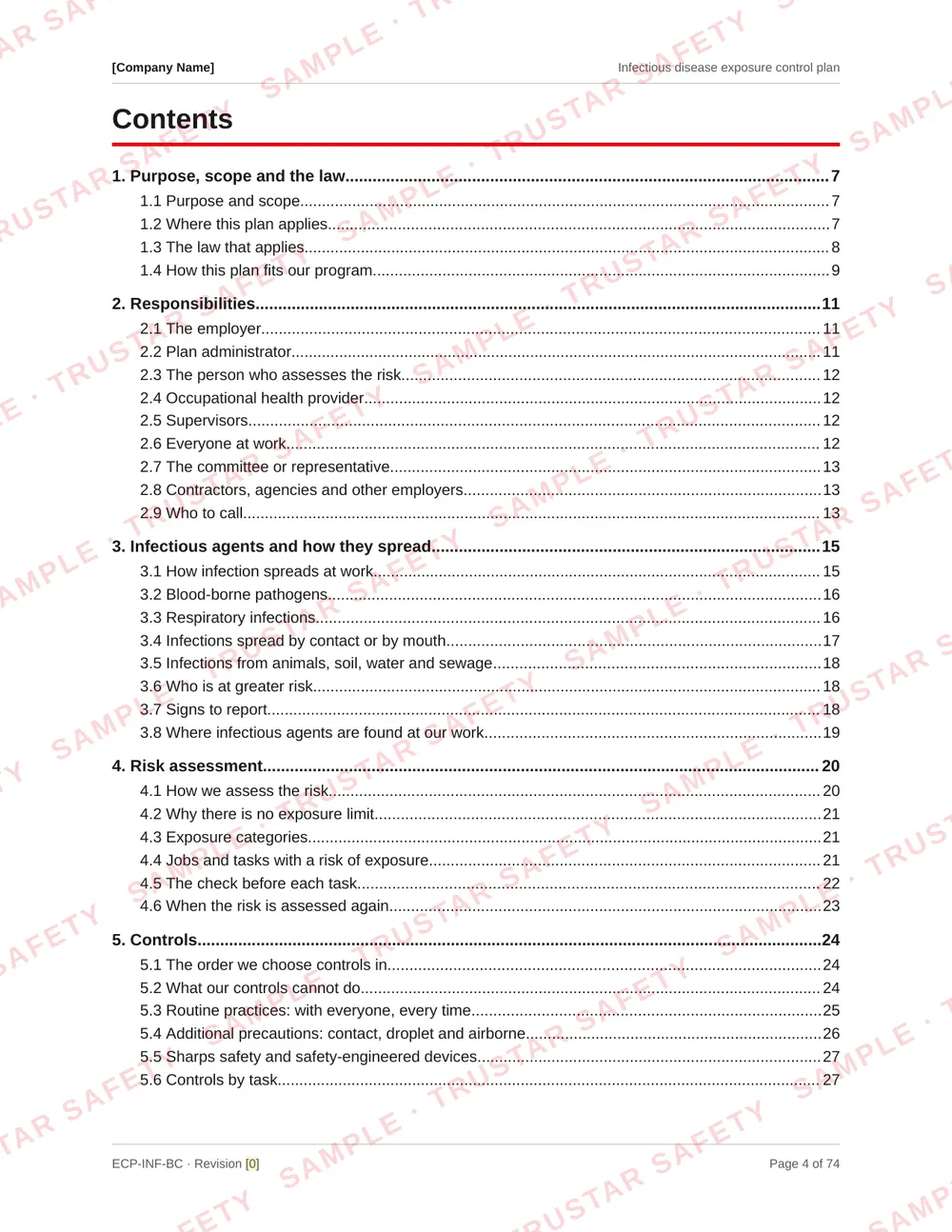
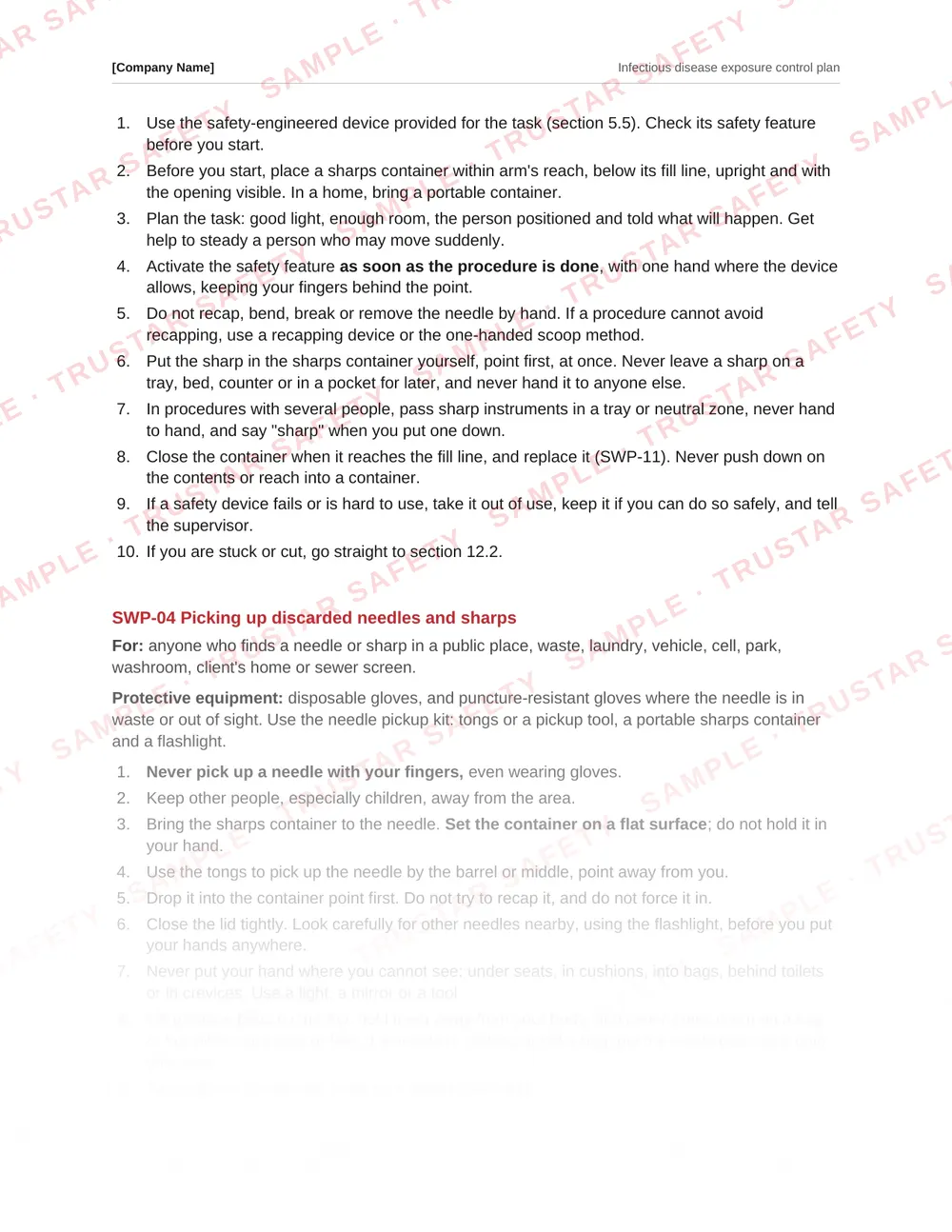
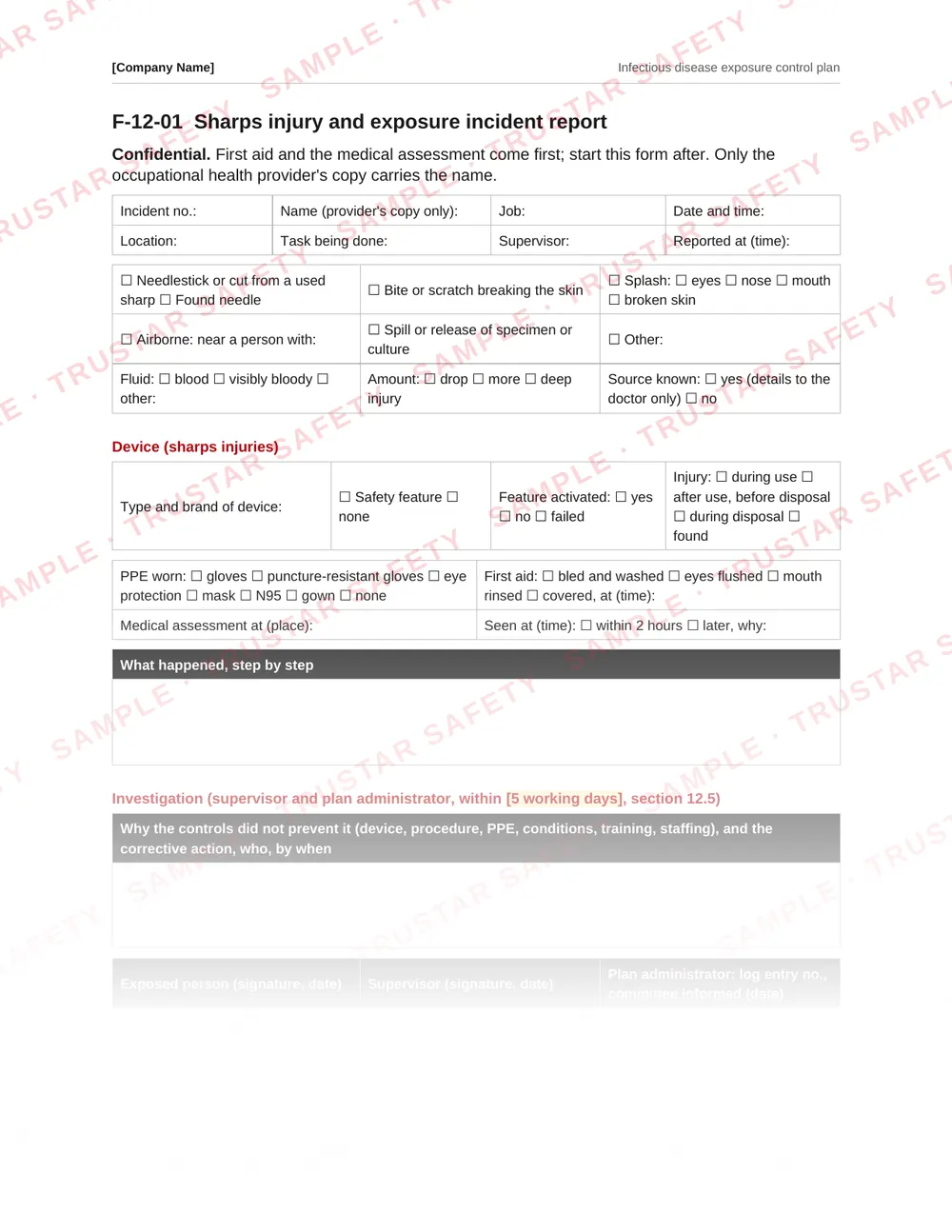
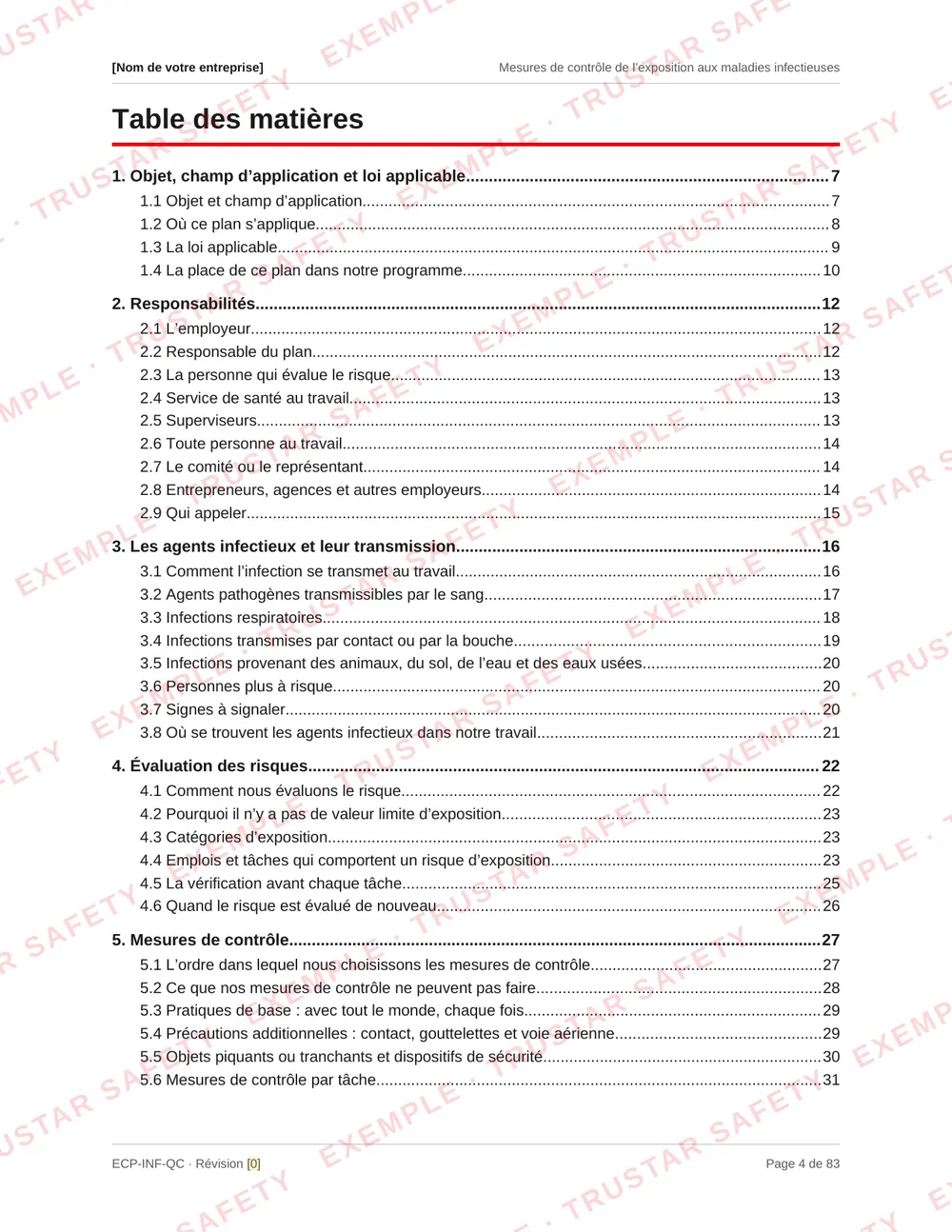
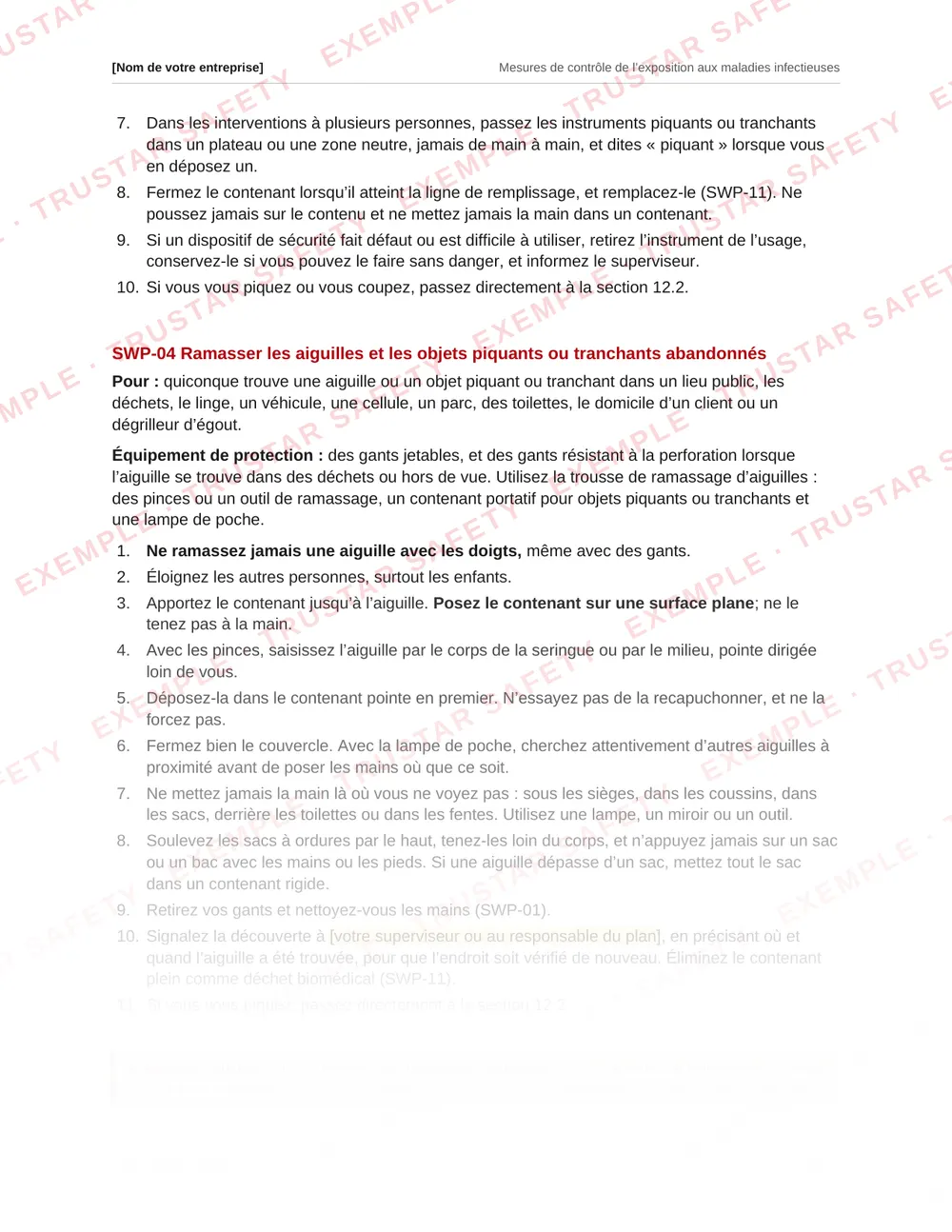
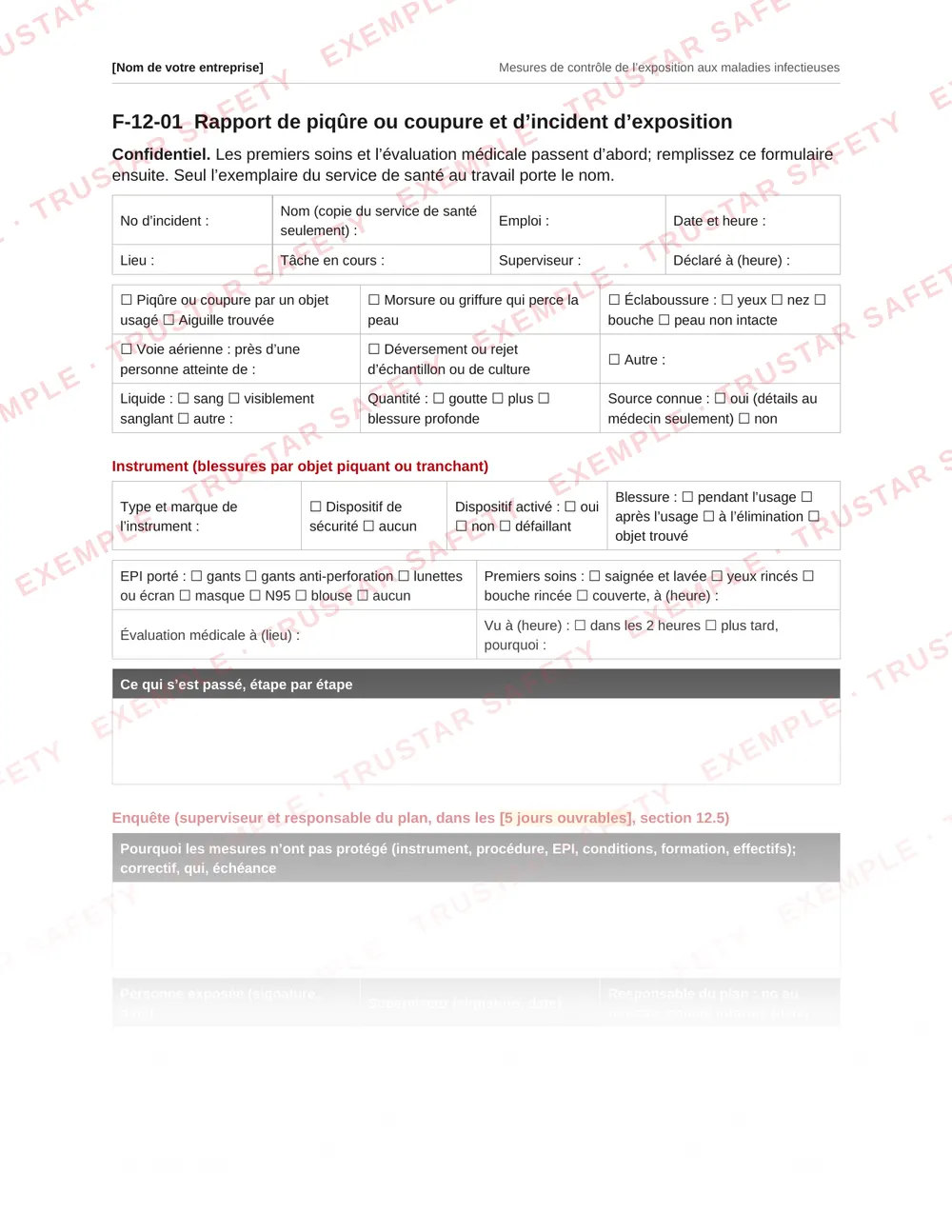
Sample pages from the plan, marked and cut short. Your copy has no watermark.
What’s in the plan
1. Purpose, scope and the law
The infections the plan covers and what it aims for, the kinds of work it is written for, the law that applies in your jurisdiction with pinpoint citations (section 1.3), and how it fits your program.
2. Responsibilities
The employer, the plan administrator, the person who assesses the risk, the occupational health provider, supervisors, everyone at work, the committee or representative, contractors and agencies, and who to call.
3. Infectious agents and how they spread
How infection spreads at work, blood-borne pathogens, respiratory infections, infections spread by contact or by mouth, those from animals, soil, water and sewage, who is at greater risk, signs to report, and where infectious agents are found in your work.
4. Risk assessment
How the risk is assessed and why there is no exposure limit, three exposure categories (routine, occasional and none expected), the jobs and tasks at risk, the check before each task, and when the risk is assessed again.
5. Controls
Controls chosen in order and what they cannot do, routine practices with everyone every time, added precautions for contact, droplet and airborne spread, sharps safety and safety-engineered devices, and the controls for each task.
6. Safe work procedures
17 procedures: hand hygiene, putting on and taking off protective equipment, sharps and discarded needles, blood and body fluid cleanup, first aid and CPR, caring for people with respiratory infections, home visits, searches, bites and spitting, laundry and waste, lab specimens, care of the deceased, tattooing and aesthetics, wastewater, childcare, and cleaning and disinfection.
7. Personal protective equipment and respirators
Your rules for protective equipment, choosing it for the task, masks or respirators and which one, fit testing, and care, storage and disposal.
8. Hand hygiene, cleaning and disinfection
Hand hygiene and washing facilities, change rooms, showers and eating areas, the cleaning and disinfection program, laundry, biomedical waste and sharps disposal, and water systems and ventilation.
9. Monitoring and inspections
Checking that the controls work, watching for infection, exposure incident and sharps injury trends, and sharing the results.
10. Vaccination and health monitoring
The vaccines offered and how, declining one, tuberculosis screening, fitness for work and staying home when sick, and people at greater risk with confidentiality.
11. Education and training
Who is trained and when, general awareness for everyone, full training for the jobs at risk, how training is given and checked, and records.
12. Exposure incidents, spills and outbreaks
What counts as an exposure incident, what to do at once, the medical assessment and the source person, follow-up and confidentiality, investigation, outbreaks and pandemics, and spills and releases.
13. Records, communication, consultation and review
The records you keep, confidentiality, communication, consulting your committee or representative, and reviewing the plan.
Appendix A. Regulatory cross-reference
Every provision of your jurisdiction’s law the plan is written to meet, in plain words, with the section that meets it and whether an inspector will also want your records. Each entry links to its section.
Appendix B. Forms
8 print-ready forms, each with a form code: the risk assessment by job, the respirator fit test and PPE record, the cleaning and disinfection log, the vaccination record with offer and declination, the training record, the sharps injury and exposure incident report, the post-exposure follow-up checklist and the plan review record.
One plan, 14 editions
Each plan is written once and fitted to the law of each of Canada’s 14 jurisdictions: the ten provinces, the three territories and federally regulated workplaces under the Canada Labour Code. Each edition takes the name its law gives the document, and its own limits, terms and citations.
Every purchase includes all 14, each in English and in French: 28 Word files. The French editions follow the English section for section and form for form, and their cross-reference matches row for row. Laws published only in English keep their English titles.
Written to the law where you work
Section 1.3 of each edition sets out the law that applies there, with pinpoint citations: what that law calls the plan, which work it applies to, and what the law adds, such as sharps rules, vaccination, reporting exposures or how often the plan is reviewed. Appendix A lists every provision the plan is written to meet, in plain words, with the section that meets it and whether an inspector will also want to see your records. Each entry links to its section.
Every legal reference was checked against the official texts between September 30 and October 3, 2026, and each edition lists its sources and the date each was checked. A template can’t make you compliant on its own, and we don’t claim it does: the plan works once a qualified person adapts it to your work.
Who it is for
Any employer whose workers can reasonably be expected to come into contact with an infectious agent because of their work: hospitals, long-term care and clinics, home care, first aid attendants, policing, corrections and security, cleaning, waste and recycling, laboratories, funeral services, tattoo and aesthetics, education and childcare, and wastewater and sewers.
You delete the kinds of work you don’t do, and add any others, such as veterinary work, shelters and supportive housing or harm reduction services.
Lifetime updates
When the law changes, we publish a new edition and email everyone who bought the template, on its own or in the Core 5 exposure control plans. Every update is free, for as long as we publish it.
Version 1.0 October 3, 2026
- First edition, in 14 jurisdiction editions (one for each province and territory, and one for federally regulated workplaces), each in English and French.
- Every legal reference checked against the official texts between September 30 and October 3, 2026. Each edition lists its sources and the date each was checked.
More exposure control plans
Get all five in the Core 5 exposure control plans for $449.95, $149.80 less than buying them separately. Or buy templates together and save on the whole order: 2 for 10% off, 3 for 15% off, 4+ for 20% off.
All provinces, territories and federal
Core 5 exposure control plans (silica, asbestos, lead, noise, infectious disease)$449.95
All provinces, territories and federal
Noise exposure control and hearing conservation plan template$119.95
Questions
Which edition do I use?
The one for the law that covers the workplace: the province or territory where the work is done, or the federal edition if your business is federally regulated under Part II of the Canada Labour Code (for example, interprovincial trucking, airlines, railways, banks and telecommunications). If you are not sure which law covers you, confirm it with your regulator before you rely on an edition. All 14 come with every purchase, in English and French, so you never pay twice for the right one.
Is this legal advice? Will it make us compliant?
No. It is a template, not legal advice: a complete plan written to the law with every requirement cited, as a starting point. The plan only works once a qualified person adapts it to your work (your tasks, your materials and the exposure your own assessment finds) and you put it in place and follow it, so no template can promise compliance. If you want help with that, our team does it too.
Does it cover my province’s own rules?
Yes. Section 1.3 of each edition sets out the law that applies there, with pinpoint citations: what that law calls this document, the exposure limit, and what the law adds to the plan, such as monitoring, health checks, notices, records or training. Where the law changes something in the plan’s general text, section 1.3 says what and where. Appendix A then lists every provision the plan is written to meet, with the section of the plan that meets it.
What if we work in more than one province?
Use the edition for each place you work: every purchase includes all 14. Each edition is complete on its own, and they share the same sections and form codes, so crews moving between provinces work to the same plan and only what the law changes is different.
What format is it in, and can I edit it?
Editable Microsoft Word (.docx) files on US Letter pages: 28 of them, one for each of the 14 jurisdictions in English and in French. Type your company name once and desktop Word puts it on the cover, in every header and through the text. Shaded “Tailor” notes say what to check or change in each section, and highlighted placeholders mark every name, date and place you fill in. The files also open in Google Docs and Word on the web, where you use Find and replace to put your company name in.
What happens when the law changes?
We update the plan, and you get every update free for as long as we publish it: lifetime updates at no extra charge, for all 14 editions in both languages. We email you when a new edition is ready, with what changed and a link to download it.
Can I use it for more than one company?
Each purchase is licensed to one company. Consultants setting up programs for several clients should contact us.
Want it built for you?
Our safety advisors assess the hazards in your work and help you tailor the plan to it, from the risk assessment to the procedures your crews follow and the controls behind them.
Hazard assessments and control