

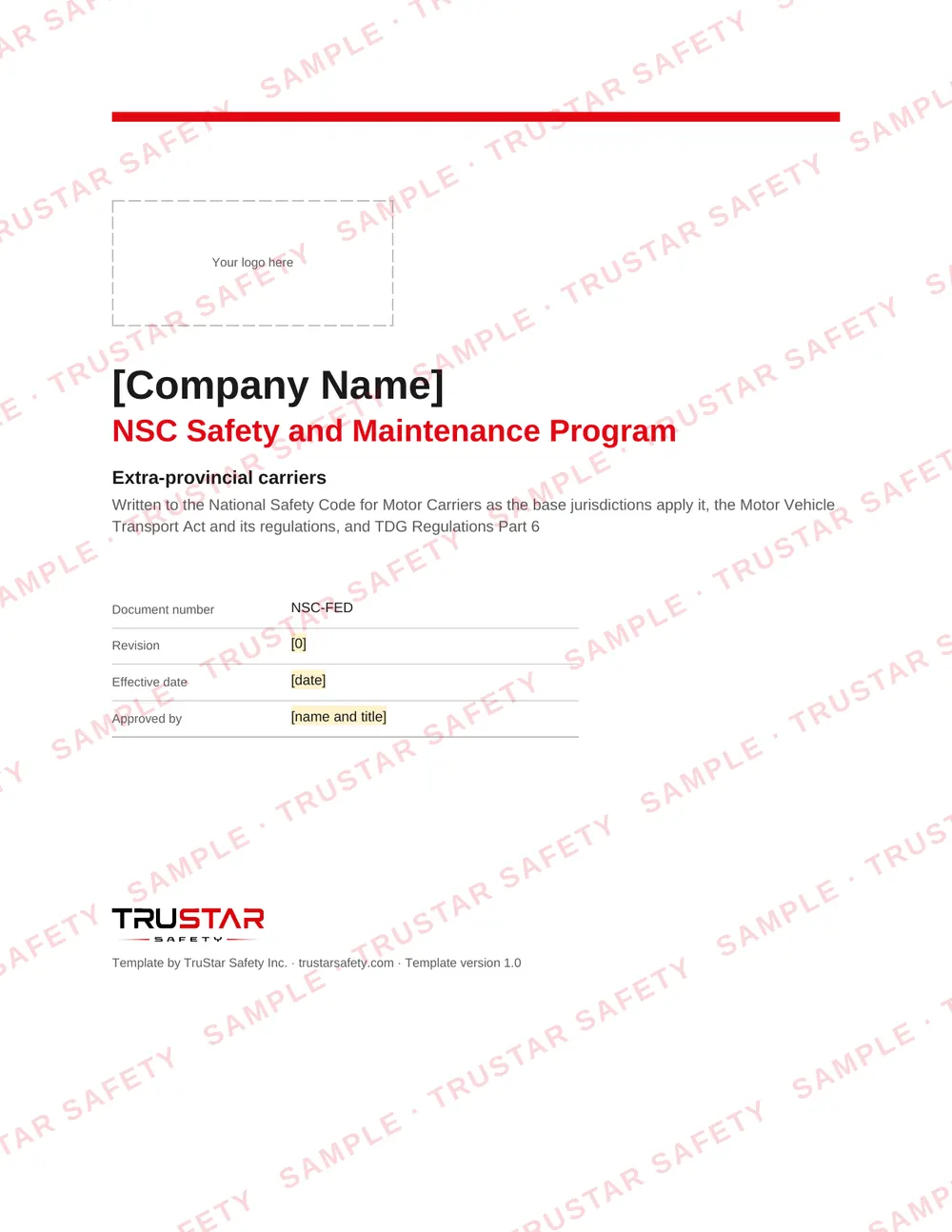
NSC safety and maintenance program template for extra-provincial carriers (English and French)
A complete written safety and maintenance program for extra-provincial motor carriers: trucking, courier and bus companies whose vehicles cross a provincial or national border. It is written to the National Safety Code standards as base jurisdictions apply them, the Motor Vehicle Transport Act and its safety fitness certificate and hours of service regulations, and Part 6 of the TDG Regulations, and laid out for the facility audit your base jurisdiction carries out. You get it in English and in French, both editable Word files you make your own: your name, your NSC number and your fleet.
A look inside
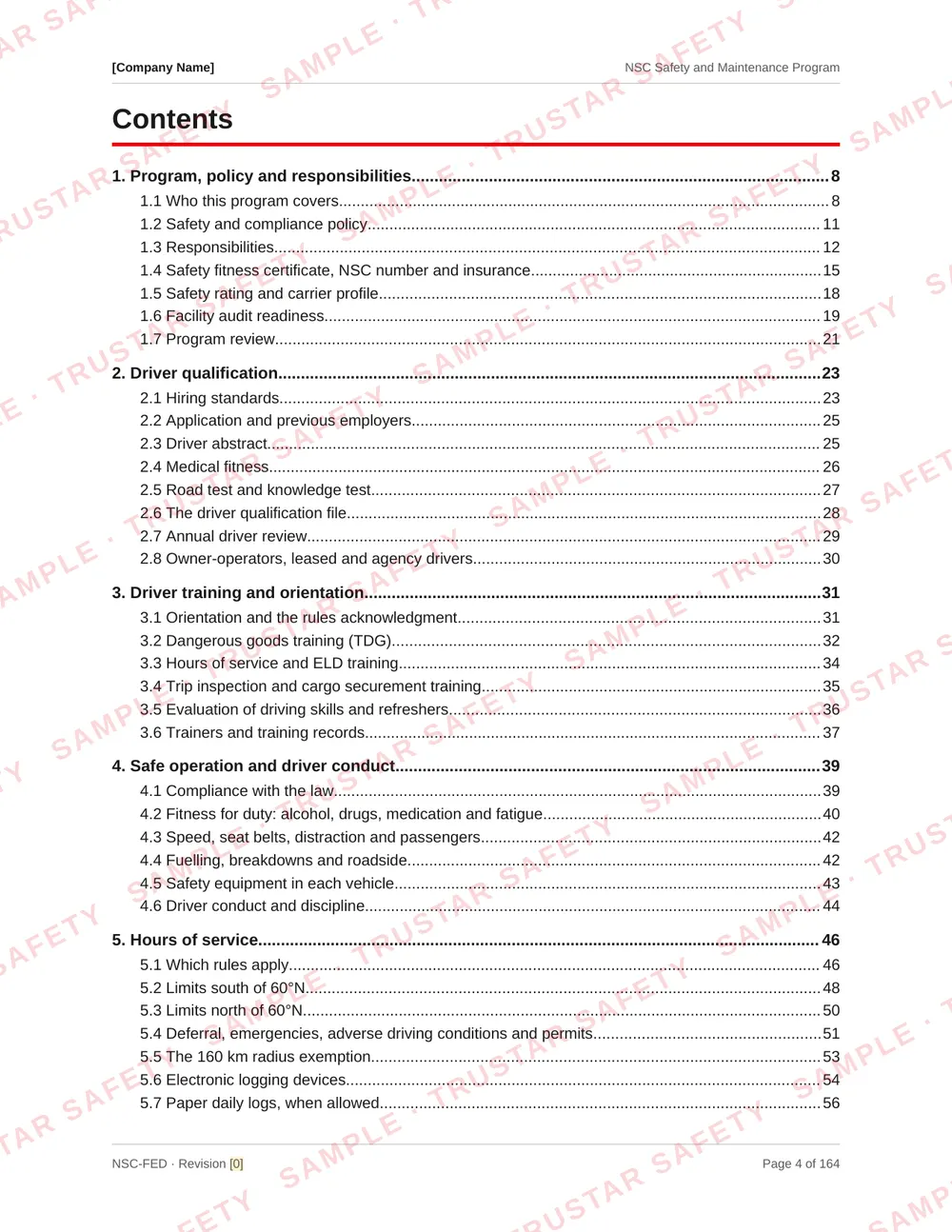
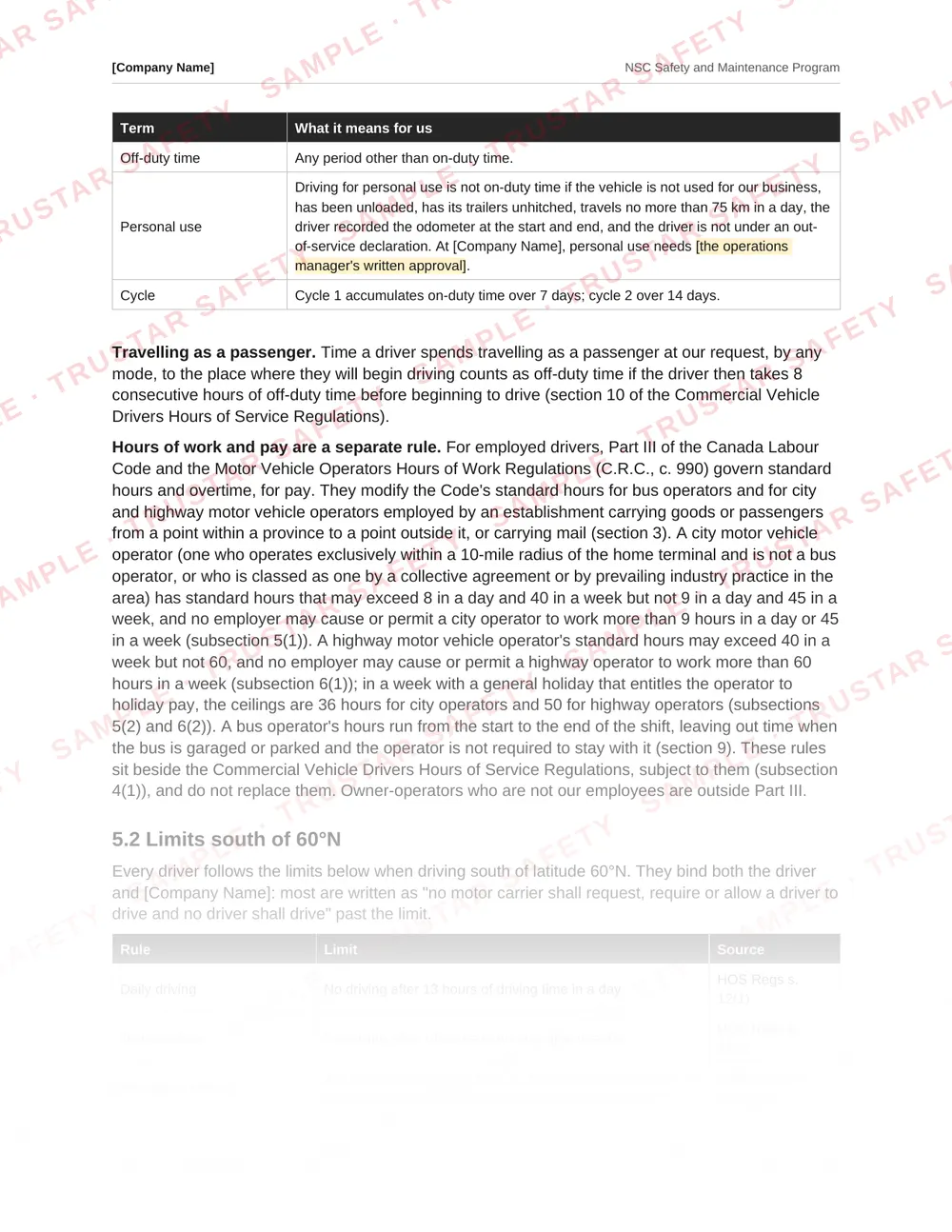
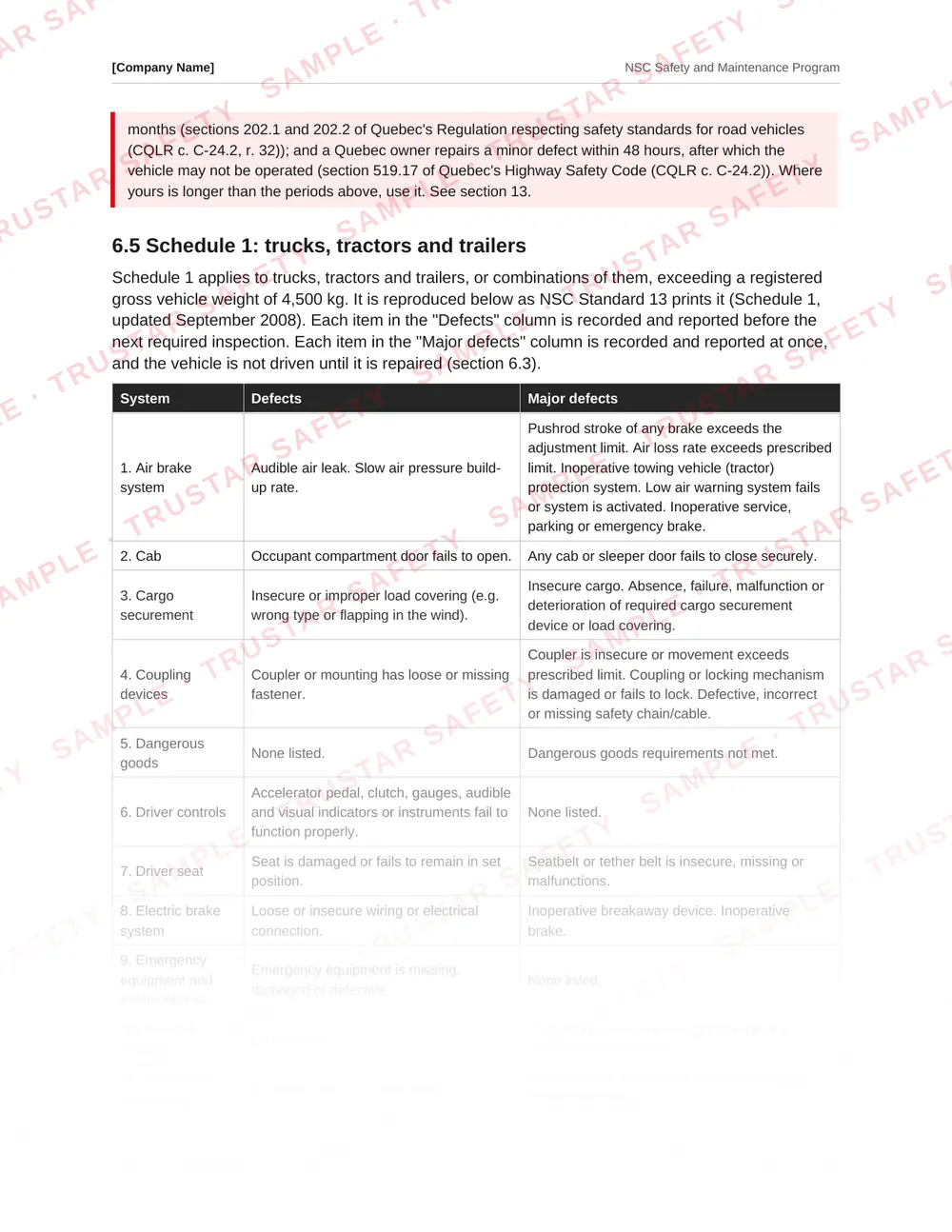
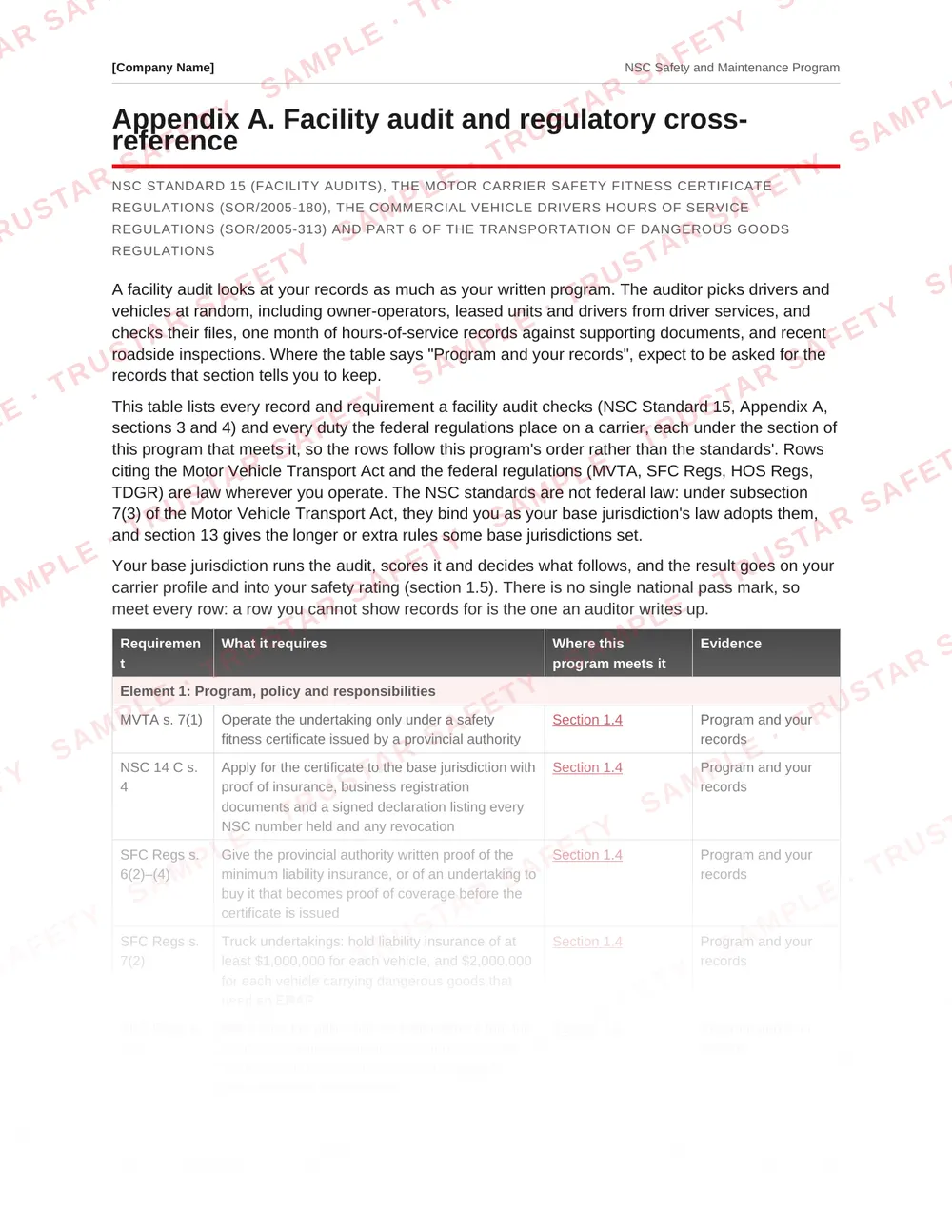
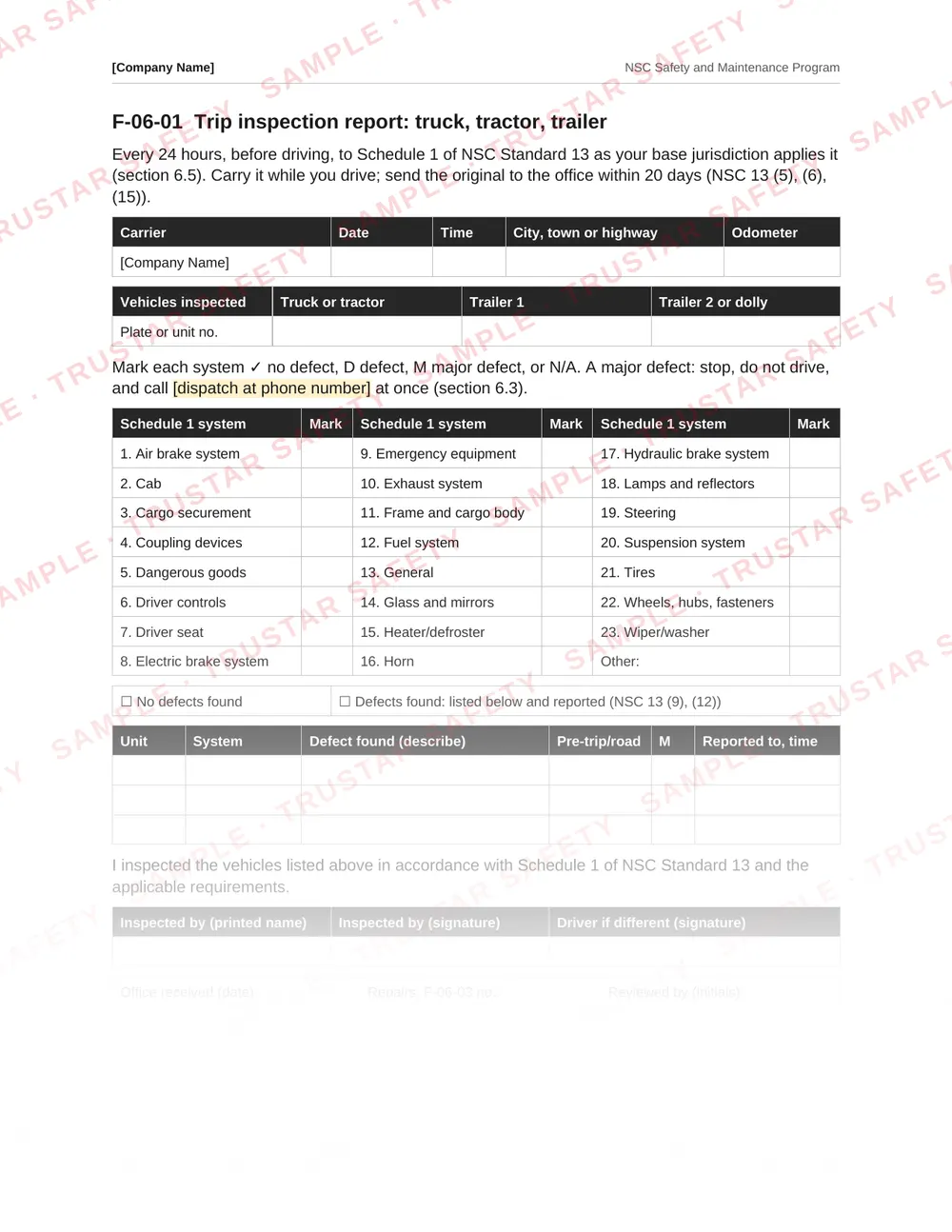
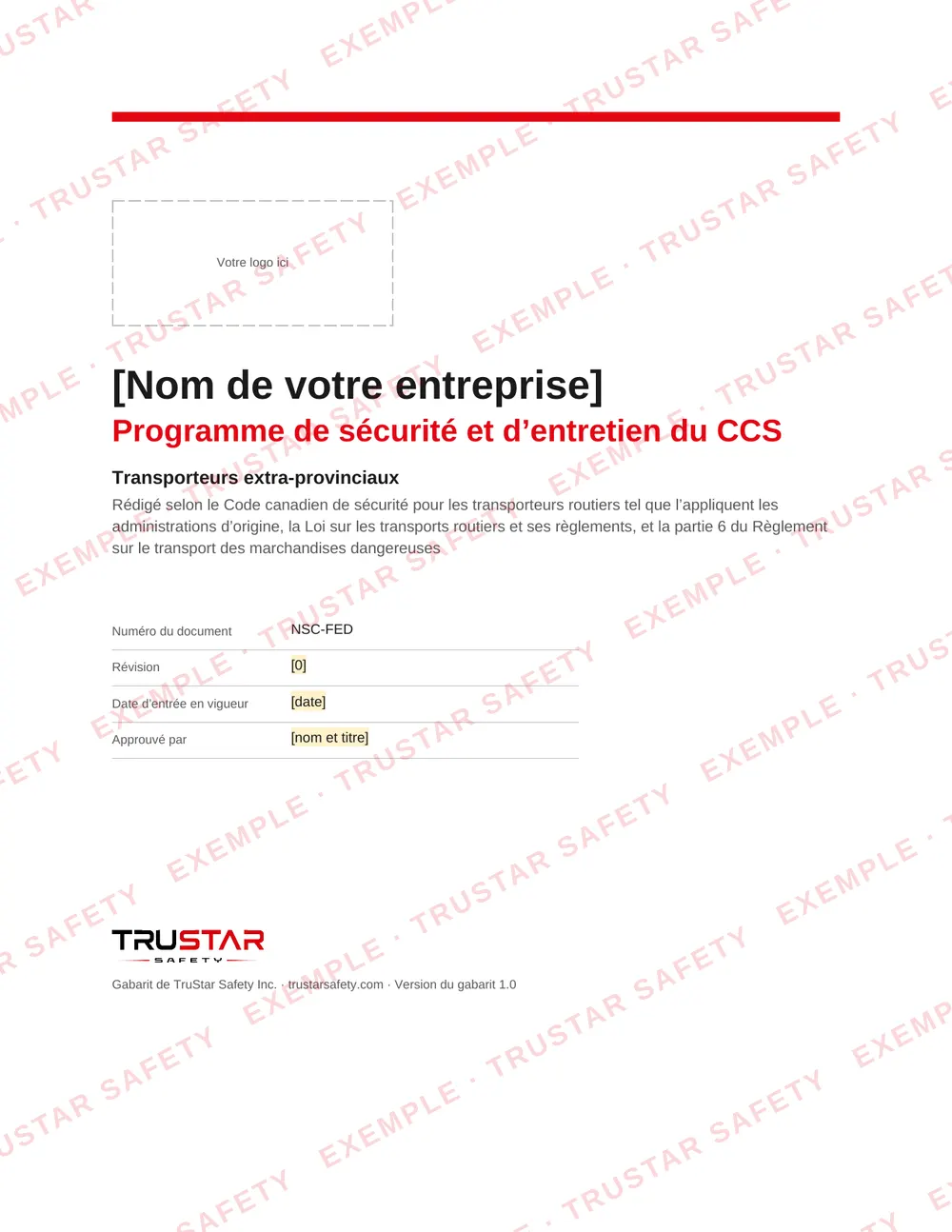
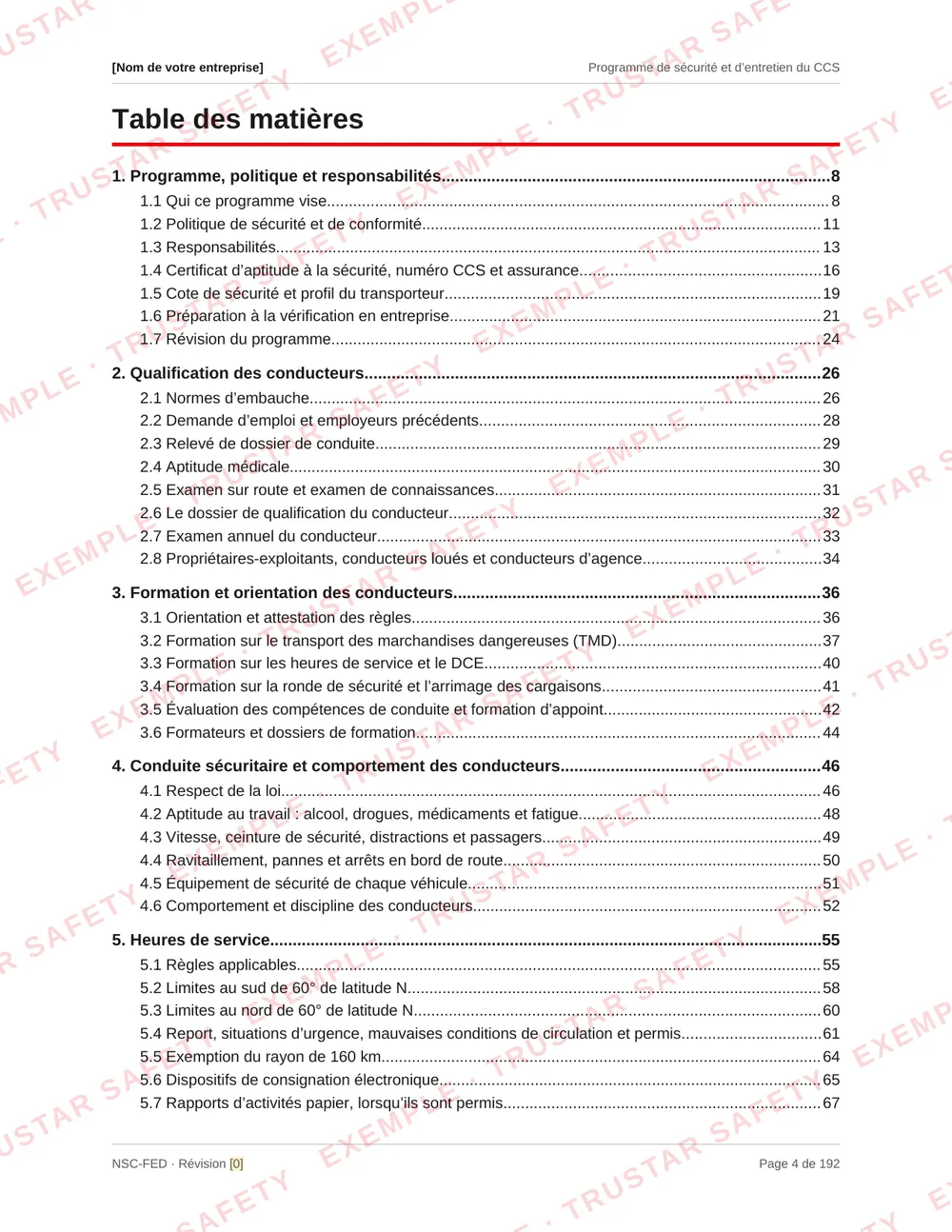
Sample pages from the program, marked and cut short. Your copy has no watermark.
What’s in the program
1. Program, policy and responsibilities
Who and what the program covers and where each rule comes from, your signed safety and compliance policy, responsibilities, the safety fitness certificate, NSC number and insurance, your safety rating and carrier profile, staying ready for a facility audit, and the yearly program review.
2. Driver qualification
Hiring standards, applications and previous employer checks, the driver abstract, medical fitness, road and knowledge tests, the driver qualification file, the annual driver review, and owner-operators, leased and agency drivers.
3. Driver training and orientation
Orientation and the rules acknowledgment, dangerous goods (TDG) training and certificates, hours of service and ELD training, trip inspection and cargo securement training, evaluating driving skills, and trainers and training records.
4. Safe operation and driver conduct
Obeying the law wherever you travel, fitness for duty (alcohol, drugs, medication and fatigue), speed, seat belts, distraction and passengers, fuelling, breakdowns and the roadside, the safety equipment in each vehicle, and discipline.
5. Hours of service
Which rules apply, the limits south and north of 60°N, deferral, emergencies and adverse driving conditions, the 160 km radius exemption, electronic logging devices, paper logs where allowed, supporting documents, monitoring compliance and out-of-service declarations.
6. Trip inspection
Who inspects, when and to which schedule, the inspection report, defects and major defects, repairs and sign-off, and the schedules for trucks, tractors and trailers and for buses and motor coaches.
7. Vehicle maintenance program
Your written maintenance program, a file for every unit, the preventive maintenance schedule, reminders and recalls, repairs and units out of service, leased, rented and owner-operator units, and maintenance records.
8. Periodic inspection (PMVI)
Inspection intervals, where and by whom, and tracking every unit’s decal and report so none leaves the yard without a valid one.
9. Cargo securement
The carrier’s and the driver’s duties, the performance criteria, checks en route, tiedowns and devices, and commodity-specific rules.
10. Dangerous goods (TDG)
Where TDG applies and who is responsible, training and certificates, documents, safety marks and ERAPs, and releases. Deliberately short: it points to the TDG Regulations rather than replacing them.
11. Collisions, roadside inspections and convictions
What to do at the scene, reporting to the office, reviewing every collision, the accident register, roadside inspections and out-of-service declarations, convictions and penalties, and watching your carrier profile.
12. Records
Where records are kept and how fast you can produce them, a retention table for every record the program creates, and electronic records and backups.
13. Base jurisdiction requirements
The longer or extra rules each province and territory sets for the carriers it base-plates, from Western Canada and the territories to Ontario, Quebec and Atlantic Canada, so you tailor the program once to your own.
14. Operating into the United States
What changes at the border, drug and alcohol testing for drivers who drive in the United States, and medical and licence reciprocity. It names the US rules that apply without restating them.
Appendix A. Facility audit and regulatory cross-reference
All 91 requirements a facility audit checks and the federal regulations place on a carrier, each in plain words, with the section that meets it and whether the auditor will also want your records.
Appendix B. Forms
27 print-ready forms that match the program, each with a form code: driver applications, previous employer inquiries, the driver file checklist, road test certificate and annual review, orientation and training records, hours of service audits, ELD malfunctions and 160 km time records, trip inspection reports for trucks and buses, defect repairs, vehicle files, the maintenance schedule, recall and PMVI trackers, cargo securement, collision reports and the accident and inspection registers.
Built for the facility audit
There is no federal office that audits carriers. Your base jurisdiction, the province or territory where your vehicles are base-plated, issues your NSC number, keeps your carrier profile, assigns your safety rating and carries out your facility audit. A facility audit is an audit of records, so every section says which records to keep, and Appendix A lists every requirement the audit checks with the section that meets it.
Your safety rating depends on your carrier profile and on what an audit finds in your records, not on the written program alone, so no template can promise a rating, and we don’t claim to. What it gives you is a complete program to put in place and follow.
Federal law, and your base jurisdiction’s rules
The program keeps apart what is federal law wherever you operate (the safety fitness certificate, hours of service and ELDs, dangerous goods) and the NSC standards that bind you as your base jurisdiction adopts them (driver files, trip inspection, maintenance and periodic inspection, cargo securement). Section 13 gives the longer or extra rules each province and territory sets.
The federal texts were checked against the official consolidations current to September 21, 2026. A new version of the national technical standard for ELDs has been published, and Transport Canada will set when it takes effect. When the rules change, we update both editions and you get them free.
Who it is for
Extra-provincial truck, courier and bus carriers: undertakings that operate commercial vehicles into, across or out of a province, with trucks, tractors or trailers over 4,500 kg, or buses seating more than 10 people including the driver.
It is your fleet compliance program, not your occupational health and safety program. Health and safety at work under the Canada Labour Code is in our Federal Road Transport Health and Safety Manual, and harassment and violence prevention is in our Federal Workplace Harassment and Violence Prevention Program.
Lifetime updates
When the law changes, we publish a new edition and email everyone who bought the template, on its own or in the Federal Carrier Bundle. Every update is free, for as long as we publish it.
Version 1.2 October 2, 2026
- Yukon: section 13 now sets out Yukon’s National Safety Code Regulation (O.I.C. 2007/168): the NSC standards it makes law, the federal hours of service rules for every commercial vehicle, the NSC number, and the person a carrier must designate to handle compliance.
- Section 8.1: the periodic inspection threshold for Yukon is 4,500 kg, as Yukon’s regulation sets it.
- Sections 1, 5, 9 and 12: short Yukon notes added where Yukon’s rules apply.
Version 1.1 October 2, 2026
- Yukon: section 13 now covers the Traffic Safety Act (S.Y. 2024, c. 10), which comes into force by order and replaces the Motor Vehicles Act: what it requires of owners and drivers, and what it leaves to regulations. Carriers based in Yukon are told to confirm which parts are in force.
- Section 8.1: the Yukon periodic inspection note now says the Act leaves intervals and thresholds to regulations.
Version 1.0 October 2, 2026
- First edition, in English and French, written to the National Safety Code standards as base jurisdictions apply them, the Motor Vehicle Transport Act, the safety fitness certificate and hours of service regulations, and Part 6 of the TDG Regulations.
- Federal texts checked against the official consolidations current to September 21, 2026.
Complete your federal program
The Federal Carrier Bundle has all three for $549.95, $149.90 less than buying them separately. Or buy templates together and save on the whole order: 2 for 10% off, 3 for 15% off, 4+ for 20% off.
Questions
Who needs an NSC safety and maintenance program?
A carrier whose trucks or buses cross a provincial or national border is an extra-provincial motor carrier undertaking under the Motor Vehicle Transport Act. If it operates trucks, tractors or trailers over 4,500 kg, or buses seating more than 10 people including the driver, it needs a safety fitness certificate (its NSC number) from its base jurisdiction, which expects the written program and records this template sets out. A carrier that stays within one province follows its own province’s carrier rules.
Is this the same as a health and safety manual?
No. This program covers fleet compliance: the safety fitness certificate, driver qualification, hours of service, trip inspection, maintenance and periodic inspection, cargo securement, dangerous goods and the records a facility audit checks. The health and safety of your employees at work, in the cab, on the dock and in the shop, comes under Part II of the Canada Labour Code if you are federally regulated, and is covered in our Federal Road Transport Health and Safety Manual. The Federal Carrier Bundle has both, with the harassment and violence prevention program.
Does it cover hours of service and ELDs?
Yes. Section 5 covers the federal Commercial Vehicle Drivers Hours of Service Regulations: the limits south and north of 60°N, the 160 km radius exemption, electronic logging devices, paper logs where they are allowed, supporting documents, and how you monitor each driver’s compliance.
Will this get us a Satisfactory safety rating?
It gives you the written program a facility audit looks for, with every requirement cross-referenced. Your rating depends on your carrier profile and on what the audit finds in your records, so no template can promise a rating. It is a template, not legal advice.
Do I get both the English and the French program?
Yes. Every purchase includes both editions as separate Word files, and both are on your confirmation page, in your email and in Find my downloads. Lifetime updates cover both.
What format is it in?
Two editable Microsoft Word (.docx) files on US Letter pages, one in English and one in French. They work best in desktop Word for Windows or Mac. They also open in Google Docs and Word on the web, where you use Find and replace to put your company name in.
What happens when the rules change?
We update the template, and you get every update free for as long as we publish it: lifetime updates at no extra charge, in both languages. We email you when a new edition is ready, with what changed and a link to download it.
Can I use it for more than one company?
Each purchase is licensed to one company. Consultants setting up programs for several clients should contact us.
Want it built for you?
Our safety advisors set up and run fleet safety for carriers: driver files, hours of service, maintenance and NSC compliance, and the health and safety program around them.
Transportation management