












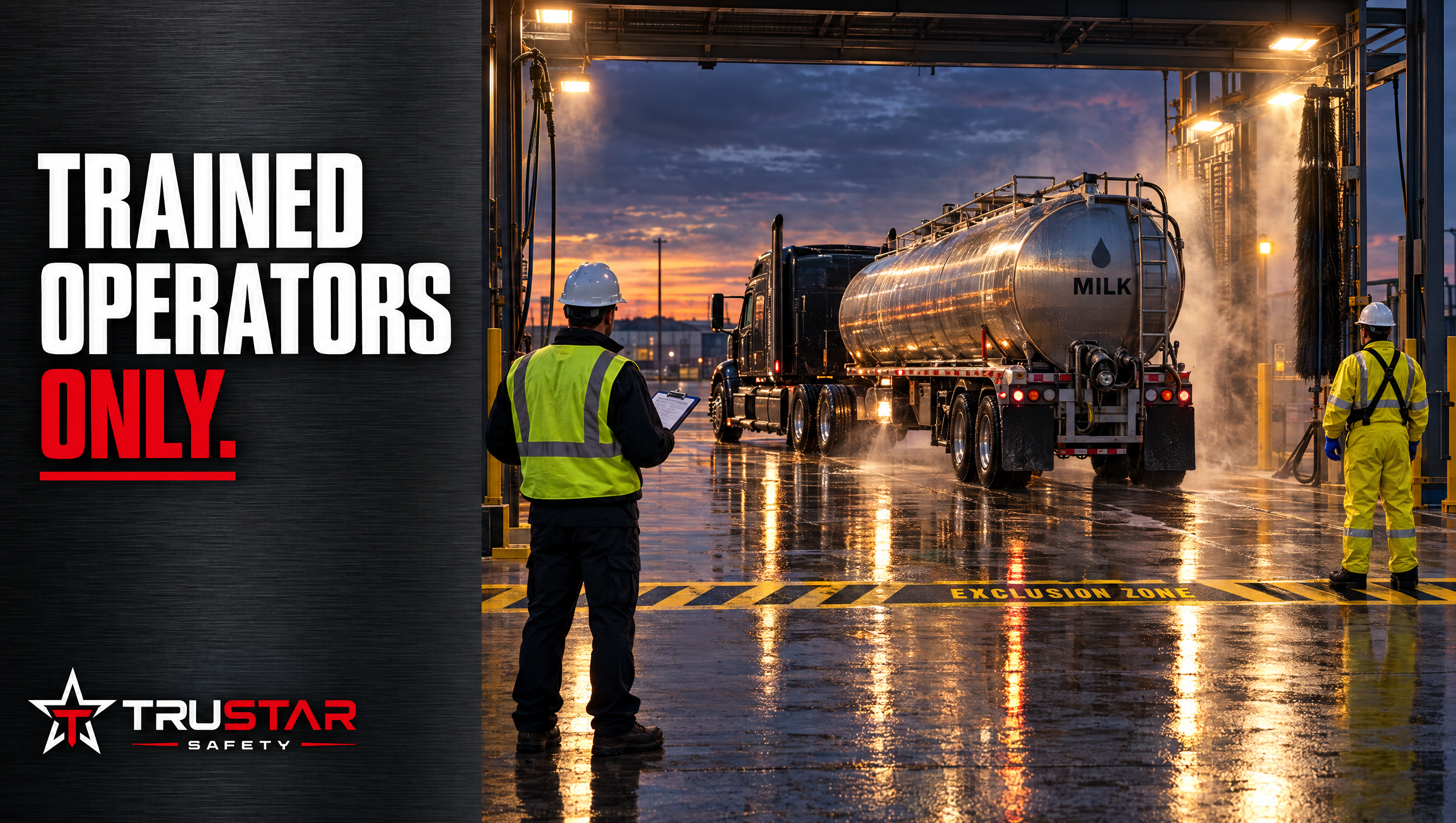
A Saskatchewan company was fined $100,000 after a wash bay attendant was seriously injured between a semi tractor and a milk tanker trailer, and the charge was about training. If your site has powered mobile equipment of any kind, the lesson is simple: everyone who operates or moves it, in the yard or the wash bay included, needs current training and a record that proves it.
This article walks through what the Government of Saskatchewan reported, what the charge actually said, and a practical way to check your own operator training and authorization records this month.
What happened: the Agrifoods International Cooperative fine
According to the Government of Saskatchewan news release, a wash bay attendant was seriously injured on November 20, 2023, in Saskatoon. The worker was pinched between a semi tractor and a milk tanker trailer.
Agrifoods International Cooperative Ltd. pleaded guilty in Saskatoon Provincial Court on September 29, 2026. The Ministry of Labour Relations and Workplace Safety announced the outcome on October 9, 2026.
The key facts, as reported:
- The charge was under subsection 11-2(2) of The Occupational Health and Safety Regulations, 2020 (Saskatchewan).
- The charge was failing to ensure that only trained operators were required or permitted to operate powered mobile equipment.
- The court imposed a fine of $71,428.57 plus a victim fine surcharge of $28,571.43, which together make $100,000.
- Two other charges were withdrawn.
Notice what the charge was not. It was not about a missing guard or a missing procedure on paper. It was about who was permitted to operate the equipment, and whether those people were trained.
Why this matters outside Saskatchewan
This is a Saskatchewan prosecution under Saskatchewan regulations, and it does not set a rule for Alberta or any other province. Each jurisdiction has its own legislation and its own wording. But the pattern is worth noticing wherever you work: untrained operation of powered mobile equipment, followed by a serious injury, led to a six-figure penalty.
Employers in every province can read the same practical message. If you cannot show who was trained, on what, and who authorized them, you have a gap that an investigator will find quickly after an incident. Check the equivalent requirements in your own jurisdiction's legislation, and confirm them with your regulator or a qualified advisor.
Where powered mobile equipment training gaps hide
When people think of operator training, they picture the loader, the excavator or the crane. The gaps are usually elsewhere.
Yard and wash bay work
The injured worker in this case was a wash bay attendant. Yard and wash bay staff often move trucks and trailers a short distance, reposition equipment to wash it, or work in the tight space between units. Because the moves are short, they are rarely treated as "operating", and they are rarely in the training matrix.
Short moves and "just this once"
A supervisor asks whoever is closest to move a unit. A driver hands off a tractor to a helper. A mechanic repositions a trailer. None of it feels like a decision, and all of it is operation of powered mobile equipment.
Temporary, seasonal and contract workers
New starts and workers from a contractor or agency can arrive without anyone checking operator qualifications against the equipment they will actually touch. The record that was current for the permanent crew may not exist for them.
Equipment changes
A worker trained on one machine is not automatically trained on another. New attachments, a different trailer configuration or a different make of tractor can all mean new training needs.
A practical check of your operator training and authorization records
Use this checklist to audit your own program. It is good practice, not a quotation of any regulation.
- List every piece of powered mobile equipment. Include trucks and tractors, trailers being moved, forklifts, loaders, yard trucks and anything else that is driven or moved under its own power.
- List every person who operates or moves it. Walk the site at different shifts. Include yard, shop, wash bay, shipping and receiving, and contractors.
- Match people to equipment. For each person and each machine, is there a training record that is current?
- Check the authorization. Training is one thing; the employer permitting a trained person to operate a specific piece of equipment is another. Record who authorized it and when.
- Look at the dates. Note refreshers and any evaluation that is due. An expired record should be treated as a gap.
- Close the gaps in writing. Remove people from the equipment until they are trained, or train them, and keep the record.
- Tell supervisors the rule. If someone is not on the authorized list, they do not move the equipment, even for a few metres.
What a good record contains
- The worker's name and the equipment type
- What the training covered and who delivered it
- The date, and when a refresher or re-evaluation is due
- Who evaluated the worker's competence on site
- Who authorized the worker to operate the equipment, and the date
Controls that keep untrained people off equipment
Training records only help if the floor matches the paper. A few controls make that happen.
- Authorized operator lists posted where equipment is dispatched. If the list is on the wall by the keys, the question gets asked.
- Key control. Keys for equipment held by supervisors or issued against the list.
- Pre-shift briefing. Cover who is moving what, where pedestrians will be, and who is spotting.
- Separate pedestrian and equipment space. Wash bays and tight yards need clear exclusion zones, especially around articulated units such as a tractor and trailer, where the pinch point sits between them.
- Spotters and communication. Agree on signals before the move, and make sure the person in the pinch zone is seen and has agreed that the unit may move.
- Stop-work authority. Every worker should know they can refuse to move or work near equipment when the operator is unsure.
What to do after an incident
If someone is hurt around powered mobile equipment, the first question investigators and your own team will ask is who was operating it and whether they were trained and authorized. Have the records ready, and have a process to pull them quickly. Report as your jurisdiction requires, and look at the root causes, which in a case like this may include supervision, scheduling and how short moves are assigned.
Frequently asked questions
Do yard and wash bay workers need operator training?
If they operate or move powered mobile equipment, the safest approach is to treat them like any other operator. The Saskatchewan case involved a wash bay, and the charge concerned only trained operators being permitted to operate powered mobile equipment. Check the requirements in your own jurisdiction.
Does a Saskatchewan fine apply to Alberta employers?
No. The charge was laid under Saskatchewan's regulations. Alberta employers are bound by Alberta's legislation. The case is still a useful signal about how seriously regulators and courts treat untrained equipment operation.
What is a victim fine surcharge?
In this case, the court imposed a fine of $71,428.57 plus a victim fine surcharge of $28,571.43, for a total of $100,000. The surcharge was added to the fine amount.
How often should operator training records be reviewed?
The source does not set a schedule, so follow your jurisdiction's requirements and the equipment maker's guidance. As a practice, review the matrix at least when staff, equipment or contractors change, and before each busy season.
How TruStar can help
TruStar Safety helps employers build training and authorization systems that stand up after an incident: equipment inventories, operator competency and evaluation records, safe work practices for yard and shop moves, and internal audits that find the gaps before a regulator does.
Contact TruStar Safety to review your operator training program. If your records live in spreadsheets and binders, TruStar Connect tracks worker training and expiry dates in one place, with a free trial.
Source: Government of Saskatchewan, Agrifoods International Cooperative Ltd. Fined for Worker Injury, October 9, 2026.